


At FediMTL, advocates say growing the social web is vital to combating Big Tech.
Digital Sovereignty: A Framework to improve digital readiness of the Government of Canada
The Government of Canada (GC) must be able to manage and protect its data, systems and infrastructure to operate securely and independently in a globally connected environment. This paper explains what digital sovereignty means for the GC and how it informs the management of government digital operations. Broader issues such as Canada’s economic, industrial, or national security interests are out of scope of this paper.
Tech Giants and Giant Slayers: The case for Digital Sovereignty and the Digital Commons | Open Rights Group
Executive Summary Reclaiming Digital Sovereignty The high cost of digital dependency In Part I The Digital Sovereignty challenge we find: The UK’s current position Part II Current UK policy position shows that: Digital Sovereignty reduces costs and grows the digital economy We show in Part III Beyond the UK how other countries are benefiting from prioritising Digital Sovereignty.
Digital Sovereignty
The term “digital sovereignty” has become an integral part of current political discourse. Across party lines and administrative levels, there is consensus: Being digitally sovereign is desirable and important. However, it often remains unclear what it actually means to be digitally sovereign and how this desirable state should be achieved.
European Commission (@EUCommission@ec.social-network.europa.eu)
Attached: 1 image A strong Europe needs independent digital spaces. We believe true digital sovereignty thrives on a competitive, contestable, open ecosystem where diverse platforms co-exist. Today, we’re expanding our presence to W, the new social media. By being on W, we want to boost alternatives and support all efforts toward a decentralised web. And we continue to invest into our presence on the Fediverse!
Foundations of Digital Sovereignty | Canadian Shield Institute
The Canadian Shield Institute is an independent policy institute advancing Canada's economic resilience, sovereignty, innovation, and global competitiveness....

Digital Sovereignty
Digital sovereignty has a bad reputation. In internet governance circles, sovereignty is considered awkward enough to be referred to by as the "s-word." It is often associated with misguided attempts at returning to the era of national champions, like building a French search engine or a European Google, or worse with the eternal boogeyman that is the "splinternet." It doesn't have to be this way!

The Fediverse Explained: Social Media’s Next Form
The fediverse is a network of social media platforms that are interconnected. Find the answers to fediverse FAQs here.

The Gander Passport: Why a Sovereign Node Beats a Digital Bunker - Jason Butterfield
Why is Gander connected to Bluesky, and why should you care? Explore the architectural shift of the AT Protocol and how Wingspan is building a "Third Way" for Canadian data residency. This is an early adopter’s take on the infrastructure required for true digital land back and the end of vendor lock-in for the human experience.
Sovereignty and Landscape | Simon Wardley | 15 comments
X : What is digital sovereignty? Me : I was asked that question by some friends within Government at the beginning of this month. I know some have been working on the idea, which is very encouraging, but I gave my tuppence worth of a definition. "Digital sovereignty is a country's ability to make its own decisions about the technology it uses, the data it creates, and how digital systems work in service of its people rather than being forced to accept choices made by other entities. This requires continuous situational awareness of the economic and technological landscape to anticipate changes, maintain strategic advantage, and shape international digital norms. Digital sovereignty is achieved through strategic control over critical digital assets and relationships, extending from public sector systems to the broader digital ecosystem affecting citizens and economic interests." The key is choice. You are sovereign if you retain the ability to make your own decisions rather than being forced to accept the decisions of others. This doesn't mean you need to own the entire tech stack, or all the data but you do need to maintain control over critical assets and relationships. This can be achieved by many means not just by conflict with others but through co-operation and collaboration (i.e. all the forms of competition matter). You also can consciously compromise, accepting some loss of sovereignty in one space to gain sovereignty in another. Anyway, I quite like the Mike Bracken description https://lnkd.in/eFjzcAdr "Digital sovereignty is the agency and capacity of any organisation to make intelligent, informed choices to shape its digital future by design". I used to do a lot of work on sovereignty many years ago, so if you want to know more about my view and how to achieve this, well I have a series of hopefully useful but somewhat introductory posts. Sovereignty and Landscape https://lnkd.in/eku2X_Ea Societal versus Market benefit https://lnkd.in/eXxkCv-K Whose interests are you serving? https://lnkd.in/eAgHS5wc | 15 comments on LinkedIn

Symposium: A Skeptical View of Information Fiduciaries
In recent years, the concept of “information fiduciaries” has surged to the forefront of debates on platform regulation. In a forthcoming essay, we question the wisdom of applying a fiduciary framework to dominant digital platforms.

Spritely and Veilid: Exciting Projects Building the Peer-to-Peer Web
While there is a surge in federated social media sites, like Bluesky and Mastodon, some technologists are hoping to take things further than this model of decentralization with fully peer-to-peer
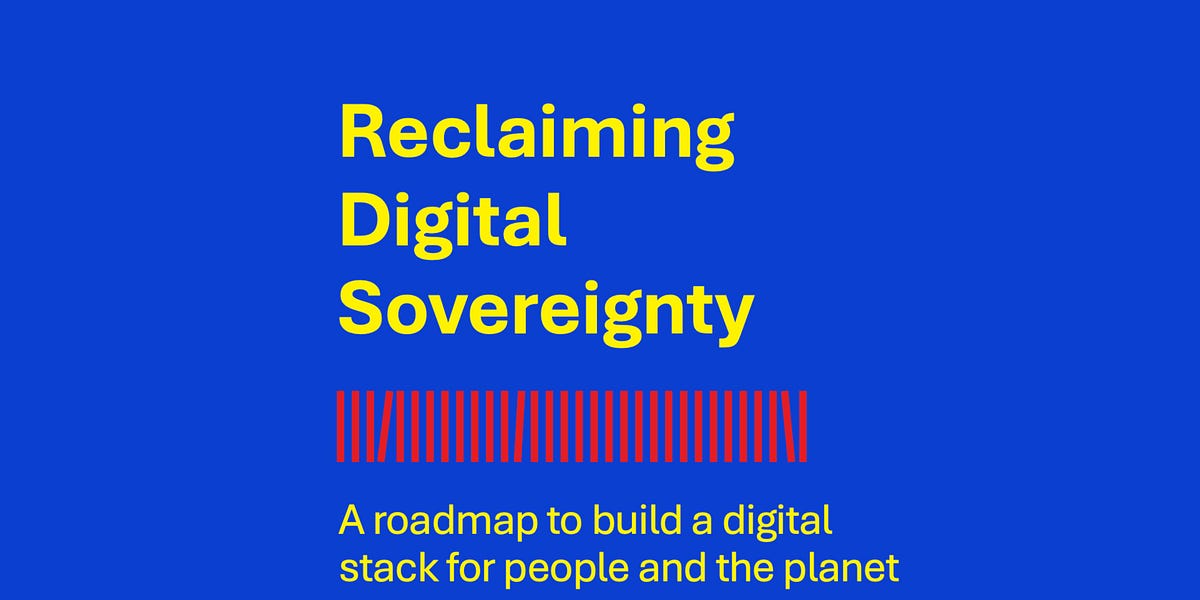
Why we must reclaim digital sovereignty
A new white paper envisions a radically different technological future
maegul (@maegul@hachyderm.io)
I think the #Ghost and #Wordpress federations pose interesting questions about what #fediverse platforms can and should be. Do we actually want blogs and feeds of blogs folded into a mastodon/microblog social feed? Do we want to read and comment on blogs on mastodon? Do we want all the diversity of the fediverse fed into a single platform's UI and hope that it works well? Are we worried that some choices by our platform or instance admin might hinder this process? I'm rather skeptical. 1/
Interoperable Sovereignty: The Democratic Alternative to Digital Authoritarianism
A Democratic Architecture for the Digital Age Digital sovereignty has become a central concern for governments worldwide, yet its meaning remains contested. Too often it is framed as...
