

Hierarchical modeling is a powerful technique for modeling heterogeneity and, consequently, it is becoming increasingly ubiquitous in contemporary applied statistics. Unfortunately that ubiquitous application has not brought with it an equivalently ubiquitous understanding for how awkward these models can be to fit in practice. In this case study we dive deep into hierarchical models, from their theoretical motivations to their inherent degeneracies and the strategies needed to ensure robust computation. We'll learn not only how to use hierarchical models but also how to use them robustly.
A Nonparametric Approach to Practical Identifiability of Nonlinear Mixed Effects Models
Mathematical modelling is a widely used approach to understand and interpret clinical trial data. This modelling typically involves fitting mechanistic mathematical models to data from individual trial participants. Despite the widespread adoption of this individual-based fitting, it is becoming increasingly common to take a hierarchical approach to parameter estimation, where modellers characterize the population parameter distributions, rather than considering each individual independently. This hierarchical parameter estimation is standard in pharmacometric modelling. However, many of the existing techniques for parameter identifiability do not immediately translate from the individual-based fitting to the hierarchical setting. In this work, we propose a nonparametric approach to study practical identifiability within a hierarchical parameter estimation framework. We focus on the commonly used nonlinear mixed effects framework and investigate two well-studied examples from the pharmacometrics and viral dynamics literature to illustrate the potential utility of our approach.

Hierarchical Task Analysis - an overview | ScienceDirect Topics
Prior Modeling
In Bayesian inference the prior model provides a valuable opportunity to incorporate domain expertise into our inferences. Unfortunately this opportunity often becomes a contentious issue in many fields, and this potential value is lost in the debate. In this case study I will discuss the challenges of building prior models that capture meaningful domain expertise and some practical strategies for ameliorating those challenges as much as possible.
Recursive partitioning for heterogeneous causal effects
In this paper we propose methods for estimating heterogeneity in causal effects in experimental and observational studies and for conducting hypothesis tests about the magnitude of differences in treatment effects across subsets of the population. We provide a data-driven approach to partition the data into subpopulations that differ in the magnitude of their treatment effects. The approach enables the construction of valid confidence intervals for treatment effects, even with many covariates relative to the sample size, and without “sparsity” assumptions. We propose an “honest” approach to estimation, whereby one sample is used to construct the partition and another to estimate treatment effects for each subpopulation. Our approach builds on regression tree methods, modified to optimize for goodness of fit in treatment effects and to account for honest estimation. Our model selection criterion anticipates that bias will be eliminated by honest estimation and also accounts for the effect of making additional splits on the variance of treatment effect estimates within each subpopulation. We address the challenge that the “ground truth” for a causal effect is not observed for any individual unit, so that standard approaches to cross-validation must be modified. Through a simulation study, we show that for our preferred method honest estimation results in nominal coverage for 90% confidence intervals, whereas coverage ranges between 74% and 84% for nonhonest approaches. Honest estimation requires estimating the model with a smaller sample size; the cost in terms of mean squared error of treatment effects for our preferred method ranges between 7–22%.

Introducing Model Council
Today we are launching Model Council, a multi-model research feature that brings several models together for one answer.

Software in the natural world: A computational approach to hierarchical emergence
Understanding the functional architecture of complex systems is crucial to illuminate their inner workings and enable effective methods for their prediction and control. Recent advances have introduced tools to characterise emergent macroscopic levels; however, while these approaches are successful in identifying when emergence takes place, they are limited in the extent they can determine how it does. Here we address this limitation by developing a computational approach to emergence, which characterises macroscopic processes in terms of their computational capabilities. Concretely, we articulate a view on emergence based on how software works, which is rooted on a mathematical formalism that articulates how macroscopic processes can express self-contained informational, interventional, and computational properties. This framework establishes a hierarchy of nested self-contained processes that determines what computations take place at what level, which in turn delineates the functional architecture of a complex system. This approach is illustrated on paradigmatic models from the statistical physics and computational neuroscience literature, which are shown to exhibit macroscopic processes that are akin to software in human-engineered systems. Overall, this framework enables a deeper understanding of the multi-level structure of complex systems, revealing specific ways in which they can be efficiently simulated, predicted, and controlled.

Models
Amp uses the best model for each task: leading generalist foundation models for complex reasoning and planning, and smaller specialized models for fast, accurate responses in specific domains.

Is Model Collapse Inevitable? Breaking the Curse of Recursion by Accumulating Real and Synthetic Data
The proliferation of generative models, combined with pretraining on web-scale data, raises a timely question: what happens when these models are trained on their own generated outputs? Recent investigations into model-data feedback loops proposed that such loops would lead to a phenomenon termed model collapse, under which performance progressively degrades with each model-data feedback iteration until fitted models become useless. However, those studies largely assumed that new data replace old data over time, where an arguably more realistic assumption is that data accumulate over time. In this paper, we ask: what effect does accumulating data have on model collapse? We empirically study this question by pretraining sequences of language models on text corpora. We confirm that replacing the original real data by each generation's synthetic data does indeed tend towards model collapse, then demonstrate that accumulating the successive generations of synthetic data alongside the original real data avoids model collapse; these results hold across a range of model sizes, architectures, and hyperparameters. We obtain similar results for deep generative models on other types of real data: diffusion models for molecule conformation generation and variational autoencoders for image generation. To understand why accumulating data can avoid model collapse, we use an analytically tractable framework introduced by prior work in which a sequence of linear models are fit to the previous models' outputs. Previous work used this framework to show that if data are replaced, the test error increases with the number of model-fitting iterations; we extend this argument to prove that if data instead accumulate, the test error has a finite upper bound independent of the number of iterations, meaning model collapse no longer occurs.
Is Model Collapse Inevitable? Breaking the Curse of Recursion by Accumulating Real and Synthetic Data
The proliferation of generative models, combined with pretraining on web-scale data, raises a timely question: what happens when these models are trained on their own generated outputs? Recent investigations into model-data feedback loops proposed that such loops would lead to a phenomenon termed model collapse, under which performance progressively degrades with each model-data feedback iteration until fitted models become useless. However, those studies largely assumed that new data replace old data over time, where an arguably more realistic assumption is that data accumulate over time. In this paper, we ask: what effect does accumulating data have on model collapse? We empirically study this question by pretraining sequences of language models on text corpora. We confirm that replacing the original real data by each generation's synthetic data does indeed tend towards model collapse, then demonstrate that accumulating the successive generations of synthetic data alongside the original real data avoids model collapse; these results hold across a range of model sizes, architectures, and hyperparameters. We obtain similar results for deep generative models on other types of real data: diffusion models for molecule conformation generation and variational autoencoders for image generation. To understand why accumulating data can avoid model collapse, we use an analytically tractable framework introduced by prior work in which a sequence of linear models are fit to the previous models' outputs. Previous work used this framework to show that if data are replaced, the test error increases with the number of model-fitting iterations; we extend this argument to prove that if data instead accumulate, the test error has a finite upper bound independent of the number of iterations, meaning model collapse no longer occurs.
Awni Hannun on Twitter / X
I love this line of research from my colleagues at Apple:Augmenting a language model with a hierarchical memory makes perfect sense for several reasons:- Intuitively the memory parameters should be accessed much less frequently than the weights responsible for reasoning. You… https://t.co/q7HQnYmdR4 pic.twitter.com/38b9q7YKCe— Awni Hannun (@awnihannun) October 6, 2025
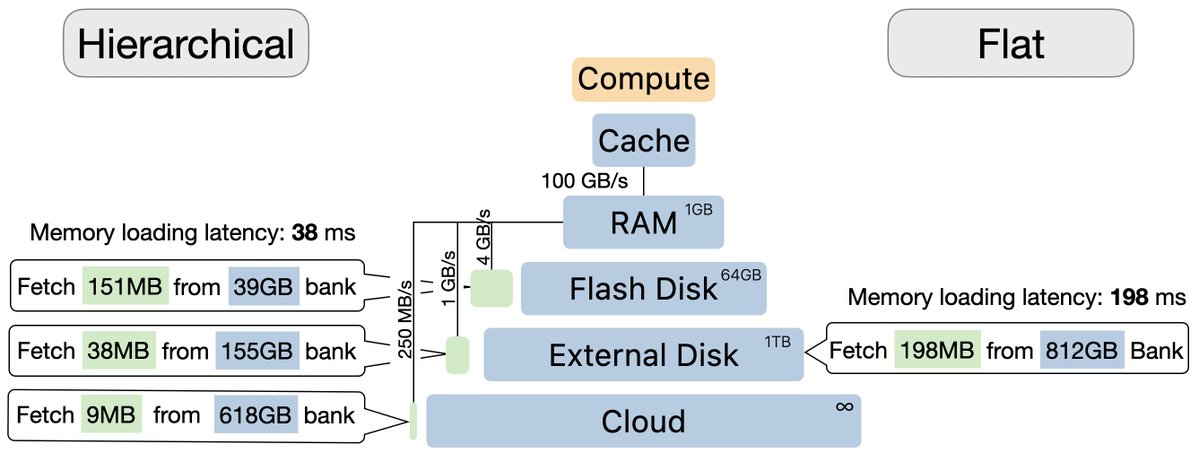
Hierarchical Reasoning Model: Substance or Hype?
Scaling Laws Across Model Architectures: A Comparative Analysis of...
The scaling of large language models (LLMs) is a critical research area for the efficiency and effectiveness of model training and deployment. Our work investigates the transferability and...
Forcing Generative Models to Degenerate Ones: The Power of Data...
Growing applications of large language models (LLMs) trained by a third party raise serious concerns on the security vulnerability of LLMs.It has been demonstrated that malicious actors can...

On Second-Order Group Influence Functions for Black-Box Predictions
With the rapid adoption of machine learning systems in sensitive applications, there is an increasing need to make black-box models explainable. Often we wan...
Decision-style Model Examples

Decision-style models, like TypeSafe's Jev model, are fast and cheap models that output structured data that has been opening a lot of doors for interesting HCI applications. Here I'll collect interesting examples I come across.

Matt DesLauriers on Twitter / X

Jack Cheng on Twitter / X

Andy Gao on Twitter / X

Chris Tate on Twitter / X

mikegee on Twitter / X

Marek Sotak on Twitter / X