


Investing in movements or networks for social change is a strategy that some funders are using. But, how do you measure the results? Marino Morino, who wrote “Leap of Reason: Managing to Outcomes in an Era of Scarcity” pointed me to this recent report, “Transactions, Transformations, Translations: Metrics That Matter for Building, Scaling and Funding Social Movements” by Manual Paster, Jennifer Ito, and Rachel Rosner with the USC Program for Environmental and Regional Equity and funded by the Ford Foundation. The report addresses metrics for success for investing in broad field social movements or networked approaches to social change. The report is written for funders and those on the ground doing the work in the context of networks, although it doesn’t go deep into practice. The report captures a conundrum in measuring social change movements or networked approaches. Outcomes for “wicked problems” can be easily counted – policies passed, housing the homeless, educating children. But there are less tangible results such as “we changed the frame” or “we shifted members’ consciousness” which for grassroots organizers on the ground view as the vibrancy of the network . The report lays out some new metrics for movement building – that are paths to the more easily counted tangible results and where the unit of analysis is the movement or network, not an organization. As the report points out, movement organizers are grappling with big questions. It is less about how to raise funds for their organizations (although that’s important) but focused on the big picture: What is the long-term change that we want to see? What is needed to achieve it? What roles do different organizations play? The report identifies metrics to measure progress around this these questions – it asks and answers – “What exactly are the right metrics for today?
Ten Elements of Movement Building - WKKF Community Leadership Network
What defines a social movement? How does a movement gain power?

Introduction to Movement Ecology
Movement Building
Features of Movement Capacity Building for Nonprofits There have been significant resources dedicated to the development of nonprofits' organizational capacity. However, far less attention has been paid to the capacity of groups to support movements for social change. Below are nine areas the Build
Holding the Roots: Resourcing the Infrastructure Behind Movements - Interaction Institute for Social Change
There’s a quiet revolution underway. You can see it in church gatherings and small-town meetings, on Zoom calls between elders and young organizers, in community art projects, healing circles, and protest planning sessions. Across the country, IISC has had the deep honor of supporting and witnessing this movement: the call for food justice in Mississippi,... Read More

Bridging Social Movements and the New Social Web (working draft) - Variable Context with @CaptainCalliope.blue
On connecting movements, media, and new protocol ecosystems to rebuild the civic, cultural, and technical foundations of a freer, more self-determining society.
Scaling Open Source communities
Successful Open Source projects must transition from pure volunteerism to include paid contributions, mirroring how public goods like roads evolved historically.

How Can the Social Sector Rebuild Trust and Align Movements for Greater Collective Impact?
Civil society is under pressure — trust is declining, advocacy [...]

How To End Capitalism
Civic, Citizen and Grassroots Science: Towards a Transformative Scientific Research Model | Request PDF
Request PDF | On Jan 1, 2013, Jessica McCallum Breen and others published Civic, Citizen and Grassroots Science: Towards a Transformative Scientific Research Model | Find, read and cite all the research you need on ResearchGate

The Launch of the European Social Association
Social media’s impact on society and citizens clearly shows the need for change. European social media companies and civil society are joining forces to move away from large monopolistic platforms to establish a diverse and resilient infrastructure for information and social connection in Europe, keeping more jobs and revenue generated with social media circulating in Europe. For the first time, the organisations and people building Europe’s open social technologies have aligned behind one declaration, backed by 12 Founding Signatories, 100+ organisations and 600+ individuals. On 4 November the coalition becomes an organisation: the European Social Association, a charitable association based in Germany, and led by civil society. At the launch event, we will lay out European Social´s path towards common projects on moderation, bridging and other infrastructure elements, policy approaches, advocacy and fundraising based on common values and principles that shape the Open Social Web. Curious and interested to support? Please join in. **Schedule** 10.00 **Check-In and Get-Together** 10.30 **The launch of the European Social Association** with founding members Michael Foster (Newsmast Foundation), Sophie Bloemen (Commons Network), Jantien Borsboom (PublicSpaces), Björn Staschen (Save Social – Networks For Democracy), Felix Hlatky (Mastodon), Sebastian Vogelsang(Eurosky), Cathleen Berger (Co-Initiator Open Social Web Alliance) 11.00 **The platforms: The state of the Open Social Web** Panel discussion with Felix Hlatky (Mastodon), Sebastian Vogelsang (Eurosky) Moderation: Björn Staschen (Save Social) 11.30 **Civil Society: The need for an Open Social Web** Panel discussion with Sophie Bloemen (Commons Network), Jantien Borsboom (PublicSpaces), Cathleen Berger (Co-Initiator Open Social Web Alliance) Moderation: Michael Foster (Newsmast Foundation) 12.00 - 12.30 Coffee, Tea & Soft Drinks **Location:** Room "Mosaik" at Wikimedia Deutschland (thanks for hosting us!) **→ Please let us know if you can attend, places are limited:** https://savesocial.eu/eulaunch
Resourcing Relationships: Funding Community, Connection and Change
How do you nurture and resource communities, networks of relationships, ecosystems to grow and flourish? This is something I've been thinking about a lot in my work with the Participatory Grantmaking Community of Practice. There’s a quiet revolution happening in how people think about funding social

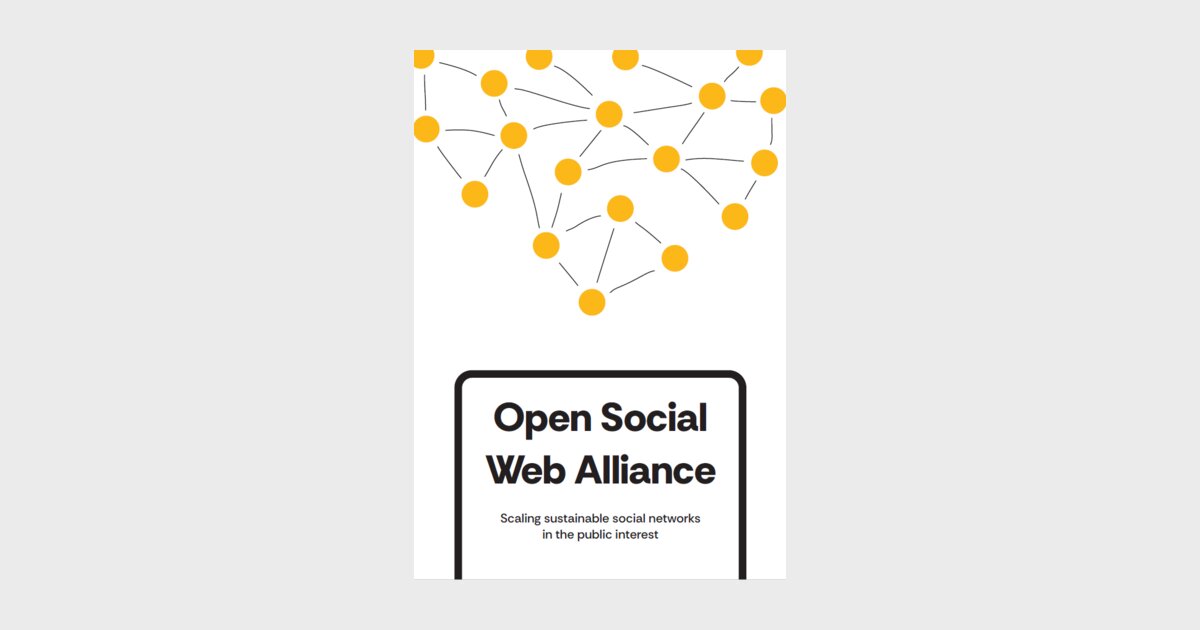
Scaling sustainable social networks in the public interest | Heinrich Böll Stiftung | Brussels office - European Union
This policy paper identifies five key challenges for scaling a public-interest social web: infrastructure, governance, funding, attractiveness, and public mandate. It outlines a roadmap for overcoming these challenges and building the Open Social Web Alliance into a relevant force within months — starting in Germany.
Scaling Social Movements: An Overview
The Commons is an online library for the change makers of the world and for those interested in social change, activism, organising, advocacy and justice.

More notes on Organizing, Mutual Aid, and Activism on decentralized social networks
Part 3 of a series. See If not now, when? Mutual aid and organizing in the fediverses, the ATmosphere, and whatever comes next and Notes (and thoughts) on organizing in the fediverses and the ATmosphere for previous installments and a reading list. "Mutual aid. Organizing. Sharing, contextualizing, and making meaning

RadicalxChange
We are a community of activists, artists, entrepreneurs, and scholars committed to using mechanism design to inspire radical social change.

Funding / contribution structures

Alternative org, funding, finance, contribution structures towards... improving society somewhat
Otipêy | Indigenous-Led Investment Platform

How to Finance Community-Led Solutions (SSIR)
Driving Finance for Sustainable Food Systems: A Roadmap to Implementation for Financial Institutions and Policy Makers
Founders Hub | Transform Finance