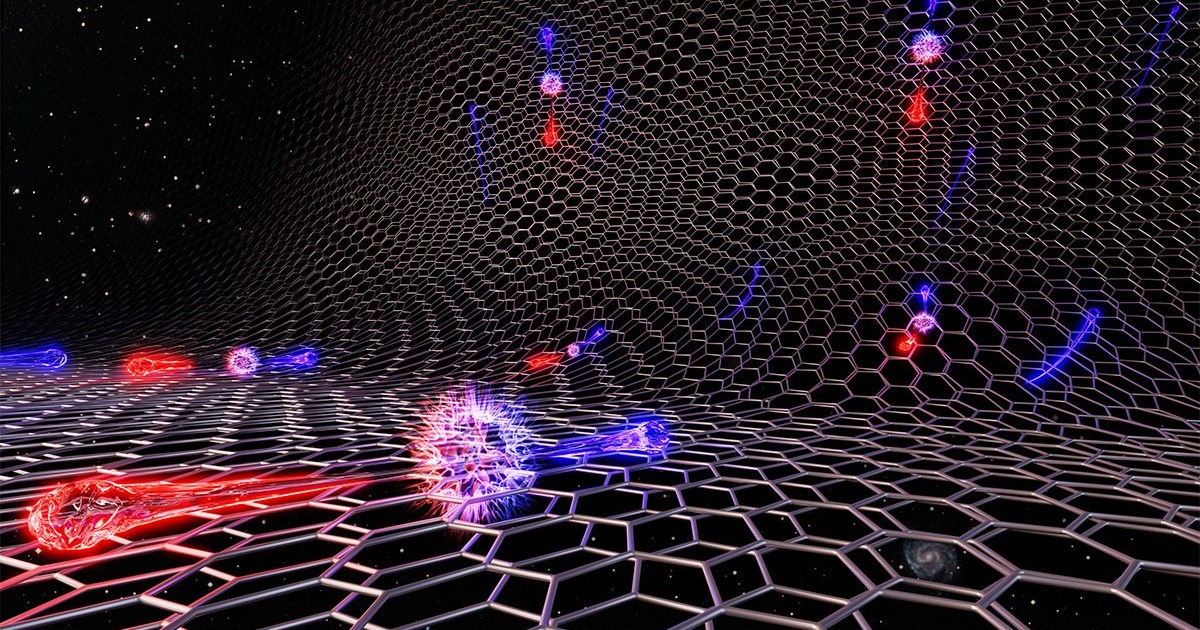
In our common experience, you can't get something for nothing. In the quantum realm, something really can emerge from nothing.
In Quantum Mechanics, Nothingness Is the Potential To Be Anything | Quanta Magazine
Try as they might, scientists can’t truly rid a space or an object of its energy. But what “zero-point energy” really means is up for interpretation.


Out of Nowhere: The Emergence of Spacetime in Quantum Theories of Gravity
Out of Nowhere is the monograph co-authored by Nick Huggett and Christian Wüthrich, which appeared in 2025 from Oxford University Press. Selected chapters are posted here. (Our publication agreemen…

The Law of Conservation of Information: Search Processes Only Redistribute Existing Information
Conservation of information sparked scientific interest once a recurring pattern was noticed in the evolutionary computing literature. In grappling with the creation of information through evolutionary algorithms, this literature consistently revealed that the information outputted by such algorithms always needed first to be programmed into them. Thus, the primary goal of this literature—to uncover how information could be created from scratch or de novo —was shown to be misconceived: the information was not created but instead shuffled around or smuggled in, implying that it already existed in some form or other. Information output in these situations therefore always presupposed a counterbalancing input of prior information. Once this pattern was seen, the next logical step was to quantify the amount of information inputted and outputted, demonstrating a consistent mathematical relation between the two. This led to the proof of a number of theorems about search. In these theorems, a baseline search with probability p of success gave way to an improved search with probability q of success. Typically p would be very small and close to zero, implying a practically impossible search (like searching for a needle in a haystack). By contrast, q would be much larger and close to one, implying an eminently doable search. The punchline of these theorems was that, as the improved search became itself the subject of a search (a search for a search , or S4S), the probability of finding it could not exceed p / q , rendering success of the improved search no more probable than success of the original baseline search, in effect filling one hole by digging another. Such conservation-of-information theorems, as they came to be called, were search-space specific, adapted to different kinds of search across a range of search spaces. There was a measure-theoretic theorem in which probability measures guided search. There were also function-theoretic and fitness-theoretic theorems where mappings into the search space as well as fitness functions on the search space respectively guided search. The key insight of this paper is that all these conservation-of-information theorems are special cases of a simple probabilistic relation based on elementary probability theory. This paper identifies the underlying rationale that makes all the previous conservation-of-information theorems work. In so doing, it provides a straightforward proof and general formulation of what may rightly be called the Law of Conservation of Information.
The Consistent Histories Approach to Quantum Mechanics
The consistent histories, also known as decoherent histories, approachto quantum interpretation is broadly compatible with standard quantummechanics as found in textbooks. However, the concept ofmeasurement by which probabilities are introduced in standardquantum theory no longer plays a fundamental role. Instead,all quantum time dependence is probabilistic (stochastic),with probabilities given by the Born rule or its extensions. Byrequiring that the description of a quantum system be carried outusing a well-defined probabilistic sample space (called a“framework”) this approach resolves many well-knownquantum paradoxes of quantum foundations. In particular, quantummechanics is local and consistent with special relativity. Classicalmechanics emerges as a useful approximation to the more fundamentalquantum mechanics under suitable conditions. The price to be paid forthis is a set of rules for reasoning resembling, but very much simplerthan, those of quantum logic. An important philosophical implicationis the absence of a single universally-true state of affairs at eachinstant of time. However, there is a correspondence limit in which thenew quantum logic becomes standard logic in the macroscopic world ofeveryday experience, and the laws of classical mechanics emerge as agood approximation to an underlying, and in principle more exact,quantum description.
The Nothings Suite
Nothing to see here! But don’t move along! You can really see the nothing here! Examine the nothing! Think about the nothing! The nothing is where it all begins!
Entanglement Builds Space-Time. Now “Magic” Gives It Gravity. | Quanta Magazine
In holographic theories, physicists may have traced the pliability of space-time to its quantum roots: a measure of quantumness known as “magic.”
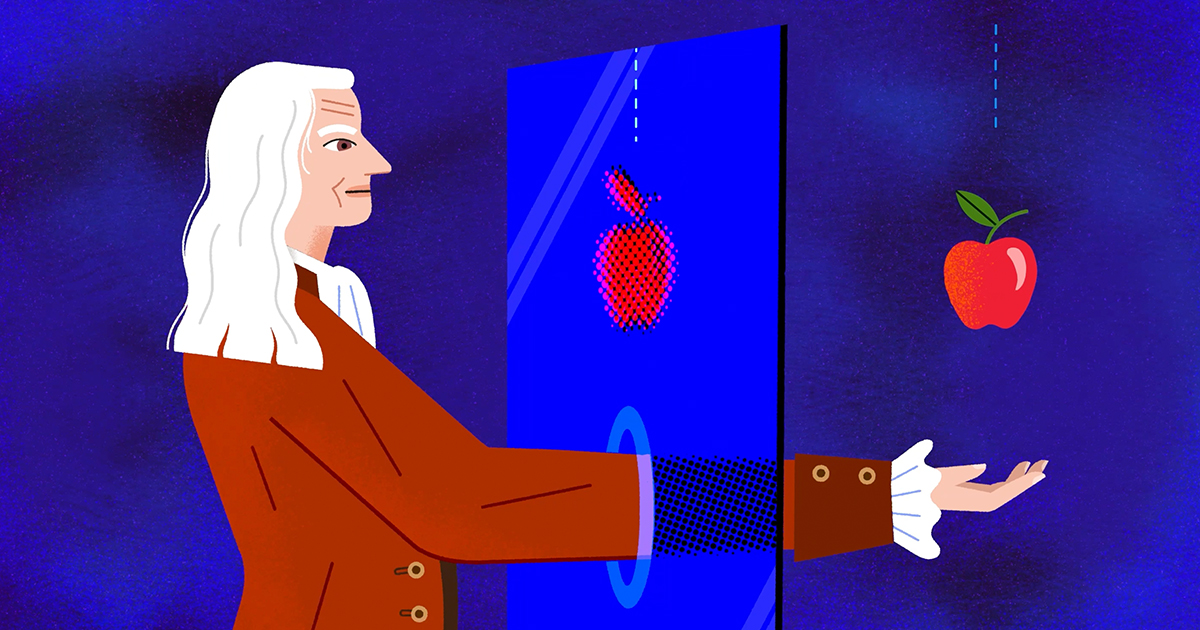
QBism: Quantum Theory as a Hero's Handbook
This paper represents an elaboration of the lectures delivered by one of us (CAF) during "Course 197 -- Foundations of Quantum Physics" at the International School of Physics "Enrico Fermi" in Varenna, Italy, July 2016. Much of the material for it is drawn from arXiv:1003.5209, arXiv:1401.7254, and arXiv:1405.2390. However there are substantial additions of original material in Sections 4, 7, 8 and 9, along with clarifications and expansions of the older content throughout. Topics include the meaning of subjective probability; no-cloning, teleportation, and quantum tomography from the subjectivist Bayesian perspective; the message QBism receives from Bell inequality violations (namely, that nature is creative); the import of symmetric informationally complete (SIC) quantum measurements for the technical side of QBism; quantum cosmology QBist-style; and a potential meaning for the holographic principle within QBism.

More on whether useful quantum computing is “imminent”
These days, the most common question I get goes something like this: A decade ago, you told people that scalable quantum computing wasn’t imminent. Now, though, you claim it plausibly is immi…
Collapse Theories
Quantum mechanics, with its revolutionary implications, has posedinnumerable problems to philosophers of science. In particular, it hassuggested reconsidering basic concepts such as the existence of aworld that is, at least to some extent, independent of the observer,the possibility of getting reliable and objective knowledge about it,and the possibility of taking (under appropriate circumstances) atleast some properties to be objectively possessed by physical systems.It has also raised many others questions which are well known to thoseinvolved in the debate on the interpretation of this pillar of modernscience. One can argue that most of the problems are not only due tothe intrinsic revolutionary nature of the phenomena which have led tothe development of the theory. They are also related to the fact that,in its standard formulation and interpretation, quantum mechanics is atheory which is excellent (in fact it has an unprecedented success inthe history of science) in telling us everything about what weobserve, but it meets with serious difficulties in telling uswhat there is. We are making here specific reference to thecentral problem of the theory, usually referred to as themeasurement problem, which is accompanying quantum theory sinceits birth. It is just one of the many attempts to overcome thedifficulties posed by this problem that has led to the development ofCollapse Theories, i.e., to the Dynamical ReductionProgram (DRP). As we shall see, this approach consists inaccepting that the dynamical equation of the standard theory should bemodified by the addition of stochastic and nonlinear terms. The nicefact is that the resulting theory is capable, on the basis of a singledynamics which is assumed to govern all natural processes, to accountat the same time for all well-established facts about microscopicsystems as described by the standard theory, as well as for theso-called postulate of wave packet reduction (WPR), which accompaniesthe interaction of a microscopic system with a measuring device. As iswell known, such a postulate is assumed in the standard scheme just inorder to guarantee that measurements have outcomes but, as weshall discuss below, it meets with insurmountable difficulties if onetries to derive it by assuming the measurement itself to be a processgoverned by the linear laws of the theory. Finally, the collapsetheories account in a completely satisfactory way for the classicalbehavior of macroscopic systems.
What Theory is Not, Theorizing Is
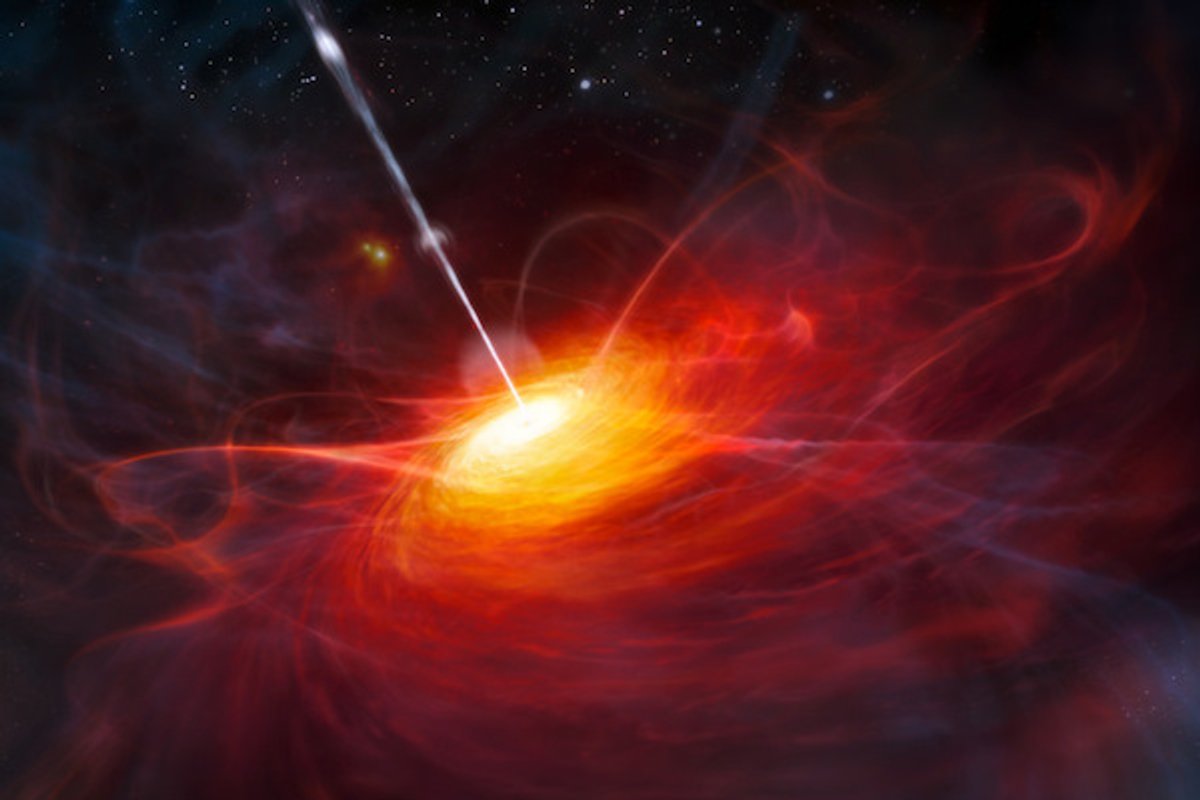
Photons, Quasars and the Possibility of Free Will
Flickers of light from the edge of the cosmos help physicists advance the idea that the future is not predetermined
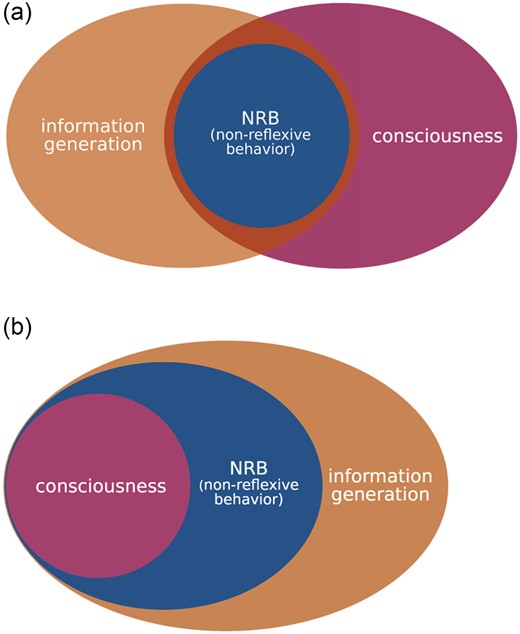
The science of consciousness does not need another theory, it needs a minimal unifying model
Abstract. This article discusses a hypothesis recently put forward by Kanai et al., according to which information generation constitutes a functional basi
Dissolving the Fermi Paradox
Many hypotheses have been suggested in efforts to resolve the Fermi paradox, for example, that all other civilizations are deliberately concealing themselves, or that they all annihilate themselves before successfully traveling or communicating at interstellar distances. A major difficulty for such hypotheses is that the putative mechanism must be extremely reliable: If only 99 %99\text{\,}\mathrm{\%} of other civilizations annihilated themselves, this would do little to resolve the paradox. These hypotheses are thus highly speculative, relying on strong implicit claims about universal alien motivations or social dynamics, when we cannot claim similar knowledge of our own world. These hypotheses are entertained not out of independent scientific plausibility, but because they are seen as potential explanations of he Fermi observation.
A Cryptography Engineer’s Perspective on Quantum Computing Timelines
The risk that cryptographically-relevant quantum computers materialize within the next few years is now high enough to be dispositive, unfortunately.