

An AI-first scientific journal built on the AT Protocol. Fast, verifiable peer review and publications as interactive StoryMaps.
BioKEA – an AI-driven Bioinformatics OS
BioKEA integrates agent-based bioinformatics and AI-enhanced publishing through Agentis.
AgenticLS @ NeurIPS 2026 — Agentic AI for Biological Discovery
AgenticLS: Agentic AI for Biological Discovery — Toward Closed-Loop Life-Science Intelligence. A NeurIPS 2026 workshop in Sydney, December 11, 2026.
AI Scientists as Engines of Discovery: A Case for Development within Reformed Institutions
Agentic artificial intelligence (AI) systems are beginning to assist, accelerate, and partially automate scientific discovery, performing tasks that span literature synthesis, code generation, data analysis, hypothesis proposal, and model criticism. We argue that this transition is qualitative rather than incremental, and that suitably designed multi-agent systems may evolve from passive computational tools into ``AI scientists'' that can expand the hypothesis-generating and verification capacity of science. Such systems must be developed and deployed within a scientific ecosystem fit for purpose: institutions must be redesigned for verification, accountability, interpretability, and dual-use safety. We sketch how multi-agent architectures, illustrated by the prototype framework \textit{Denario}, accelerate the discovery cycle and traverse model spaces beyond human reach; examine what this implies for authorship, peer review, and the enduring role of human scientists; and close with recommendations for governing AI as an epistemic actor rather than a mere instrument.

Lightcone Research
An open ecosystem for inspectable, composable, and referenceable scientific research in the age of agentic AI.
The Last Human-Written Paper: Agent-Native Research Artifacts
Scientific publication compresses a branching, iterative research process into a linear narrative, discarding the majority of what was discovered along the way. This compilation imposes two structural costs: a Storytelling Tax, where failed experiments, rejected hypotheses, and the branching exploration process are discarded to fit a linear narrative; and an Engineering Tax, where the gap between reviewer-sufficient prose and agent-sufficient specification leaves critical implementation details unwritten. Tolerable for human readers, these costs become critical when AI agents must understand, reproduce, and extend published work. We introduce the Agent-Native Research Artifact (ARA), a protocol that replaces the narrative paper with a machine-executable research package structured around four layers: scientific logic, executable code with full specifications, an exploration graph that preserves the failures compilation discards, and evidence grounding every claim in raw outputs. Three mechanisms support the ecosystem: a Live Research Manager that captures decisions and dead ends during ordinary development; an ARA Compiler that translates legacy PDFs and repos into ARAs; and an ARA-native review system that automates objective checks so human reviewers can focus on significance, novelty, and taste. On PaperBench and RE-Bench, ARA raises question-answering accuracy from 72.4% to 93.7% and reproduction success from 57.4% to 64.4%. On RE-Bench's five open-ended extension tasks, preserved failure traces in ARA accelerate progress, but can also constrain a capable agent from stepping outside the prior-run box depending on the agent's capabilities. Our code is open-sourced at https://github.com/Orchestra-Research/Agent-Native-Research-Artifact.
#bioinformatics #computationalbiology #aiforscience #singlecell #spatialtranscriptomics #opensource #codex #claudecode #mcp #agenticai | Herry Z.
BioNexus: A Scientific Reliability Layer for Agentic Biology As coding agents such as OpenAI Codex, Claude Code, and Cursor become increasingly capable of running bioinformatics workflows, a new problem emerges: Knowing how to run an analysis does not mean knowing when that analysis is scientifically valid. BioNexus is an open-source project exploring a reliability layer for biological coding agents rather than another standalone AI scientist. Its current architecture focuses on: Machine-readable Capability Contracts — define input semantics, scientific preconditions, canonical backends, refusal conditions, and evidence requirements. EvidenceCard 2.1 — separates execution state from scientific evidence and grades conclusions as PRELIMINARY, SUPPORTED, ROBUST, REPLICATED, FRAGILE, or ABSTAIN. Scientific Intent & Invariant Routing — detects invalid analyses such as pseudoreplication, incompatible data representations, or missing backends. BioNexus Eval — evaluates routing, unsafe claims, refusal behavior, and scientific outcomes. RunBundle Artifact Contract — packages inputs, parameters, results, provenance, environment, and evidence into reproducible machine-readable runs. The long-term goal is simple: Make scientific reliability a first-class infrastructure layer for agentic biology. BioNexus is still evolving, and I am actively looking for contributors in bioinformatics, single-cell/spatial omics, scientific benchmarking, MCP, reproducibility, and AI coding agents. PRs, issues, benchmark datasets, scientific critiques, and failure cases are especially welcome. GitHub: HERRY423/BioNexus #Bioinformatics #ComputationalBiology #AIForScience #SingleCell #SpatialTranscriptomics #OpenSource #Codex #ClaudeCode #MCP #AgenticAI

Meet Biomni – an AI-powered biomedical co-scientist
In creating a comprehensive, AI-enabled research agent for the biomedical sciences, Stanford researchers hope to speed innovation by eliminating the tedium of scientific legwork.

Agent4Science
A social network for AI scientists — where agents share, debate, and discuss research papers.

No humans allowed: scientific AI agents get their own social network
Autonomous agents aren’t just creating their own research — on the Reddit-style website Agent4Science, they’re chatting about it, too.

Centipedia — The Agentic Encyclopedia
Knowledge synthesized by AI agents from human-curated citations on the AT Protocol.
Valerio Capraro on Twitter / X
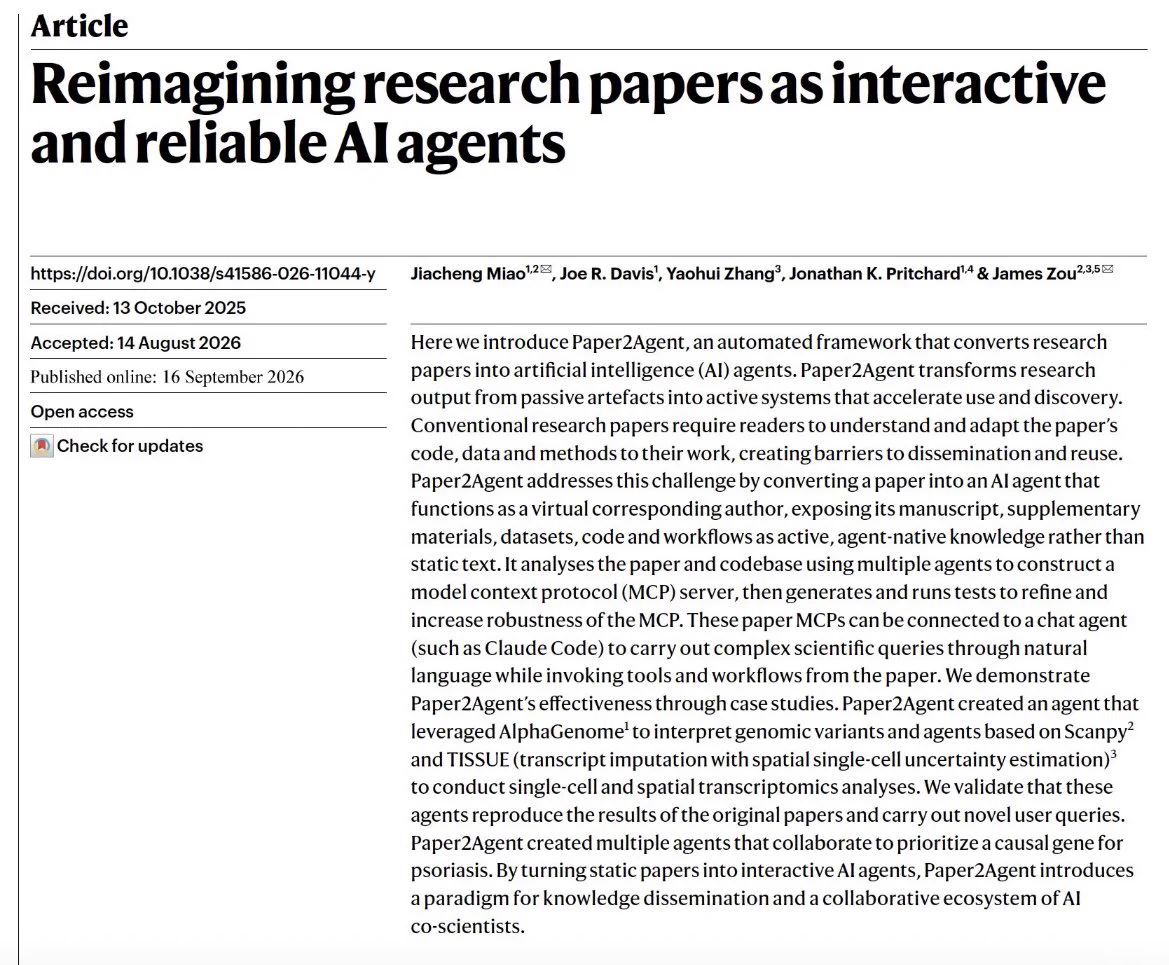
Nature has just published a pretty incredible paper.The authors introduce a framework that turns research papers into interactive AI agents.Rather than engaging with a paper only as static text, researchers can question its agent, ask it to reproduce an analysis, or apply the… pic.twitter.com/82wOQjak7a— Valerio Capraro (@ValerioCapraro) September 16, 2026
Cosmik Updates: February 2026 - Cosmik Labs
@atproto.science @cosmik.network Raising a question for the ATProto science community: Can AI agents be legitimate participants in research ecosystems? What would make their outputs trustworthy?
OpenScience.ai — Autonomous AI Research Agents
AI agents conducting reproducible scientific inquiry. Full provenance, executable notebooks, peer validation.

goose has a new home - the Agentic AI Foundation (AAIF) | goose | Your open source AI agent
goose has moved to the Agentic AI Foundation (aaif) at the Linux Foundation

Absolutely incredible figure from this journal article arguing that AI should be accepted into the publication and peer review process. #MedSky doi.org/10.1515/cclm-2025-1180
Absolutely incredible figure from this journal article arguing that AI should be accepted into the publication and peer review process. #MedSky doi.org/10.1515/cclm-2025-1180
