


Robin Berjon
@robin.berjon.com


"Private Government: How Employers Rule Our Lives (and Why We Don't Talk About It)" by Elizabeth Anderson A much-needed reframing to show that government can take place in private contexts too. She focuses on employers in the US, but it works well for tech monopolies in the digital space too.
Jan 10, 2026 at 9:29 PM
Private-sector Trumpism
Monopoly, facial recognition and property rights all add up to a private system of government.

AI Wants Your Life: Tech Boss Meredith Whittaker Says No | The Mishal Husain Show
AI, Oligarchs & The Commodification of Public Education With John Koyczek
The Antitrust Revolution, by Barry C. Lynn
Liberal democracy’s last stand against Big Tech

Private data: developing a rubric for success - Paul's Leaflets
What will an effective solution look like?
Governable Spaces: Democratic Design for Online Life – Writings and rehearsals by Nathan Schneider
Read the free, open access editionBuy: Amazon, Bookshop, Narrow Gauge Book Co-op, UC Press
Artificial Intelligence and the Purpose of Social Systems
The law and ethics of Western democratic states have their basis in liberalism. This extends to regulation and ethical discussion of technology and businesses doing data processing. Liberalism relies on the privacy and autonomy of individuals, their ordering through a public market, and, more recently, a measure of equality guaranteed by the state. We argue that these forms of regulation and ethical analysis are largely incompatible with the techno-political and techno-economic dimensions of artificial intelligence. By analyzing liberal regulatory solutions in the form of privacy and data protection, regulation of public markets, and fairness in AI, we expose how the data economy and artificial intelligence have transcended liberal legal imagination. Organizations use artificial intelligence to exceed the bounded rationality of individuals and each other. This has led to the private consolidation of markets and an unequal hierarchy of control operating mainly for the purpose of shareholder value. An artificial intelligence will be only as ethical as the purpose of the social system that operates it. Inspired by the science of artificial life as an alternative to artificial intelligence, we consider data intermediaries: sociotechnical systems composed of individuals associated around collectively pursued purposes. An attention cooperative, that prioritizes its incoming and outgoing data flows, is one model of a social system that could form and maintain its own autonomous purpose.

The Wealth of Networks
The Wealth of Networks: How Social Production Transforms Markets and Freedom is a book by Harvard Law School professor Yochai Benkler published by Yale University Press on April 3, 2006. The book has been recognized as one of the most influential works of its time concerning the rise and impact of the Internet on the society, particularly in the sphere of economics. It also helped popularize the term Benkler coined few years earlier, the commons-based peer production (CBPP).

W Social is a textbook case for everything wrong with digital sovereignty
Insanity is doing the same thing over and over again, but expecting different results. This saying is attributed to the famous socialist (and theoretical physicist) Albert Einstein but actually traces back to novelist Rita Mae Brown. I have been thinking about this saying a lot lately. The reason is

The Power of Habit: Why We Do What We Do in Life and Business by Charles Duhigg
A young woman walks into a laboratory. Over the past two years, she has transformed almost every ...

AI and the Dangerous Fiction of ‘All Lawful Use’
Dunstan Allison-Hope and Iain Levine argue that human rights commitments are essential for all companies selling their products to governments worldwide.

Writings and rehearsals by Nathan Schneider
Welcome. I’m a professor of media studies at the University of Colorado Boulder, where I direct the Media Economies Design Lab and teach and learn from our students. I’ve written a book each on online democracy, cooperative enterprise, the Occupy movement, and God, and I’ve edited ones about solidarity economies, crypto, and co-ops. Reporting articles for both magazines and academic journals keeps my notebooks filled. Working with others to build a democratic economy keeps me accountable.
How (Not) to Write a Privacy Law
After many years of failed starts, proposed information privacy legislation has begun moving forward in both houses of Congress. The docket in the recently ended 116th Congress was crowded, with a number of different proposals jostling for attention and no agreement on which deserved to be the front runner. Even so, as the 117th Congress begins, there is growing inside-the-Beltway consensus on the list of features that a successful bill will need to include. This paper critically assesses those zones of emerging consensus.

Danielle Robinson, PhD
Advancing the power of data to improve the social and economic lives of all people.

A brief 🧵 for all outside the #atproto bubble on why, from a digital industrial policy perspective, this step is deeply bewildering. There's @eurosky.social – open source, non-profit, fully aligned with the EU's open source strategy. It provides all that W has, & more. And yet, the Commission...

European Commission
We have now joined W, a new European social media network. We’re present on 15+ platforms, and are especially happy to join one based in Europe and with the ambition to foster open and safer online conversations. Keep the conversation going - whether from W, Bluesky or other compatible apps.
privacy - bad examples

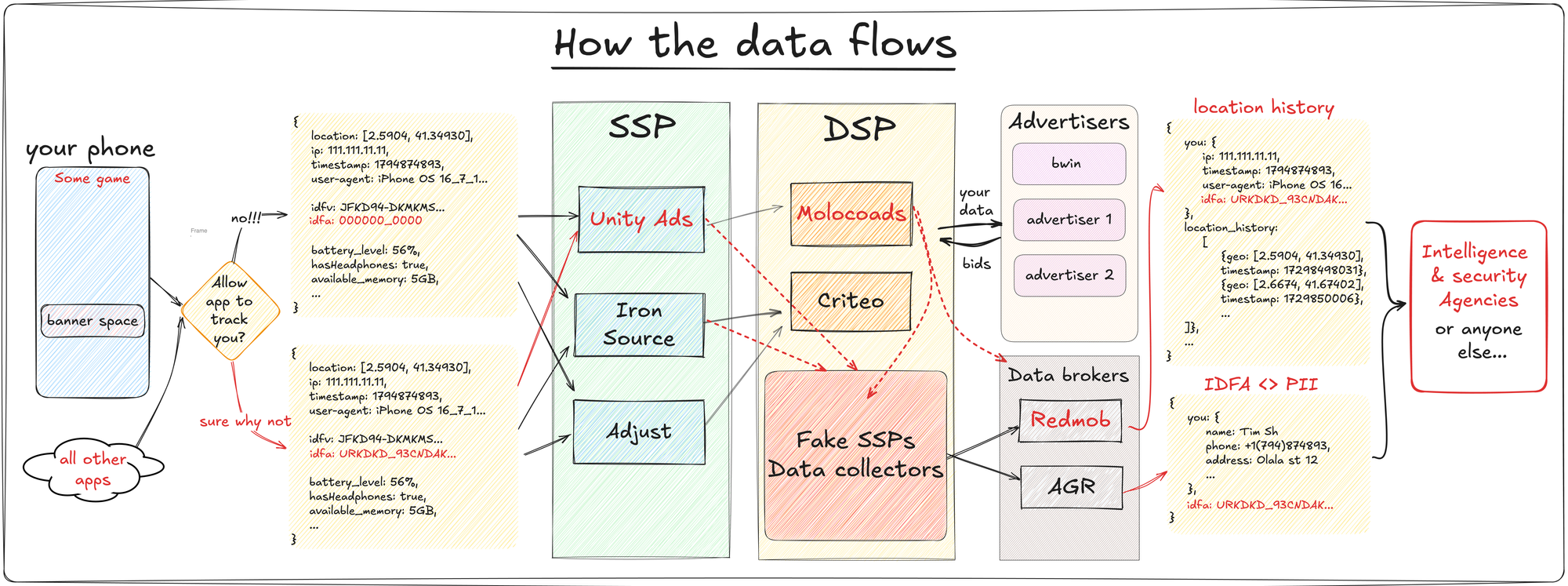
Everyone knows your location
