


Who’s responsible for regulating technological change in a democracy? Verity Harding, a globally recognized AI expert, shares her thoughts on policy and tech.
How Shifting Responsibility for AI Harms Undermines Democratic Accountability | TechPolicy.Press
The moralization of individual AI use deflects responsibility away from powerful actors like corporations and governments, Suvradip Maitra and others write.

AI Policy - Taylor & Francis
Learn about Taylor & Francis' AI Policy, which provides guidelines on the ethical use of artificial intelligence in research, publishing, and content creation to maintain integrity and transparency.

Responsible AI Principles and Approach | Microsoft AI
Discover Microsoft AI tools, industry-specific governance solutions, and responsible AI practices to make smarter, more informed decisions about AI implementation.

Responsible AI Principles and Approach | Microsoft AI
Discover Microsoft AI tools, industry-specific governance solutions, and responsible AI practices to make smarter, more informed decisions about AI implementation.
NEW BOOK: Why AI Undermines Democracy and What to Do about It
Mark Coeckelbergh's "Why AI Undermines Democracy and What to Do about It" offers a philosophical critique of AI's impact on democratic principles. The book argues that the concentration of power in tech companies and governmental use of AI pose risks to democracy, potentially leading to digital totalitarianism. While light on novel solutions, it provides a concise overview of common concerns in AI ethics literature and calls for increased democratic input in AI design and global governance. The book serves as an accessible entry point for those new to the topic, offering a valuable, if pessimistic, perspective on AI's challenges to democracy.
Americans for Responsible Innovation on Twitter / X
NEW: Today ARI released a blueprint for federal AI governance, including three pillars that promote safe frontier AI development: ✅ Standards set by the government ✅ Independent assurance they are met ✅ Transparency into frontier AI development https://t.co/s2mlUP27Wm pic.twitter.com/X6IhBS9jKF— Americans for Responsible Innovation (@americans4ri) August 10, 2026

Has technological innovation lost the plot? An interview with AI ethicist Dr. Shannon Vallor | Chicago Policy Review
Shannon Vallor is the Baillie Gifford Chair in the Ethics of Data and Artificial Intelligence at the Edinburgh Futures Institute (EFI) at the University of Edinburgh, where she is also appointed in Philosophy. Professor Vallor’s research explores how new technologies, especially AI, robotics, and data science, reshape human moral character, habits, and practices. She is […]

AI, Ethics, and Society — Home
5 questions for Meredith Whittaker
Hello, and welcome to this week’s installment of The Future in Five Questions. This week I spoke with Meredith Whittaker, president of the Signal Foundation and co-founder of the AI Now Institute, which is dedicated to researching AI’s social impact. Whittaker has emerged as a leading critic of the influence major Silicon Valley firms wield over American life and public policy, writing in a 2021 paper that modern AI advances are “primarily the product of significantly concentrated data and compute resources that reside in the hands of a few large tech corporations,” and that “our increasing reliance on such AI cedes inordinate power over our lives and institutions to a handful of tech firms.”

Our views on AI policy and political advocacy
Our approach to AI policy and political advocacy, transparency, support for thoughtful regulation and AI safety, and that no outside political group speaks on the company’s behalf.
The AI series: AI and Surveillance Capitalism
AI experts Camille Francois and Meredith Whittaker discuss how to break up Big Tech and build a safe and ethical AI.

Responsible Innovation at the Frontier - Americans for Responsible Innovation
ARI’s blueprint for federal AI governance is designed to promote safe frontier AI development in America. The blueprint is built around three governance functions any federal proposal should incorporate.

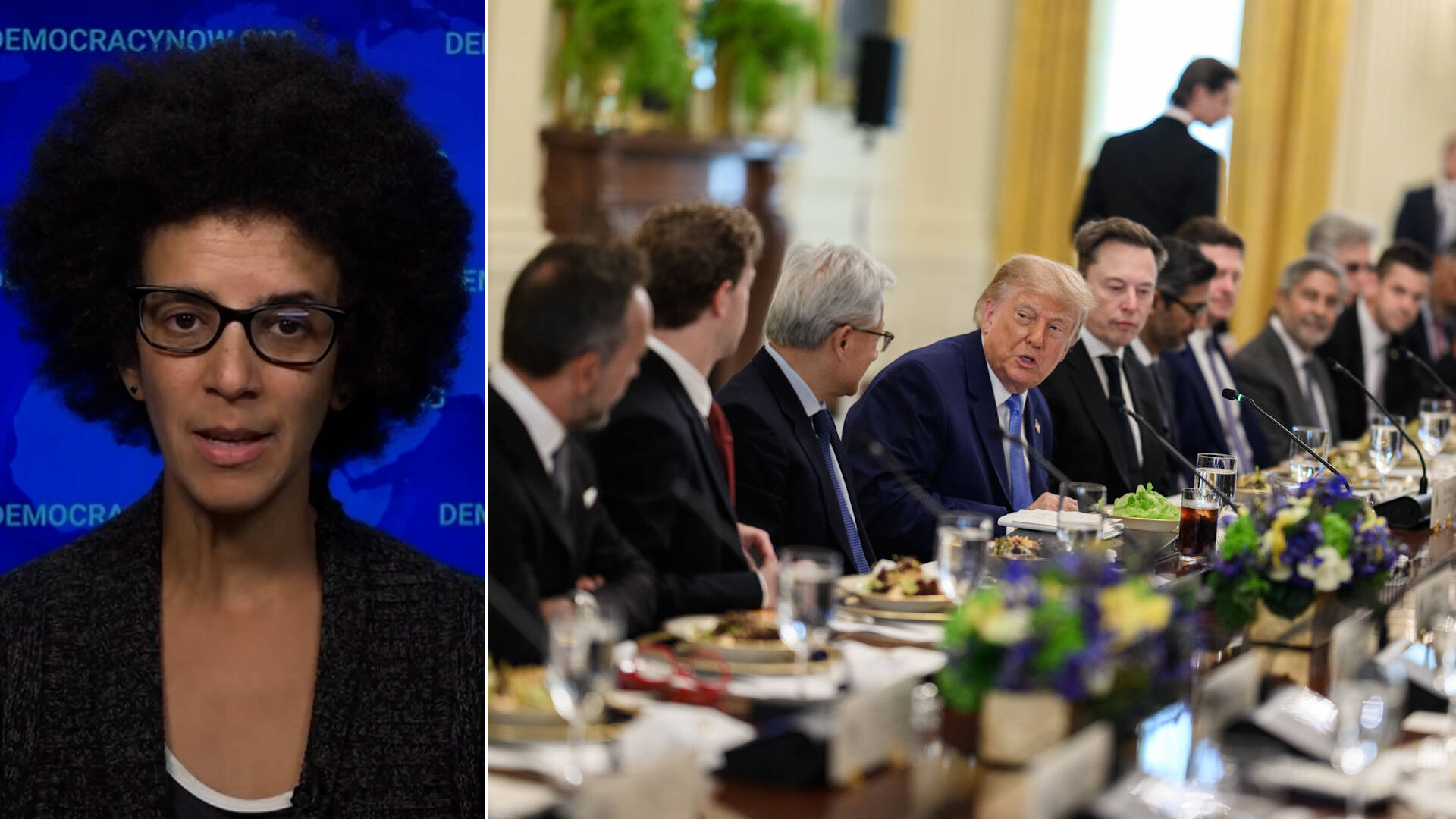
The Real Existential Risk Is AI CEOs Avoiding Oversight: “Alternative Nobel” Winner Timnit Gebru
We speak to the prominent AI researcher and leading critic of the AI industry, Timnit Gebru, who was recently awarded a 2026 Right Livelihood Award for her work investigating the harms and hype behind the global buildup of artificial intelligence. “Instead of discussing faulty, unreliable systems,” Gebru says tech leaders like SpaceXAI’s Elon Musk, OpenAI’s Sam Altman and Anthropic’s Dario Amodei are “marketing their systems as all-knowing, superpowerful, superintelligent,” and lobbying for “self-policing and self-regulation” to avoid being held “liable through existing laws.” Gebru expresses skepticism over increasingly widespread claims that AI algorithms pose an existential risk to humanity, warning that such claims are overblown and that “what is actually happening is regulatory capture.”
Where AI Regulation Stands Today
The White House has released a National Artificial Intelligence Legislative Framework and new executive orders aiming to establish a single, nationwide standard for AI regulation...

Our commitment to advancing bold and responsible AI, together
Details on Google's work with other leading AI companies to advance responsible practices in the development of artificial intelligence.

A shared agenda for responsible AI progress
AI can be hugely beneficial to society if citizens, educators, academics, civil society and governments unite to shape it responsibly.
