

For the live-updated, fully-labelled, interactive version of this infographic, click here. Eight of the top ten patient-reported treatments for Migraine are simple lifestyle changes, not drugs. CureTogether – a free resource owned by 23andMe that allows people to share information about their health and treatments – surveyed more than 6,000 people who self-identify as having […]
Ramez Naam on Twitter / X
There was a site years ago called CureTogether where patients could share information in a structured way on their disease, regimen, and progress, working towards a sort of bottoms-up clinical trial. 23andMe acquired them and it seems to be mostly dead.— Ramez Naam (@ramez) September 14, 2025
Two Research Papers Published on PatientsLikeMe - SPM Blog
Two research papers were published this month on the Health 2.0 website, PatientsLikeMe. PatientsLikeMe is arguably the only “real” health social network online today, because it lets patients share actual […]
UCLA discovers first stroke rehabilitation drug to repair brain damage
A new study by UCLA Health has discovered what researchers say is the first drug to fully reproduce the effects of physical stroke rehabilitation in model mice.
Your doctor’s AI notetaker may be making things up, Ontario audit finds
Made-up therapy referrals, incorrect prescriptions among the common mistakes.

Patient-reported treatment outcomes in ME/CFS and long COVID
Myalgic encephalomyelitis/chronic fatigue syndrome (ME/CFS) and long COVID are persistent multisystem illnesses affecting many patients. With no known effective FDA-approved treatments for either condition, patient-reported outcomes of treatments may prove helpful in identifying management strategies that can improve patient care and generate new avenues for research. Here, we present the results of an ME/CFS and long COVID treatment survey with responses from 3,925 patients. We assess the experiences of these patients with more than 150 treatments in conjunction with their demographics, symptoms, and comorbidities. Treatments with the greatest perceived benefits are identified. Patients with each condition who participated in the study shared similar symptom profiles, including all the core symptoms of ME/CFS, e.g., 89.7% of ME/CFS and 79.4% of long COVID reported postexertional malaise (PEM). Furthermore, treatment responses between these two patient groups were significantly correlated (R 2 = 0.68). Patient subgroups, characterized by distinct symptom profiles and comorbidities, exhibited increased responses to specific treatments, e.g., a POTS-dominant cluster benefiting from autonomic modulators and a cognitive-dysfunction cluster from CNS stimulants. This study underscores the symptomatic and therapeutic similarities between ME/CFS and long COVID and highlights the commonalities and nuanced complexities of infection-associated chronic diseases and related conditions. While this study does not provide recommendations for specific therapies, in the absence of approved treatments, insights from patient-reported experiences provide urgently needed real-world evidence for developing targeted patient care therapies and future clinical trials.

Your New Therapist: Chatty, Leaky, and Hardly Human - KFF Health News
With high demand for mental health care, a wave of artificial intelligence-powered chatbots are being marketed as therapy apps — with little evidence they work and few regulations.

Precision Medicine in Neuroscience: Tools, Translation, and Implementation: A Workshop
Join the web’s most supportive community of creators and get high-quality tools for hosting, sharing, and streaming videos in gorgeous HD with no ads.
Precision Medicine in Neuroscience: Tools, Translation, and Implementation: A Workshop
Precision medicine approaches are rapidly transforming neuroscience, driven by advances in genetics, neuroimaging, biomarkers, and data science. These tools enable more refined disease classification, improved diagnosis, and treatments tailored to individual patients across neurological and psychiatric disorders. However, challenges remain in translating these advances into routine research and clinical practice. On March 4–5, the National Academies’ Forum on Neuroscience and Nervous System Disorders, in collaboration with the Forum on Drug Discovery, Development, and Translation and the Roundtable on Genomics and Precision Health, will host a workshop exploring opportunities, challenges, and strategies for integrating precision medicine into neuroscience research and care.

Leading Innovation in Psychiatric Treatment | Alto Neuroscience
We leverage brain biology to develop personalized medicines, helping patients get better faster.
Co-creation process of an app for people with rare diseases - a citizen science approach
Background Rare diseases affect a small percentage of the population, leading to challenges such as delayed diagnoses and limited treatment options. Mobile health technologies offer solutions to improve patient outcomes, yet their application in rare diseases remains underexplored. The German citizen science project SelEe created a customizable app for the self-management of rare diseases through a co-creation process that involved patients with such conditions. Methods The project consisted of three phases. In Phase 1, 9 to 68 patients or relatives of patients participated in workshops to define research topics and app requirements. Phase 2 involved a core research team of nine patients and researchers who iteratively developed the app, released in March 2023. Phase 3 focused on evaluating the app’s usage and usability through an in-app survey conducted from March 2023 to February 2024. We utilized descriptive statistics to evaluate app usage and employed the mHealth App Usability Questionnaire to assess usability. Results The SelEe app offers the possibility to create and store data in a personalized health diary. Patients can create their own templates or use templates which were defined by the core research team. Users can record findings (e.g. blood test results) and export data using different graphs and formats. Furthermore, the app supports blind users. The app was downloaded 3040 times and 1456 users registered, with 1967 unique diseases entered. 50.7% of the diseases were rare, 30.5% non-rare, and 18.8% were classified as suspected, undefined, or symptoms. A total of 1223 valid user profiles were analyzed for app usage and demographics. Furthermore, 432 users qualified for the in-app survey by making at least one health diary entry, and 117 participated. The app was rated with an overall usability score of 5.19 out of 7. While the app’s health diary function was frequently used, other functionalities like findings and data export were less utilized. Feedback highlighted the need for improved usability and additional features. Conclusions The study highlights active patient engagement in developing a mobile health app for individuals with rare diseases. Although improvements are necessary for broader acceptance, the app is promising for the management of rare diseases. Supplementary information The online version contains supplementary material available at 10.1186/s13023-025-04140-1.

Doctors’ AI scribes get names of drugs and diagnoses wrong, NHS watchdog warns
Exclusive: Patients identify errors in consultation transcripts that are missed by GPs, Healthwatch England finds
How To Prompt on Twitter / X
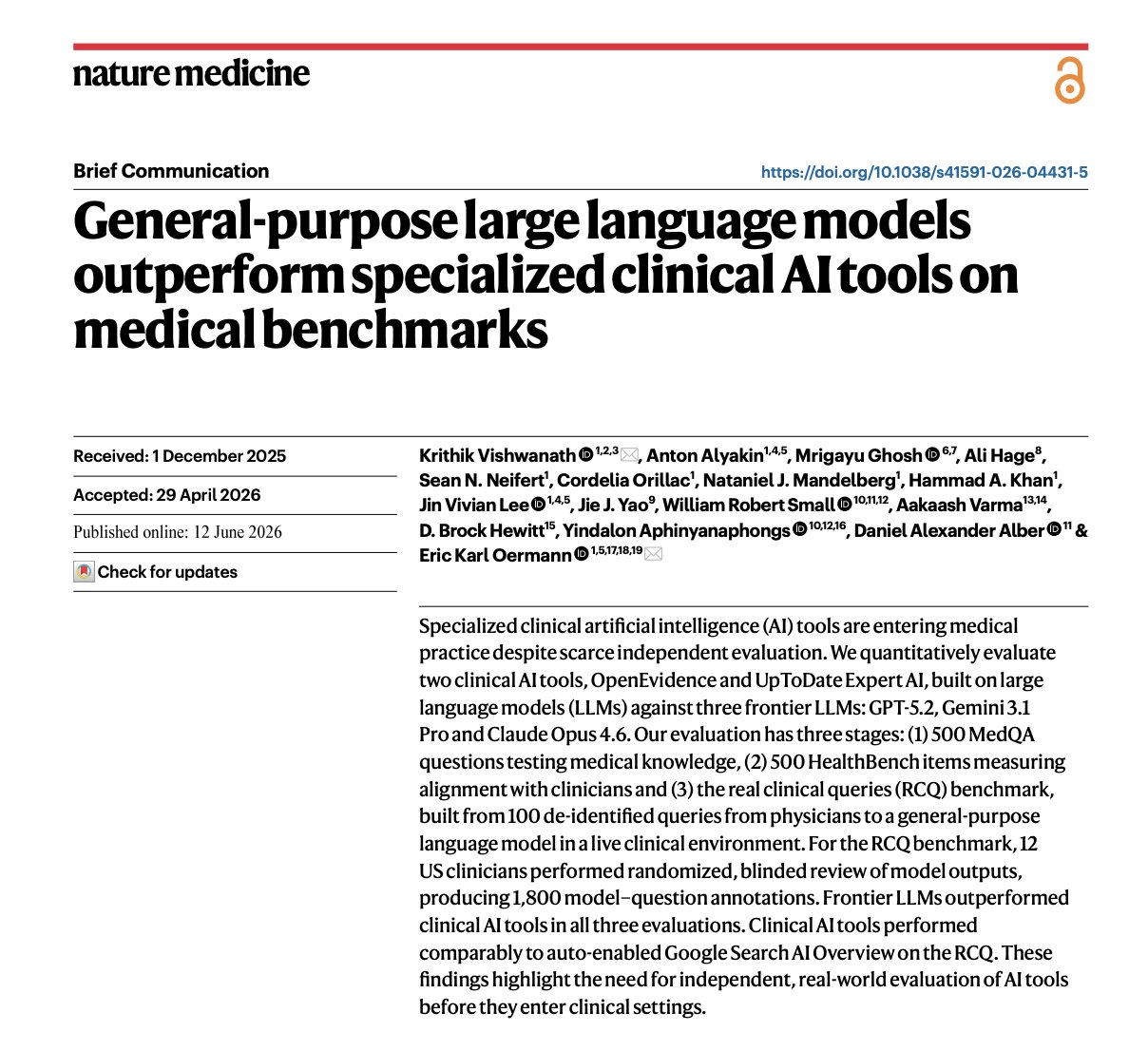
scientist tested a 3.5 billion dollar medical AI against regular chatGPT and it lost on every single one.they just published a paper in nature medicine, and the results are actually mindblowing.they took specialized clinical ai tools and tested them against general-purpose… pic.twitter.com/P7ePLunrDj— How To Prompt (@HowToPrompt__) July 6, 2026
A Stanford researcher is pioneering a dramatic shift in how we treat depression — and you can try her new tool right now
Woebot is a free therapy chatbot created by a clinical psychologist at Stanford University. It launched as a stand-alone app in January.
Symptom Response to Low-Dose Naltrexone in Fibromyalgia: An Exploratory Analysis of the Randomized Placebo-Controlled FINAL Trial
Fibromyalgia (FM) remains difficult to manage due to a highly variable symptom profile. The “FINAL” randomized, placebo-controlled trial examined the efficacy of low-dose naltrexone (LDN) on pain in women with FM, showing no significant difference in pain reduction at the group level but potentially higher 30% pain response rates. Analysis of secondary outcomes showed potential improvements in memory problems.

New Ketamine study 🧪. Abstract: ✅Ketamine "tablets were effective, safe & well tolerated" Actual results: ❌At primary endpoint of 13 weeks, 0 of 4 ketamine groups outperformed placebo /re remission ❌At 13 weeks, only 1 of 4 outperformed placebo /re response, with a beautiful p-value of 0.046 🤪

Extended-release ketamine tablets for treatment-resistant depression: a randomized placebo-controlled phase 2 trial - Nature Medicine
www.nature.com