


Don't update positively on your extremist beliefs whenever you hear a bad argument against them
The thinking style that makes people vulnerable to extremism | Psyche Ideas
The people most drawn to ideological thinking and authoritarianism aren’t aware of what makes them so susceptible
The Elusive Backfire Effect: Mass Attitudes’ Steadfast Factual Adherence
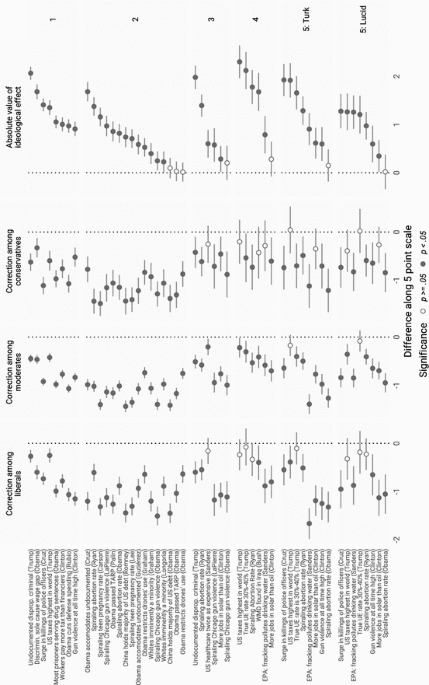
Can citizens heed factual information, even when such information challenges their partisan and ideological attachments? The “backfire effect,” described by Nyhan and Reifler (Polit Behav 32(2):303–330. https://doi.org/10.1007/s11109-010-9112-2, 2010), says no: rather than simply ignoring factual information, presenting respondents with facts can compound their ignorance. In their study, conservatives presented with factual information about the absence of Weapons of Mass Destruction in Iraq became more convinced that such weapons had been found. The present paper presents results from five experiments in which we enrolled more than 10,100 subjects and tested 52 issues of potential backfire. Across all experiments, we found no corrections capable of triggering backfire, despite testing precisely the kinds of polarized issues where backfire should be expected. Evidence of factual backfire is far more tenuous than prior research suggests. By and large, citizens heed factual information, even when such information challenges their ideological commitments.
Guide to Responsible, Strategic Reporting on Hate and Extremism
Recommendations for researchers, journalists and others on how to avoid unintentionally bolstering extremists and causing additional harm.

Resource-rational belief revision can mitigate as well as amplify polarization
People's beliefs sometimes diverge after observing the same information, which has been interpreted as evidence of irrationality. This behaviour has been proposed to result from people's limited cognitive resources and motivated reasoning, but how belief revision differs across these explanations has not been formalized or compared to a rational norm. Further, while people may be biased relative to a normative ideal, they may still make optimal choices given their limited cognitive resources, or rationally balance the utility of holding accurate beliefs with the belief's intrinsic utility. Across two studies, we develop and test a unified computational account of belief polarization under these proposed mechanisms, showing that people's performance on a belief updating task best fits a limited-resource Bayesian model; external motivations may contribute to divergence (or convergence) by determining what pre-existing information people consider relevant to a situation, rather than by changing how people evaluate new information in isolation.
Q&A: The Myth of "Radicalization" | American Civil Liberties Union
>What’s wrong with radicalization? >What's at Stake? > What's The Proper Role For Law Enforcement? > What's The Bottom Line? WHAT'S WRONG WITH “RADICALIZATION”? The word “radicalization” is commonly used in public and policy discourse, but what people mean by it varies and there’s no single agreed-upon definition. The problem is that government policies and programs are based on a theory of “radicalization” that assumes a process through which people turn to violence because of radical or extreme beliefs. This theory is unscientific and discredited — and government programs based on it result in monitoring or suppression of First Amendment-protected beliefs and ideas. For example, this dangerous radicalization theory is being applied to American Muslim communities, most recently in the form of “countering violent extremism ” programs. According to this theory, the adoption or expression of “extreme” or “radical” religious ideas or practices places individuals on a path toward terrorism or violence, and there are observable “indicators” that can identify those who are “vulnerable” to “radicalization.” This is false. The ACLU has repeatedly provided statements to Congress — in 2009, 2010, 2011, and 2012 — to explain the factual and methodological flaws in reports that promote this radicalization theory. Our allies have also written reports debunking the theory. As we and others have explained, despite years of study and experience in the United States and elsewhere, researchers have not identified criteria or behavioral indicators that can be used to reliably predict who will commit an act of terrorism or political violence. Simply put, religious beliefs and practices do not correlate with a propensity toward violence. Instead, the freedom to engage in these activities goes to the core of what it means to be an American. Cloaking American Muslims — or any other belief communities — with suspicion puts at risk the freedom of religion, gives the appearance of official endorsement of one set of religious beliefs over another, and threatens to chill free association and free speech. WHAT'S AT STAKE? The radicalization myth threatens the fundamental freedoms of American Muslims and all Americans. Government efforts to inquire whether American Muslims — or anyone else — holds “radical” or “extreme” beliefs, however those are defined, stigmatize entire communities and promote a climate of fear and self-censorship. Our values are undermined when people forsake religious exercise, political discussions, and intellectual debate to avoid being branded as extreme or at risk of “radicalization.” Probing people’s thoughts and beliefs also engenders distrust of the government and undermines the relationship between communities and law enforcement. For example, it can cripple government efforts to demonstrate to Muslims at home and abroad that the United States seeks to live up to its ideals in its equal treatment of all Americans, including Muslims, and is not engaged in a “war against Islam.” More broadly, our nation’s founders recognized that radical beliefs that challenge social and political orthodoxies are valuable and necessary for a vibrant society and democracy. That is why First Amendment, which protects the freedoms of belief, religion, speech, and association, occupies a special place in our history and in the Constitution. Unfortunately, though, government suspicion of beliefs and unsupported theories of “radicalization” are nothing new, and our nation’s history shows they are often used to target minorities or those who dissent. For example, during World War I, Congress banned anti-war speech and the FBI conducted investigations of Americans’ political beliefs to identify purported radicals and opponents. Erroneous theories of eugenics supported racist immigration policies and Jim Crow anti-miscegenation laws for decades. Misguided “red” scares and racism drove abominable policies like blacklists, McCarthyism, and Japanese internment. And the FBI infamously spied on civil rights movement leaders in the name of national security during the J. Edgar Hoover era. WHAT'S THE PROPER ROLE FOR LAW ENFORCEMENT? The protections built into the Constitution help ensure that law enforcement officers focus their investigative resources where there is evidence of wrongdoing or criminal activity. The police can conduct an investigation when they have reasonable suspicion to believe that a crime has been, or is being, committed. But the standard for initiating or widening an investigation must be rigorous enough to focus security resources on criminal activity and prevent abuse. One form of such abuse occurs when officers investigate or monitor people based on their religious beliefs or practices. Former Attorney General Eric Holder rightly stated that “law enforcement has an obligation to ensure that members of every religious community enjoy the ability to worship and to practice their faith in peace, free from intimidation, violence or suspicion. That is the right of all Americans. And it must be a reality for every citizen. In this nation, our many faiths, origins, and appearances must bind us together, not break us apart.” Too often, though, law enforcement and intelligence have targeted religious, racial, ethnic, or national origin communities for monitoring and suspicion. In the case of American Muslims, “countering violent extremism” initiatives may task communities with reporting to law enforcement about individuals’ radical or extreme beliefs. Although warning law enforcement of threats is indeed a shared civic and social responsibility, it would be illegal, unfair, and impractical for law enforcement officials to require any religious or belief community to prove its loyalty to this country by monitoring or “informing” on its members. To the contrary, American Muslims, like the rest of this country's citizens, have the right to protest illegal, overzealous or abusive government security measures and to vigorously exercise, and encourage others to exercise, rights guaranteed in the Constitution. Some in American Muslim communities have also expressed legitimate concerns about whether those who volunteer information to law enforcement will find themselves threatened with legal jeopardy. Individuals should speak to lawyers before talking to law enforcement — and know that refusing to talk to law enforcement without a lawyer is a constitutional right. WHAT'S THE BOTTOM LINE? The government’s “radicalization” theory has become a euphemism for religious and ideological profiling. It leads to discrimination and stigmatization, and is fundamentally un-American. Casting suspicion on American faith or belief communities is wrong and does nothing to make us safer.
The Internet is for Extremism
How MrBeast explains why everything online is going insane

Opinion | 9/11 took Islamophobia mainstream in America – and things have only gotten worse
Although I have always had kind and mostly tolerant neighbors, the effects of widespread Islamophobia have touched my life intimately.

Technically Radical
They're so thoroughly hypnotized by the short-term victory of global capitalism that they can't surf the new paradigm, look to the longer term. – Charles Stross, Accelerando One obvious role for a radical intellectual is to do precisely that: look at those who are creating viable alternatives, try to figure out what might be the larger implications of what they are (already) doing, and then offer those ideas back [to the world], not as prescriptions, but as contributions, possibilities—as gifts. – David Graeber, Fragments of an Anarchist Anthropology Over 2024, we saw major tech investors and company owners overtly turn toward the right, overtly backing Donald Trump in his electoral campaign....
Technically Radical
They're so thoroughly hypnotized by the short-term victory of global capitalism that they can't surf the new paradigm, look to the longer term. – Charles Stross, Accelerando One obvious role for a radical intellectual is to do precisely that: look at those who are creating viable alternatives, try to figure out what might be the larger implications of what they are (already) doing, and then offer those ideas back [to the world], not as prescriptions, but as contributions, possibilities—as gifts. – David Graeber, Fragments of an Anarchist Anthropology Over 2024, we saw major tech investors and company owners overtly turn toward the right, overtly backing Donald Trump in his electoral campaign....
Hear This
Radical Listening could transform our politics and block the rise of the far right.

When Corrections Fail: The Persistence of Political Misperceptions
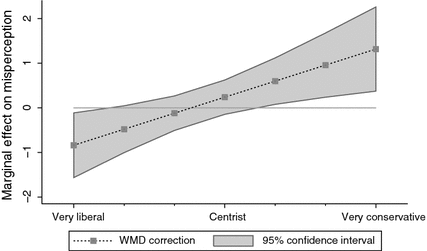
An extensive literature addresses citizen ignorance, but very little research focuses on misperceptions. Can these false or unsubstantiated beliefs about politics be corrected? Previous studies have not tested the efficacy of corrections in a realistic format. We conducted four experiments in which subjects read mock news articles that included either a misleading claim from a politician, or a misleading claim and a correction. Results indicate that corrections frequently fail to reduce misperceptions among the targeted ideological group. We also document several instances of a “backfire effect” in which corrections actually increase misperceptions among the group in question.
Facts and Myths about Misperceptions
Misperceptions threaten to warp mass opinion and public policy on controversial issues in politics, science, and health. What explains the prevalence and persistence of these false and unsupported beliefs, which seem to be genuinely held by many people? Though limits on cognitive resources and attention play an important role, many of the most destructive misperceptions arise in domains where individuals have weak incentives to hold accurate beliefs and strong directional motivations to endorse beliefs that are consistent with a group identity such as partisanship. These tendencies are often exploited by elites who frequently create and amplify misperceptions to influence elections and public policy. Though evidence is lacking for claims of a “post-truth” era, changes in the speed with which false information travels and the extent to which it can find receptive audiences require new approaches to counter misinformation. Reducing the propagation and influence of false claims will require further efforts to inoculate people in advance of exposure (for example, media literacy), debunk false claims that are already salient or widespread (for example, fact-checking), reduce the prevalence of low-quality information (for example, changing social media algorithms), and discourage elites from promoting false information (for example, strengthening reputational sanctions).
How a Papal Ban Reshaped the French Right – The Journal of Politics Blog
Political extremism is often attributed to voter anger and broader structural socioeconomic conditions. From this perspective, efforts to counter extremist movements may appear futile, since such groups are seen as deeply embedded in the contexts from which they arise. But is this necessarily the case? To address this question, we examine the Papal condemnation of an influential far-right movement in interwar France.
Exposure to ideologically diverse news and opinion on Facebook
When protests normalize intolerance: The hidden costs of far-right demonstrations
Large crowds expressing xenophobic views publicly can signal that such beliefs are socially acceptable or mainstream, influencing others to think this behavior is normal

There's growing experimental evidence¹˒²˒³˒⁴ that LLMs are unusually good at talking people out of entrenched false beliefs and conspiracy theories. ¹ pubmed.ncbi.nlm.nih.gov/39264999/ ² pubmed.ncbi.nlm.nih.gov/41179846/ ³ sciety.org/articles/activity/10.21203/rs… ⁴ connecticut.adl.org/resources/report/short-dialog…

Der Fisher
Unpopular opinion: LLMs are generally deradicalizing people whose beliefs are based on pure propaganda. I've been watching this happen slowly with some people I care about. ChatGPT is one of the reasons they finally accept that the NRA, OAN, and NewsMax are lying to them.
