Several months ago, I stumbled upon an innovative technique in the world of language model training known as Model Merging. This SOTA approach involves the fusion of two or more LLMs into a singular, cohesive model, presenting a novel and experimental method for creating sophisticated models at a fraction of
Arcee AI | March is Merge Madness
To celebrate Arcee’s recent merger with mergekit, we’re bringing you a month of resources and knowledge on model merging.
.webp)
Arcee AI | Announcing the Arcee Model Engine Public Beta
Get direct access to the small language models (SLMs) that power Arcee Orchestra, our new end-to-end, SLM-powered agentic AI platform. Sign up for the public beta of the Arcee Model Engine today.
.webp)
Introducing FlexOlmo: a new paradigm for language model training and data collaboration | Ai2
Explore how FlexOlmo enables collaborative language model training without sacrificing data privacy or control, introducing a new, flexible approach to building shared AI models.

swyx on Twitter / X
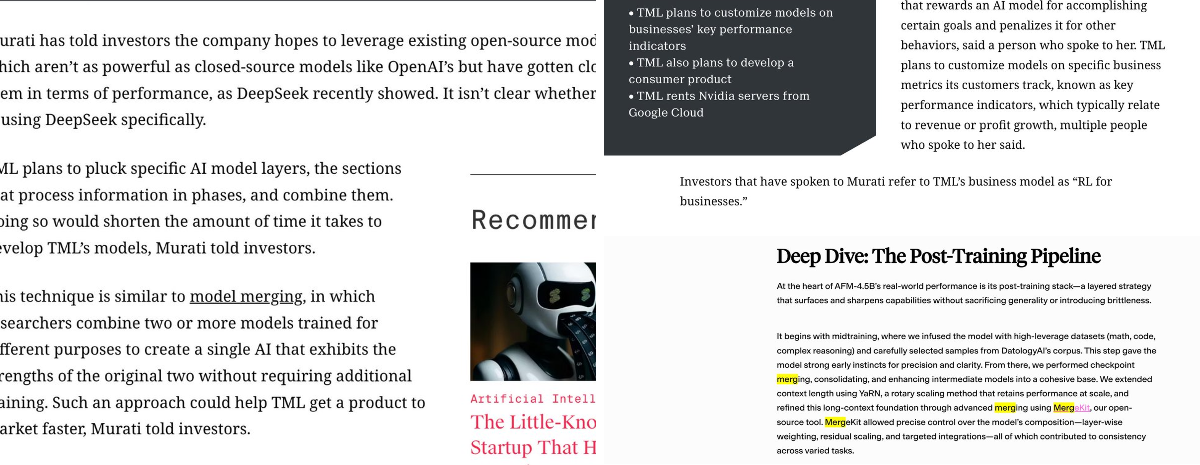
whoa so @thinkymachines is doing model merging + customized RLquite a come-up for merging in the past couple weeks, with @arcee_ai mergekit also featuring heavily in AFM. credit due to @jeremyphoward for being the first to make me take modelmerging seriously pic.twitter.com/DtXjX8li4t— swyx (@swyx) June 24, 2025
Arcee AI | Use MergeKit to Extract LoRA Adapters from any Fine-Tuned Model
We show you how to use Arcee's MergeKit to extract LoRA adapters from fine-tuned models, then leverage the Hugging Face Hub to create a library of general and task-specific LoRA adapters.

The Kaitchup – AI on a Budget | Benjamin Marie | Substack
Weekly tutorials and news on adapting large language models (LLMs) to your tasks and hardware using the most recent techniques and models. The Kaitchup proposes a collection of 180+ AI notebooks regularly updated. Click to read The Kaitchup – AI on a Budget, by Benjamin Marie, a Substack publication with tens of thousands of subscribers.
Scaling Laws Across Model Architectures: A Comparative Analysis of...
The scaling of large language models (LLMs) is a critical research area for the efficiency and effectiveness of model training and deployment. Our work investigates the transferability and...

Beyond Model Collapse: Scaling Up with Synthesized Data Requires...
Large Language Models (LLM) are increasingly trained on data generated by other LLM, either because generated text and images become part of the pre-training corpus, or because synthetized data is...
Sakana AI on Twitter / X
We’re excited to introduce Text-to-LoRA: a Hypernetwork that generates task-specific LLM adapters (LoRAs) based on a text description of the task. Catch our presentation at #ICML2025!Paper: https://t.co/2FRiVF1UXJCode: https://t.co/rx4G7dq1SWBiological systems are capable of… pic.twitter.com/UdUYfqRXBS— Sakana AI (@SakanaAILabs) June 12, 2025
AI’s Memorization Crisis
Large language models don’t “learn”—they copy. And that could change everything for the tech industry.

A Survey on Large Language Model based Autonomous Agents
Autonomous agents have long been a prominent research focus in both academic and industry communities. Previous research in this field often focuses on training agents with limited knowledge within isolated environments, which diverges significantly from human learning processes, and thus makes the agents hard to achieve human-like decisions. Recently, through the acquisition of vast amounts of web knowledge, large language models (LLMs) have demonstrated remarkable potential in achieving human-level intelligence. This has sparked an upsurge in studies investigating LLM-based autonomous agents. In this paper, we present a comprehensive survey of these studies, delivering a systematic review of the field of LLM-based autonomous agents from a holistic perspective. More specifically, we first discuss the construction of LLM-based autonomous agents, for which we propose a unified framework that encompasses a majority of the previous work. Then, we present a comprehensive overview of the diverse applications of LLM-based autonomous agents in the fields of social science, natural science, and engineering. Finally, we delve into the evaluation strategies commonly used for LLM-based autonomous agents. Based on the previous studies, we also present several challenges and future directions in this field. To keep track of this field and continuously update our survey, we maintain a repository of relevant references at https://github.com/Paitesanshi/LLM-Agent-Survey.
Large language model
A large language model (LLM) is a neural network trained on a vast amount of text for natural language processing tasks, especially language generation. LLMs can typically generate, summarize, translate, and analyze text in many contexts, and are a foundational technology behind modern chatbots.[1] Biased or inaccurate training data can make an LLM's output less reliable.[2]
Maintaining the love for coding in the time of AI
By Alex Band Over the last year, we have seen the profound effects Large Language Models (LLMs) have on our open-source software work at NLnet Labs. These can be grouped into two main areas: community contributions and security reports. Before we dive into this topic, let me first give

AI Agents: Key Concepts and How They Overcome LLM Limitations
An AI agent is an autonomous software entity that is often used to augment a large language model. Here's what developers need to know.

Sakana AI on Twitter / X
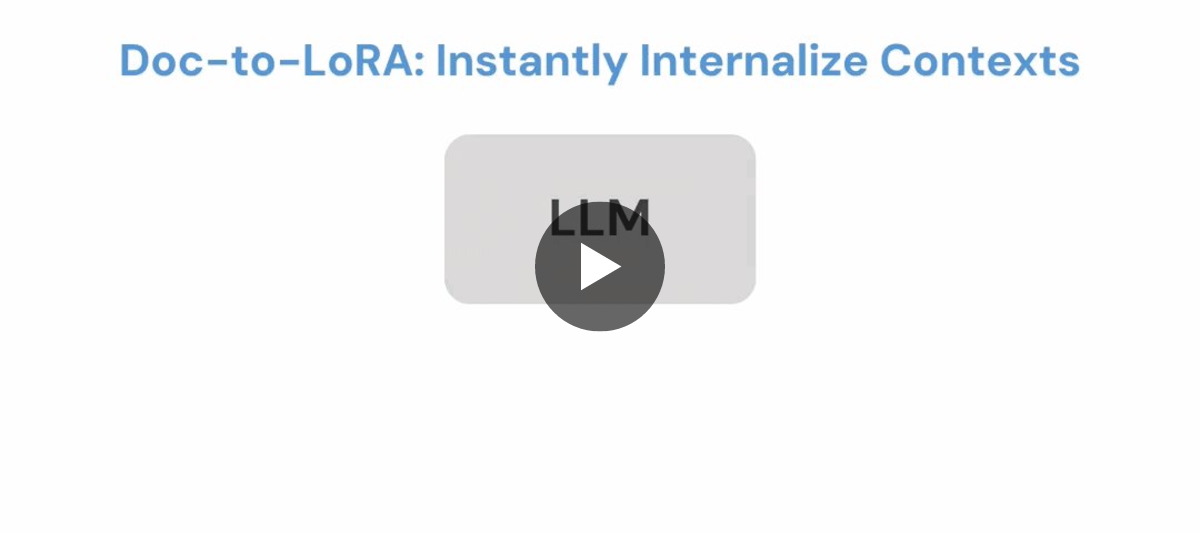
We’re excited to introduce Doc-to-LoRA and Text-to-LoRA, two related research exploring how to make LLM customization faster and more accessible.https://t.co/wGKDNhBcJXBy training a Hypernetwork to generate LoRA adapters on the fly, these methods allow models to instantly… pic.twitter.com/gId3J6hgEr— Sakana AI (@SakanaAILabs) February 27, 2026