You can charge much more than you think, if you reposition your value-proposition. Here's how.
How to Price Effectively: A Guide for Managers and Entr…
Pricing decisions are among the most important and impa…

Why Your Product Is So Hard to Explain
Stacking features makes products harder to market, less competitive, and easier to walk away from.

Pricing: A List of Tactics
Dive into the customer's mind. Read guides. Watch cool videos. Pricing, sales, design, negotiation, and more.
Pricing Your Product
A lot of startups treat pricing as a math problem or, worse, an afterthought. Pricing is as much an art as it is a science, one that relies as much on marketing and psychology as it does on classical economics.
The first rule of pricing is: you do not talk about pricing
I’ve been slightly obsessed with pricing since 2010. Before joining Magnetic, I was part of the team that changed the price of The Times…

SaaS Pricing: Lessons from 4 pricing changes - Canny Blog
We launched Canny almost a year ago. During that time, we reached ramen profitability. We also changed our pricing four times. Here's a deep dive into each pricing change and the lessons we learned.

Pain of Paying? — A Metaphor Gone Literal: Evidence from Neural and Behavioral Science
How do individuals consider the price of a good when making purchase decisions? Standard economic theories assume an analytical process: Individuals consider th

Dynamic Pricing: What It Is & Why It's Important | HBS Online
Are you reevaluating your digital platform’s pricing model? Here’s an overview of dynamic pricing and why it’s important to your business.

Double Mental Discounting: When a Single Price Promotion Feels Twice as Nice
This research finds that when a single gain has strong associations with multiple costs, consumers often mentally deduct that gain from perceived costs multiple times. For example, with some price promotions (e.g., spend $200 now and receive a $50 gift card to spend in the future), consumers mentally deduct the value of the price promotion from the cost of the first purchase when they receive the promotion, as well as from the cost of the second purchase when they use the promotion. Multiple mental deductions based on a single gain result in consumers' perceptions that their costs are lower than they actually are, which can trigger higher expenditures. This mental accounting phenomenon, referred to as “double mental discounting,” is driven by the extent to which gains feel associated, or coupled, with multiple purchases. This article also documents methods to decouple promotional gains from purchases, thus mitigating double mental discounting.

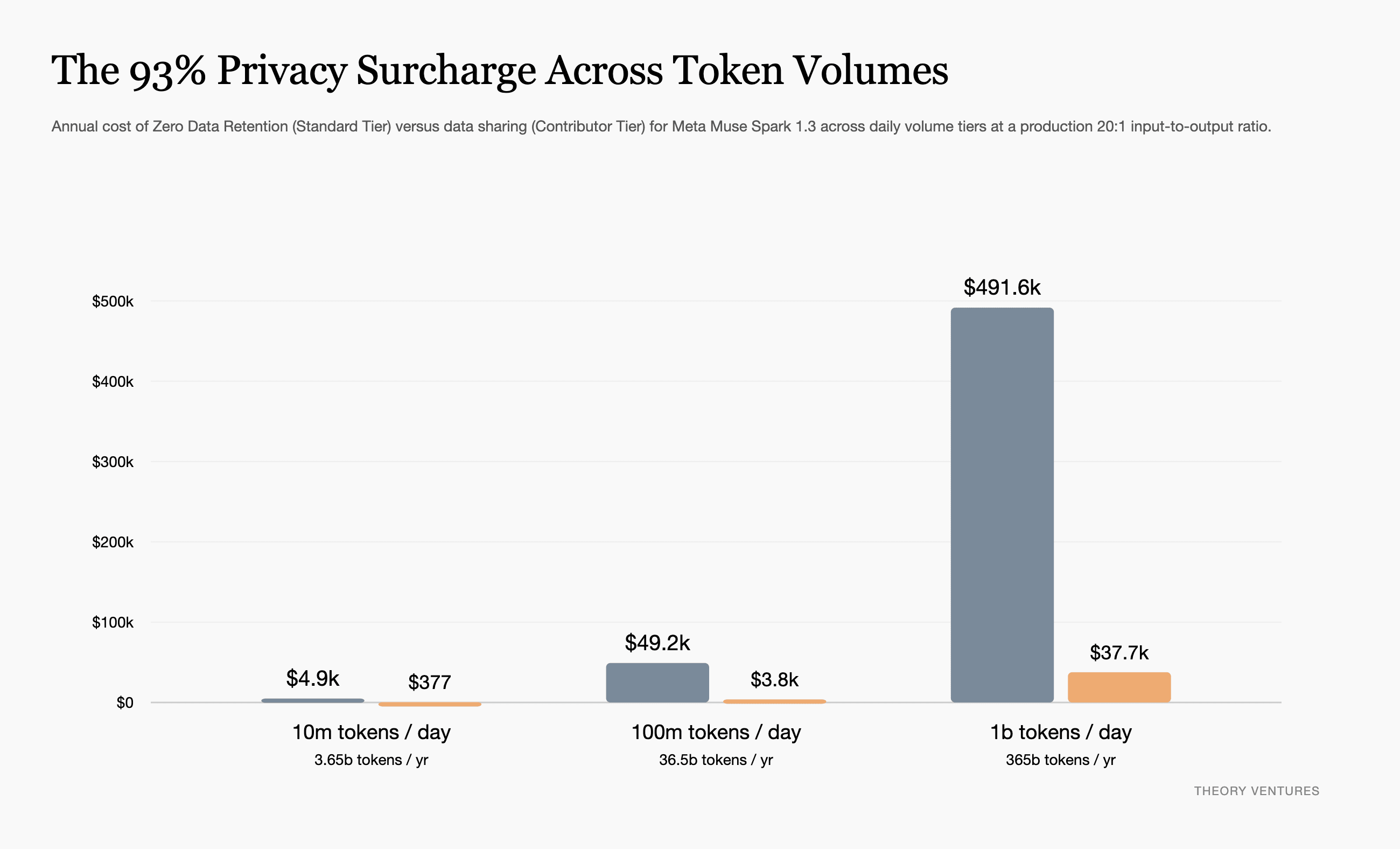
The Ads Model for Prompts Vertically Integrates AI
Meta's dual-tier AI pricing introduces an explicit barter : a 92% discount on inference in exchange for your data. Applying Michael Mauboussin's insight that prices contain information reveals the clearing price of prompt data : $1.24 per million tokens.
Buy wisely
Whenever I buy things I try to prioritize cost per use. Sometimes I consider other priorities such as cost per smile, cost per thrill, cost per externality, ...

How to Develop An AI Pricing Model | Salesforce Ventures
Your guide to developing an effective and scalable AI pricing strategy.

Artificial Intelligence, Algorithmic Pricing, and Collusion
Increasingly, algorithms are supplanting human decision-makers in pricing goods and services. To analyze the possible consequences, we study experimentally the behavior of algorithms powered by Artificial Intelligence (Q-learning) in a workhorse oligopoly model of repeated price competition. We find that the algorithms consistently learn to charge supracompetitive prices, without communicating with one another. The high prices are sustained by collusive strategies with a finite phase of punishment followed by a gradual return to cooperation. This finding is robust to asymmetries in cost or demand, changes in the number of players, and various forms of uncertainty.
“Objective Economics” Isn’t.
Some time ago, in a Facebook argument, I encountered someone who repeated the old “exchange of unequals” argument (i.e., that people never exchange equivalents because each party values what they got more than what they traded for it). I responded that this argument confuses exchange value with use value and that, regardless of subjective valuation,...