

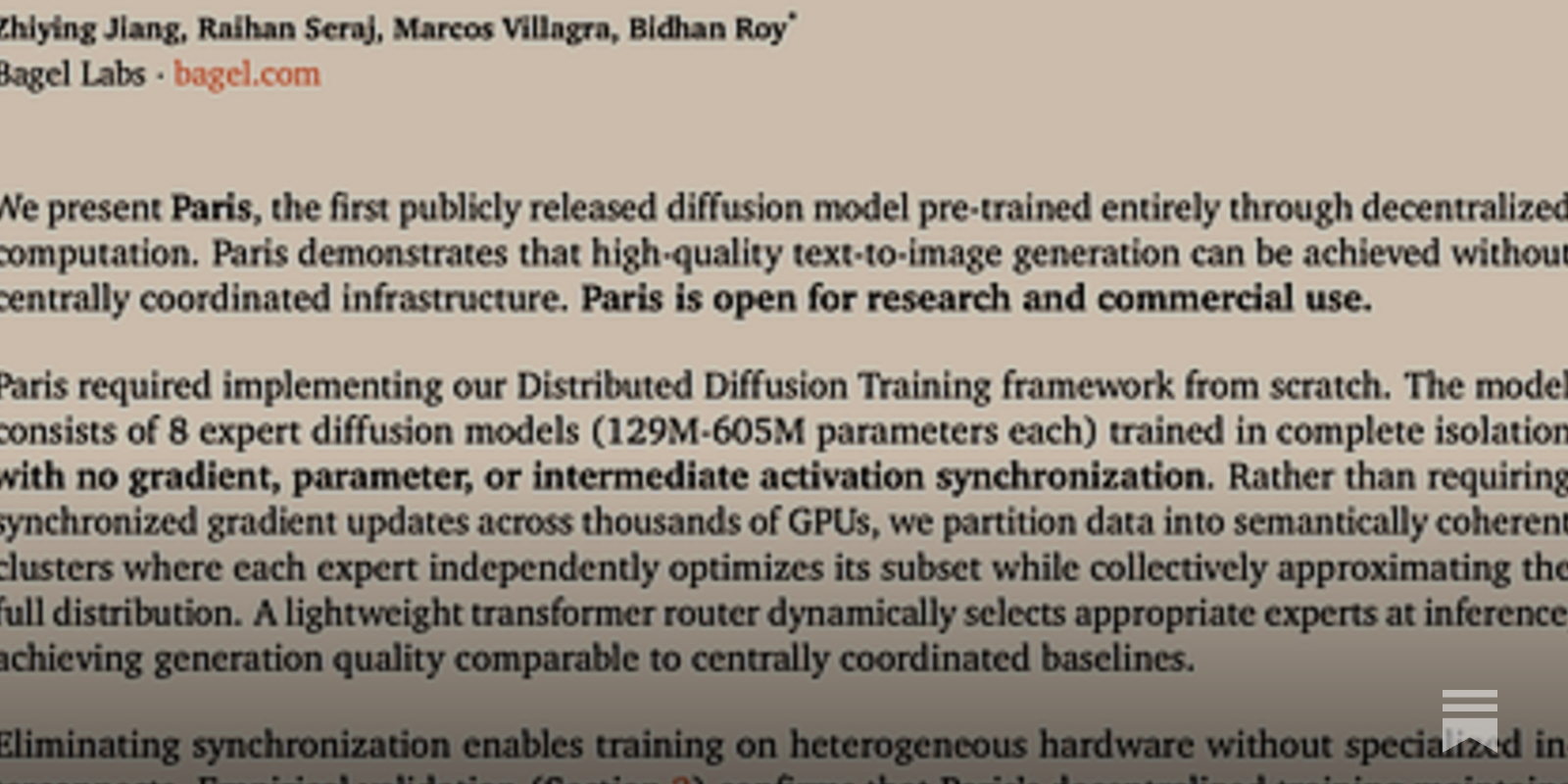
World's First Decentralized Trained Open-Weight Diffusion Model
What are Diffusion Models? | IBM
Diffusion models are generative models that “diffuse” training data with random noise, then learn to reverse the diffusion process to output new images.

DiffusionGemma as Jev: Open-Source vLLM Patch (2026) | explainx.ai Blog
A vLLM contributor built an open-source Jev clone using DiffusionGemma — roughly matching TypeSafe's proprietary model on accuracy.
Stanford CS25: V5 I Transformers in Diffusion Models for Image Generation and Beyond
Continuous diffusion language models
Fully discrete methods dominated for a few years, but language models based on continuous diffusion are making a comeback.

Continuous diffusion language models
Fully discrete methods dominated for a few years, but language models based on continuous diffusion are making a comeback.
The physics behind diffusion models
Diffusion model
In machine learning, diffusion models, also known as diffusion-based generative models or score-based generative models, are a class of latent variable generative models. A diffusion model consists of two major components: the forward diffusion process, and the reverse sampling process.[1] The goal of diffusion models is to learn a diffusion process for a given dataset, such that the process can generate new elements that are distributed similarly as the original dataset. A diffusion model models data as generated by a diffusion process, whereby a new datum performs a random walk with drift through the space of all possible data.[2] A trained diffusion model can be sampled in many ways, with different efficiency and quality.
Research – Inception
We are leveraging diffusion technology to develop a new generation of LLMs. Our dLLMs are much faster and more efficient than traditional autoregressive LLMs.

How Open Weights Are Changing the AI Race | Serverless Guru
Open Weight models: what they are, why you should care, and how the work of the open-source fine-tuning community around those models is reshaping daily life, both for developers and for everyday AI users.

Blacksky Algorithms - Open Collective
Decentralized social media built for community power, culture, and collective freedom.

Introducing Mercury 2.5 – Inception
Mercury 2.5 is the most capable diffusion LLM on the market. It runs at 1,107 tokens/sec and offers a 40% increase in intelligence over Mercury 2, comparable to cost-optimized frontier models.

mlx-examples/stable_diffusion at main · ml-explore/mlx-examples
Examples in the MLX framework. Contribute to ml-explore/mlx-examples development by creating an account on GitHub.
How Stable Diffusion works
Understand in a simple way how Stable Diffusion transforms a few words into a spectacular image.

Open-weight AI is having its Kubernetes moment. Let's not ruin it. | Tobi Knaup
Open-weight models are becoming the foundation for the next AI ecosystem. The US should compete in it, not wall itself off.

Diffusion Models

Introducing Mercury 2.5 – Inception
Diffusion model
What are Diffusion Models? | IBM

Diffusion Models: A Comprehensive Survey of Methods and Applications

Diffusion Models
Research – Inception