Today on The Keyword, we outlined our vision for an initiative aimed at evolving the web with architecture that advances privacy, while co...
Privacy Principles
Privacy is an essential part of the web. This document provides definitions for privacy and related concepts that are applicable worldwide as well as a set of privacy principles that should guide the development of the web as a trustworthy platform. People using the web would benefit from a stronger relationship between technology and policy, and this document is written to work with both.
The web should remain anonymous by default | The Mozilla Blog
The unique architecture of the web enables a much higher degree of user privacy than exists on other platforms. Many factors contribute to this, but an ess

Publishers Question Related Website Sets, Google’s Privacy Sandbox Solution for Cross-Site Tracking
Google Privacy Sandbox proposal Related Website Sets lets publishers track users across five domains.

Keeping Data Private | Web Browser Engineering
Our browser has grown up and now runs (small) web applications. With one final step—user identity via cookies—it will be able to run all sorts of personalized online services. But capability demands responsibility: our browser must now secure cookies against adversaries interested in stealing them. Luckily, browsers have sophisticated systems for controlling access to cookies and preventing their misuse.
Unlinkable Inference as a User Privacy Architecture
Unlinkable inference is a technique that provably sandboxes your AI requests from each other and from your identity. We discuss its building blocks, applications, and how it fits into the broader landscape of private personal intelligence.
Measuring the Privacy Experience
How do you know that a product respects your privacy – other than by wading through the fine print? We’ve created a framework to measure the way people actually experience privacy in tech products.
How GDPR Will Change The Way You Develop — Smashing Magazine
GDPR requires you to be more thoughtful about the sites and services you build, more transparent about the ways you collect and use data, more considerate of your users, and more thorough in your development and documentation processes. In this article, Heather Burns will explore what you, as a developer, need to know about the new data protection regime. At the end, you’ll understand how the challenges posed by the privacy overhaul will ultimately help to make you a better developer.

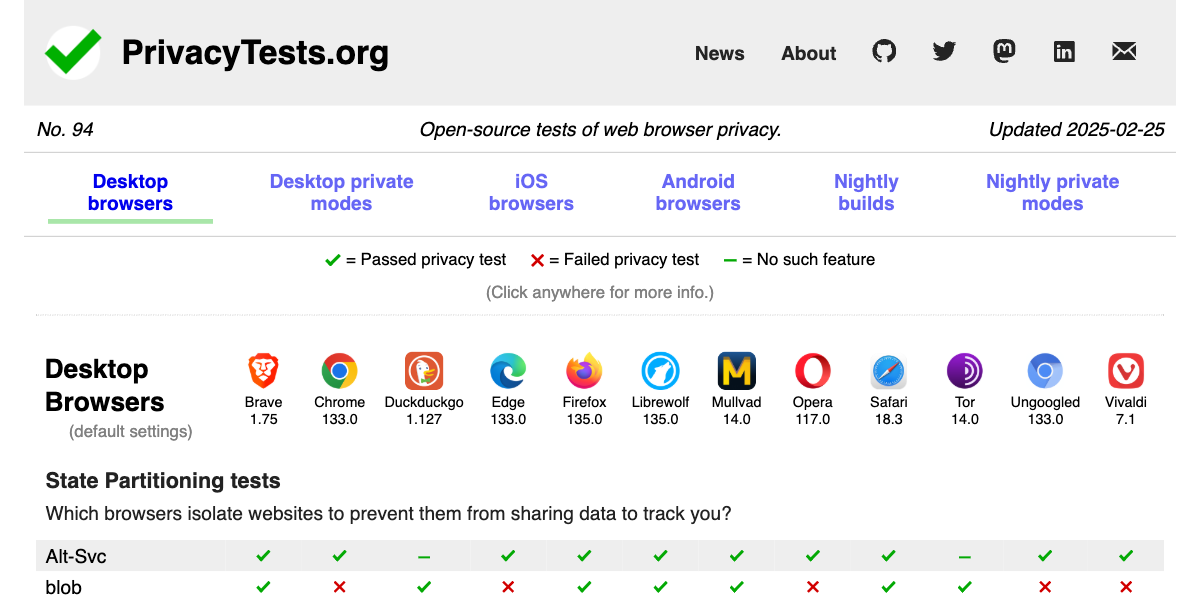
Which browsers are best for privacy?
An open-source privacy audit of popular web browsers.
EFFecting Change: How to Build a Decentralized Web That Truly Works for All
OpenClaw – NEAR AI
Run the internet’s favorite new AI agent with NEAR AI’s cryptographic privacy guarantees.
The Web’s Creator Looks to Reinvent It (Published 2016)
Tim Berners-Lee and other computer scientists are pondering newer technologies to create a web with more privacy and less government control.

Keeping the Web Open and Private in the Bot Era | The Mozilla Blog
If you’ve been running into endless CAPTCHAS or website login requests lately, you’re not imagining things. Websites, facing a rising tide of abu

The Open Anonymity Project
The Open Anonymity Project is a research & engineering effort building tools, infrastructure, and user-facing software for AI user privacy.

BrowserOS - Open-Source AI Browser
The open-source browser with AI superpowers. Privacy-first Chrome alternative backed by Y Combinator.