AI labs and policymakers are focusing on AI dividends to address economic insecurity. We asked 1,041 people across 64 countries what they actually want from AI wealth.
Mapping the Potential and Pitfalls of "Data Dividends" as a Means of Sharing the Profits of Artificial Intelligence
Identifying strategies to more broadly distribute the economic winnings of AI technologies is a growing priority in HCI and other fields. One idea gaining prominence centers on "data dividends", or sharing the profits of AI technologies with the people who generated the data on which these technologies rely. Despite the rapidly growing discussion around data dividends - including backing by prominent politicians - there exists little guidance about how data dividends might be designed and little information about if they will work. In this paper, we begin the process of developing a concrete design space for data dividends. We additionally simulate the effects of a variety of important design decisions using well-known datasets and algorithms. We find that seemingly innocuous decisions can create counterproductive effects, e.g. severely concentrated dividends and demographic disparities. Overall, the outcomes we observe -- both desirable and undesirable -- highlight the need for dividend implementers to make design decisions cautiously.

New schemes teach the masses to build AI
Treating it like a craft is paying dividends


Import AI 452: Scaling laws for cyberwar; rising tides of AI automation; and a puzzle over gDP forecasting
How much could AI revolutionize the economy?

"AI" is Automated Inequality
Tech bros still dominate the discussions about so-called "AI" with false claims. Even most "AI"-critical researchers spend much of their time meticulously debunking (always only a subset of) claims, leaving vast areas of the economic consequences of "AI" unexplored. (Even the "AI"-evangelist Economi

AI Is a Product of Humanity. Humanity Should Own AI.
Big Tech has looted humanity’s creative output to create artificial intelligence. We don’t just deserve a share of AI’s profits — we deserve control over it.

March 2026 Global Dialogues Survey | Windfall Trust
Here’s what the world had to say about the AI economy

AI security issues dominate corporate worries, spending
Two reports illustrate how business leaders are thinking about and budgeting for generative AI.
The Missing Institution: A Global Dividend System for the Age of Transformative AI — Digitalist Papers
How do we share prosperity in society if work no longer sits at the center of people’s lives? In this essay, Anna Yelizarova explores one provocative possibility: a “global dividend.” If transformative AI shows little respect for national borders, with effects that spill across countries, then we ne

AI's Trillion-Dollar Opportunity: Sequoia AI Ascent 2025 Keynote
AI is probably not a bubble
AI companies have revenue, demand, and paths to immense value
AI is probably not a bubble
AI companies have revenue, demand, and paths to immense value
People know AI is risky. They just don’t know what to do about it. | TrendLife Blog
New international research from TrendLife reveals a wide gap between AI adoption and awareness of AI-powered threats.
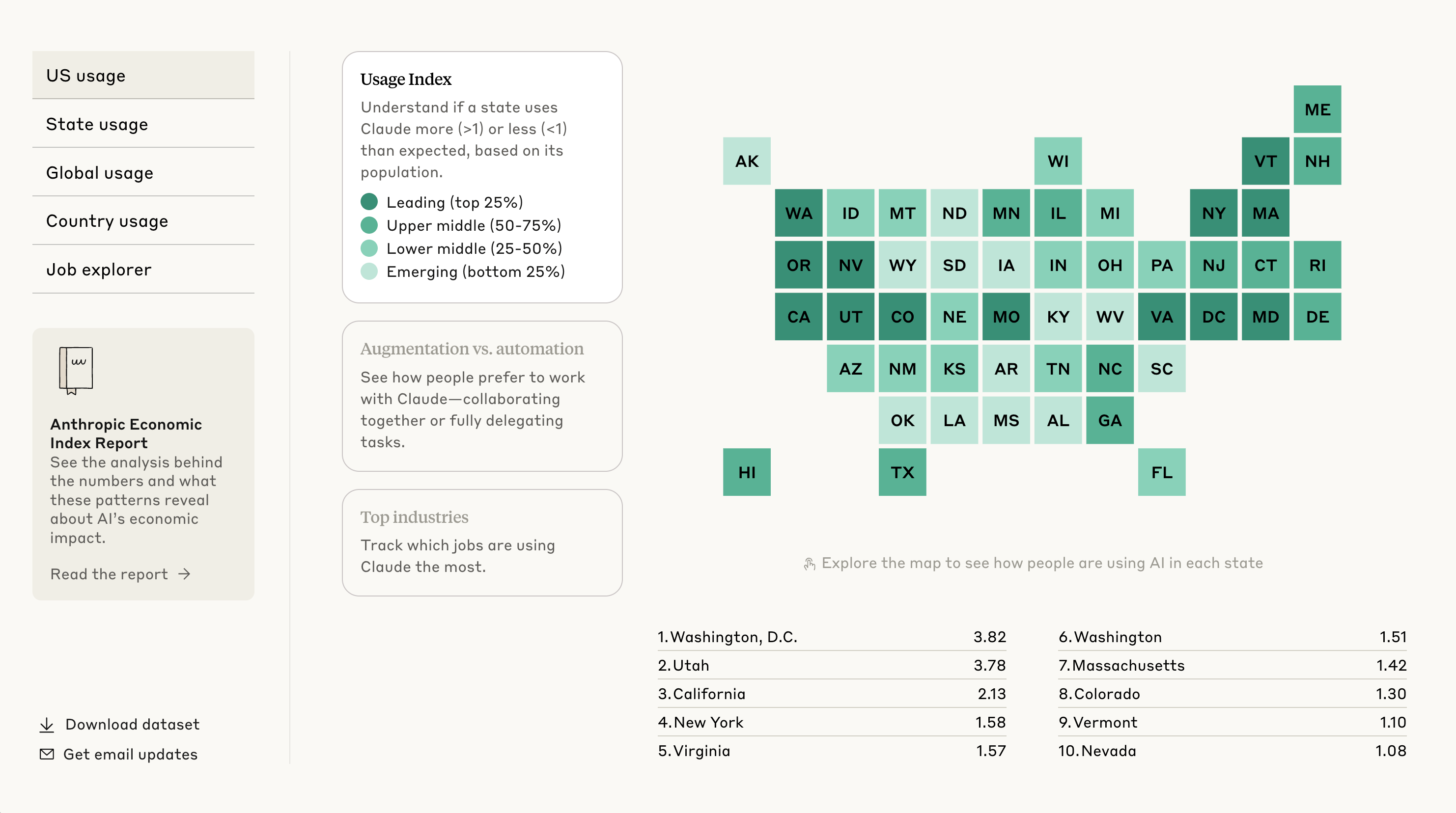
The Anthropic Economic Index
The Anthropic Economic Index reveals the shape of AI adoption across the world. Here, you can explore the data behind our research to understand how people are using Claude across every US state and hundreds of occupations. Track the topics that are trending where you live, and see how people are using AI to augment or automate their work—that is, whether they prefer to collaborate with, or delegate to, Claude.
AI FOR EPISTEMICS & COORDINATION
Civilization and technology have radically improved the human condition. Nonetheless, the world sometimes goes in directions which essentially nobody would prefer — e.g., nuclear arms races, unexpected financial crashes, predatory marketing, or ubiquitous political misinformation.
3: Consulting the Record: AI Consistently Fails the Public - AI Now Institute
Amid the excitement over AI’s (speculative, hypothetical) potential, we have lost sight of the sobering reality of its present and recent past. AI is already intermediating critical social infrastructures, materially reshaping our institutions in ways that ratchet up inequality and concentrate power in the hands of the already powerful. It is consistently deployed in ways […]