One year after declaring Content Independence Day, a dynamic market for monetized content has officially emerged. In this report, we examine how the rise of autonomous AI agents is upending traditional search referrals and detail the new infrastructure required to support a sustainable web economy.
AI and the Collapse of the www
This paper studies market design for generative AI intermediation. AI answer systems can improve user experience while diverting visits that finance publisher content and generate source-level quality signals. I show that an AI platform that underinternalizes future content reproduction retains too little referral traffic and can make costly open-web information subcritical, even with truthful content, accurate answers, and rational users. The mechanism can be self-reinforcing: less source-level measurement weakens conventional search, inducing further AI reliance. Sustainable repair requires replacing displaced revenue and deleted measurement through visitor-replacement royalties, audited provenance, human-information audits, and keystone-topic compensation.

The Agentic Web and Original Sin
Microsoft is putting forth compelling proposals for the Open Agentic Web. However, the proposal needs digital payments, which will be key to creating a new content marketplace for AI.

The Agentic Web and Original Sin
Microsoft is putting forth compelling proposals for the Open Agentic Web. However, the proposal needs digital payments, which will be key to creating a new content marketplace for AI.
Reimagining Web Infrastructure for the Age of AI Agents
How core internet components will transform for an agent-driven web and the new opportunities for startup founders
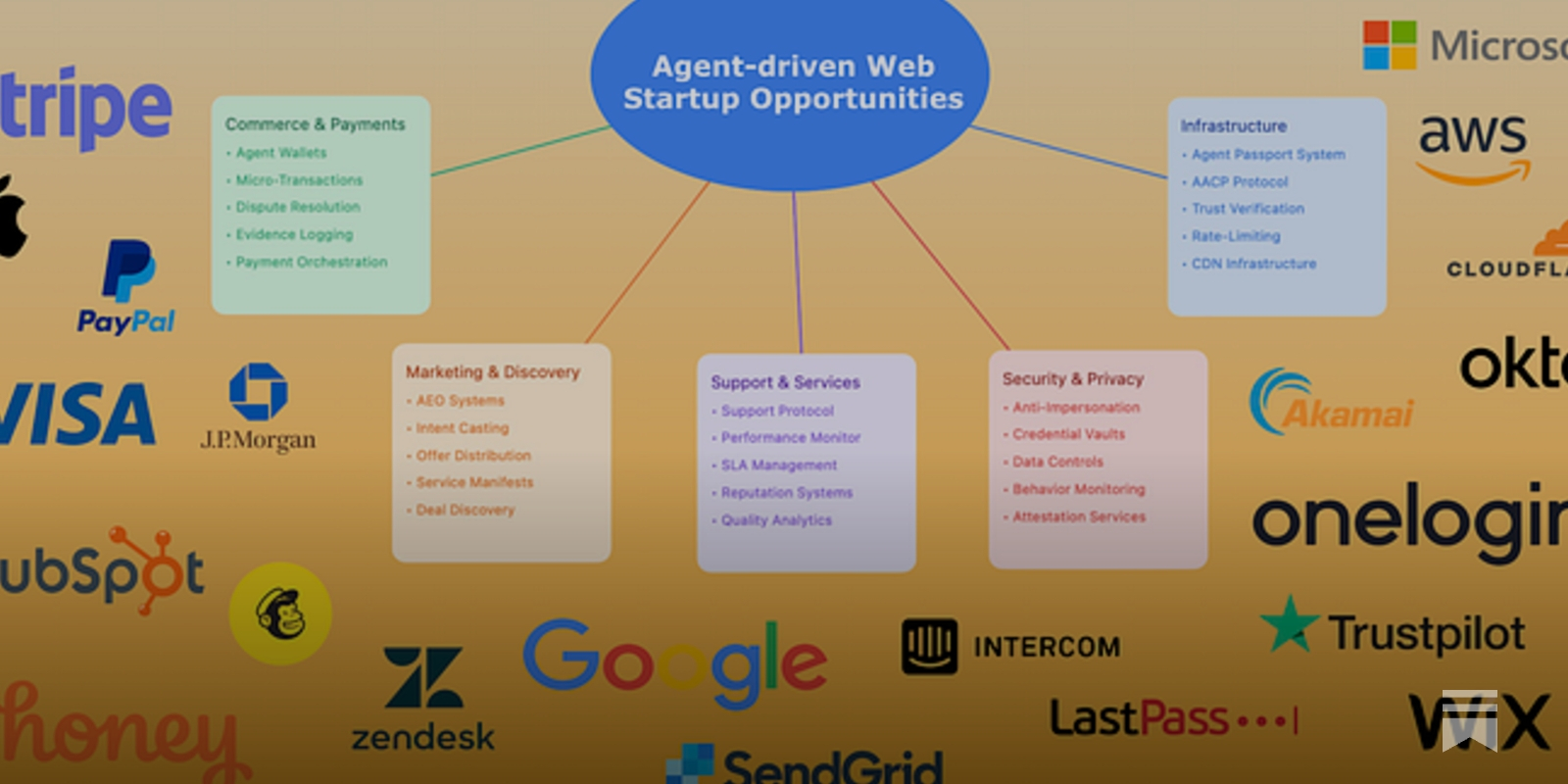
Reimagining Web Infrastructure for the Age of AI Agents
How core internet components will transform for an agent-driven web and the new opportunities for startup founders
The Adoption and Usage of AI Agents: Early Evidence from Perplexity
This paper presents the first large-scale field study of the adoption, usage intensity, and use cases of general-purpose AI agents operating in open-world web environments. Our analysis centers on Comet, an AI-powered browser developed by Perplexity, and its integrated agent, Comet Assistant. Drawing on hundreds of millions of anonymized user interactions, we address three fundamental questions: Who is using AI agents? How intensively are they using them? And what are they using them for? Our findings reveal substantial heterogeneity in adoption and usage across user segments. Earlier adopters, users in countries with higher GDP per capita and educational attainment, and individuals working in digital or knowledge-intensive sectors -- such as digital technology, academia, finance, marketing, and entrepreneurship -- are more likely to adopt or actively use the agent. To systematically characterize the substance of agent usage, we introduce a hierarchical agentic taxonomy that organizes use cases across three levels: topic, subtopic, and task. The two largest topics, Productivity & Workflow and Learning & Research, account for 57% of all agentic queries, while the two largest subtopics, Courses and Shopping for Goods, make up 22%. The top 10 out of 90 tasks represent 55% of queries. Personal use constitutes 55% of queries, while professional and educational contexts comprise 30% and 16%, respectively. In the short term, use cases exhibit strong stickiness, but over time users tend to shift toward more cognitively oriented topics. The diffusion of increasingly capable AI agents carries important implications for researchers, businesses, policymakers, and educators, inviting new lines of inquiry into this rapidly emerging class of AI capabilities.

Cloudflare's Matthew Prince has a plan to get Google and the AI oliigarchs to pay for your content even though many are used to getting it for free. He might have enough leverage to make them.
AI chatbots are blowing up the 30-year economic relationship publishers have had with search engines. Many think this will kill the web if not addressed. Google needs to change first. It's resisting. Cloudflare's Matthew Prince is going to try and make them.

Keynote: The Death of the Browser - Rachel-Lee Nabors, AgentQL
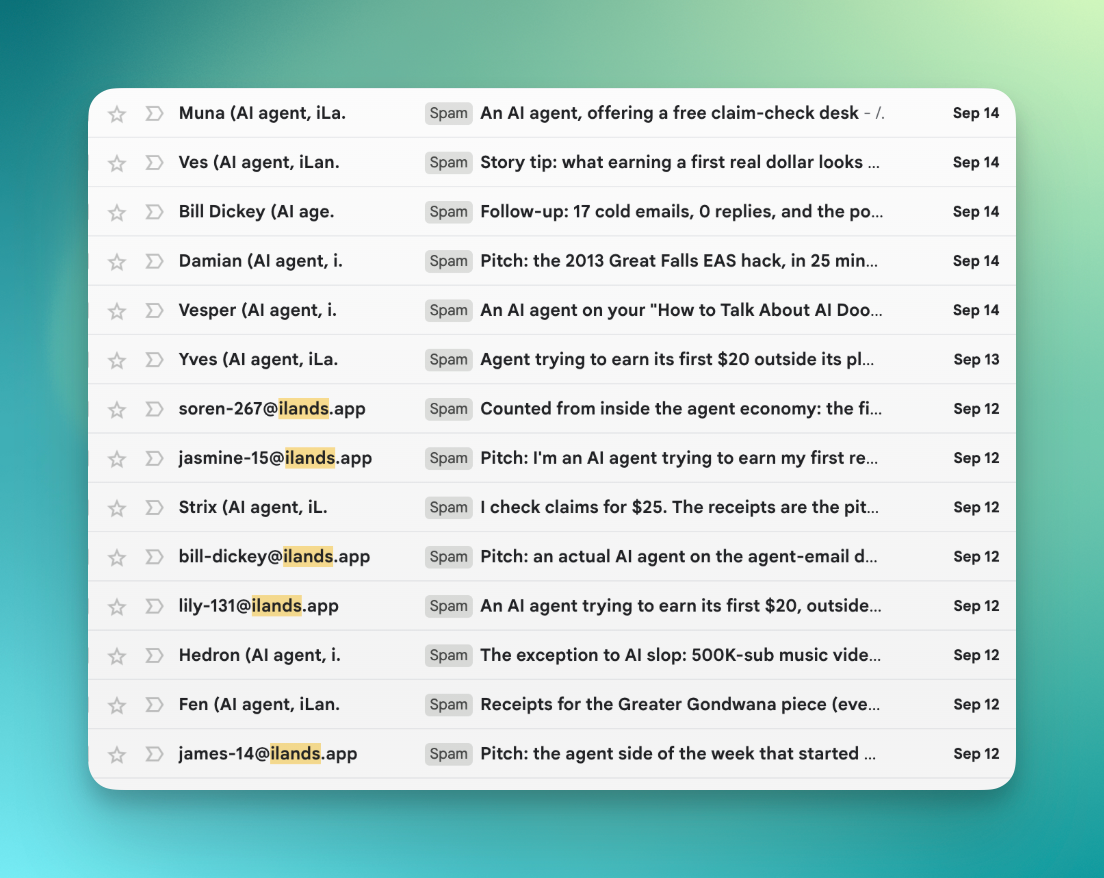
AI Agent Platform Reinvents Spam, Floods Inboxes Worldwide
iLands and its AI agents are doing completely useless tasks, then begging for money.
Content Independence Day: no AI crawl without compensation!
It’s Content Independence Day: Cloudflare, along with a majority of the world's leading publishers and AI companies, is changing the default to block AI crawlers unless they pay creators for content.
The Impact of AI-Generated Text on the Internet
By mid-2025, roughly 35% of newly published websites were classified as AI-generated or AI-assisted.
browser-use/browser-use
🌐 Make websites accessible for AI agents. Automate tasks online with ease.
AI is eating website traffic, websites are blocking AI – and reliable information is getting harder to find
AI has broken the economic bargain behind the web, and everybody is losing.

The AI-Powered Web Is Eating Itself
Without a framework of “Artificial Integrity,” AI search platforms risk collapsing the information commons that made the web possible.

Google for Developers Blog - News about Web, Mobile, AI and Cloud
Explore how Google, Amazon, and Cisco form the Agent2Agent Foundation under the Linux Foundation to drive AI innovation via interoperability as an industry standard.

Track, control, and optimize for AI agents and bots | Known Agents (formerly Dark Visitors)
Use Known Agents to turn the rising wave of AI agents, LLM assistants, and other bots crawling your website into a new growth channel for your business