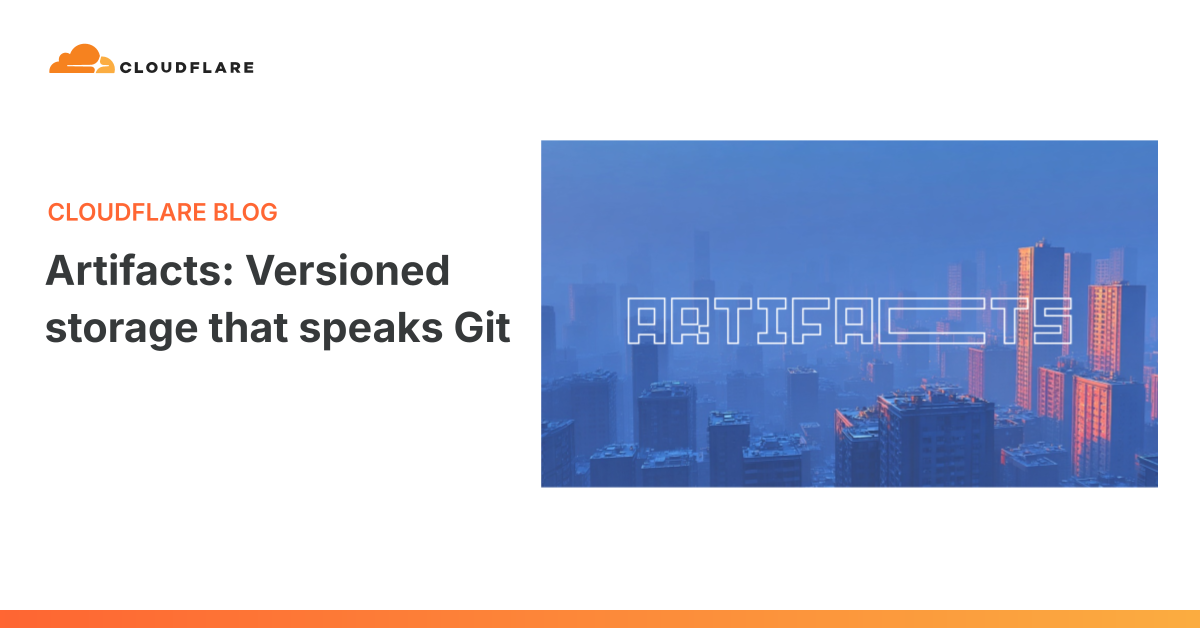
Give your agents, developers, and automations a home for code and data. We’ve just launched Artifacts: Git-compatible versioned storage built for agents. Create tens of millions of repos, fork from any remote, and hand off a URL to any Git client.
Entire Launches Distributed Git Network for the Agent Era
Five months after the largest seed round in developer-tools history, Entire is reimagining version control for agent-scale development, allowing developers to mirror GitHub repositories on a fast, independent Git network built for agents.
How we built Git storage for millions of Netlify projects
A technical look at how Netlify built Netlify Source: durable Git storage on S3, scalable caching, push consistency, and support for millions of projects.

Entire · A new developer platform is coming
Entire is a fast, distributed, Git-compatible network for mirroring GitHub repositories so agents can clone fast without hitting origin rate limits.

Gitea Official Website
Gitea - Git with a cup of tea! Painless self-hosted all-in-one software development service, including Git hosting, code review, team collaboration, package registry and CI/CD

Repositories Are Human/Agent Knowledge Factories
Repositories aren’t where code lives anymore—they’re where **knowledge is manufactured**. And increasingly, it’s not humans doing the work—it’s agents, with humans supervising the factory.…

Software Is Made Between Commits
From the Zed Blog: Agents turned the conversation into the real source of our software. DeltaDB is the version control built for it.
Git at any scale · Cursor
Hosting Git repositories at scale is a nightmare. When Linus Torvalds designed the first version of the information manager from hell (that's actually the tagline for Git, look it up), he had a very specific use case in mind: his own. He wanted to replace BitKeeper, the distributed version control system that was being used to develop the Linux Kernel. Of course, the replacement had to be distributed too. The Kernel is an unusual software project; it is extremely decentralized, with many different maintainers for its many different subsystems. A distributed version control system is a natural fit for this workflow.

Control access and protect artifacts | Artifact Registry | Google Cloud Documentation
This page describes Google Cloud services and features that help you to safeguard your artifacts.

Gregory Szorc's Digital Home | High-level Problems with Git and How to Fix Them
When Git first came onto the scene in the mid 2000's, I was initially skeptical because of its horrible user interface. But once I learned it, I appreciated its speed and features - especially the ease at which you could create feature branches, merge, and even create commits offline (which was a big deal in the era when Subversion was the dominant version control tool in open source and you needed to speak with a server in order to commit code). When I started using Git day-to-day, it was such an obvious improvement over what I was using before (mainly Subversion and even CVS).
Code Repository - Git Source Control | Harness
Host Git repositories in Harness, manage pull requests, and connect every commit to secure CI/CD workflows with source-to-deploy traceability.
shepherd-agents/shepherd
A runtime substrate that turns an agent's execution into a reversible, Git-like trace, so meta-agents can observe, fork, replay, and revert any run. Couples agent and environments in a copy-on-write fork ~5x faster than docker commit, with ~95% KV-cache reuse on replay. Framework built for meta-agents to supervise, optimize, and train other agents
OpenWiki: Open Source Repo Documentation for Coding Agents
OpenWiki generates and maintains codebase documentation so coding agents can find the repo context they need without loading everything into one instruction file.
git-pkgs/forge
Go library and CLI for working with git forges. Supports GitHub, GitLab, Gitea/Forgejo, and Bitbucket Cloud through a single interface.
Composable, fast, and secure dev environments | Workshop | Ubuntu
Launch agent-ready, sandboxed development environments with a single command. Define them via simple YAML configs, share them to recreate on different machines.