


When our AI code reviewer's cost per run doubled, we dug into the token usage to find out why. Learn how we used prompt caching and intelligent model routing to slash our inference bill by 68% while speeding up reviews.
What AI coding costs you | Tom Wojcik
What's the effect of the prolonged AI usage among coders and is it tracked correctly, if it all?
AI Coding Agents Productivity Gains Offset by Human Review
AI coding agents are cranking out significantly more code. But those efficiency gains are being wiped out by human review “bottlenecks”.

The Ads Model for Prompts Vertically Integrates AI
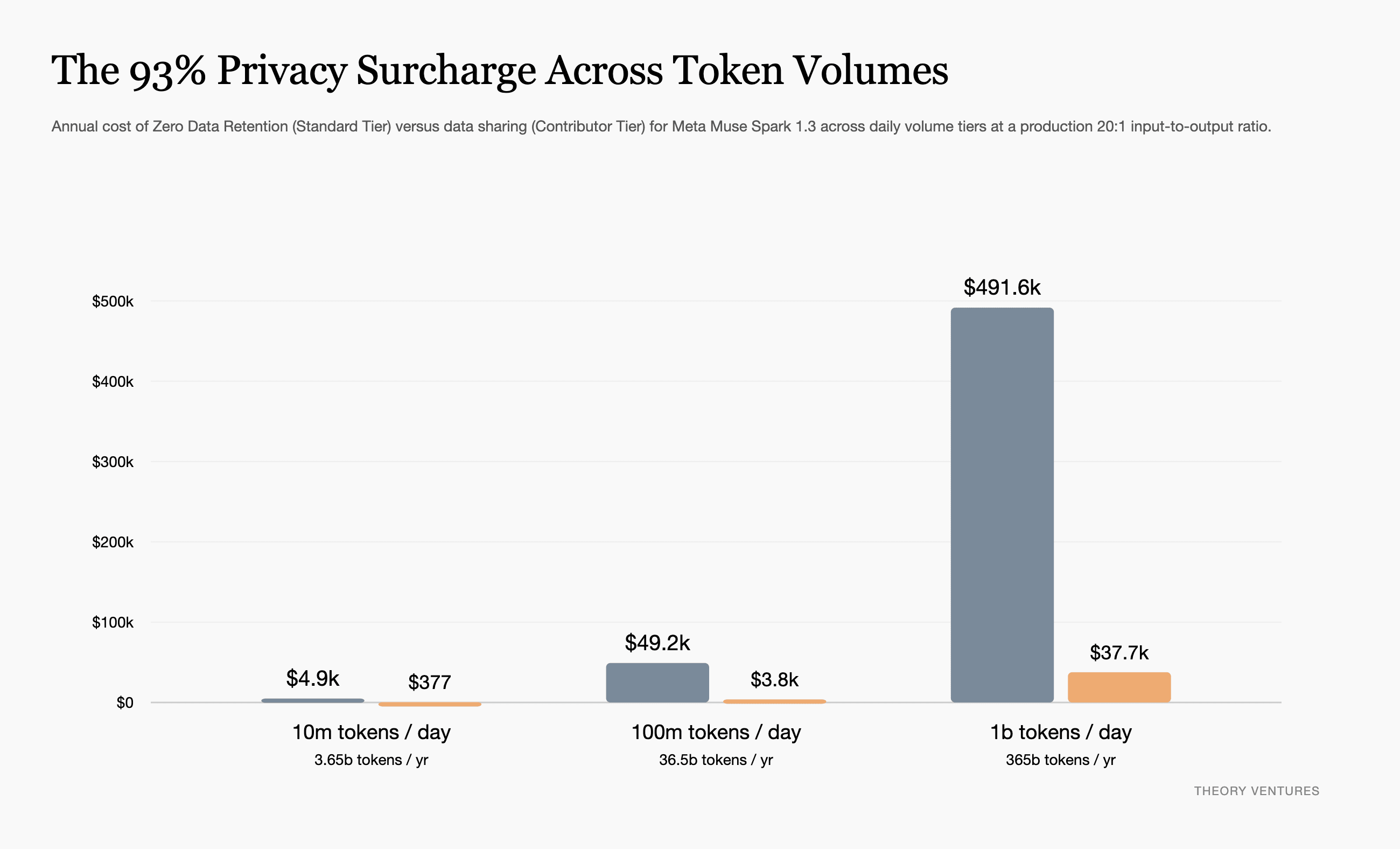
Meta's dual-tier AI pricing introduces an explicit barter : a 92% discount on inference in exchange for your data. Applying Michael Mauboussin's insight that prices contain information reveals the clearing price of prompt data : $1.24 per million tokens.
Devin Review: AI to Stop Slop | Cognition
As code generation gets easier, code review is the new bottleneck. That's why we're launching a new way to quickly review and understand complex PRs in our latest tool for codebase understanding - augmenting human attention with AI.

Why Things Like TypeSafe AI Don't Interest Me
A handful of people showed up in the comments asking 'have you tried TypeSafe?'. I use that as a hook to lay out my rule about new AI tools, actually investigate the case, and explain why I don't waste time optimizing token spend.
AI coding agents generate more code, but not more software
Study finds coding efficiency gains get "absorbed" by human review "bottleneck."

Perspective: AI demand is inflated, and only Anthropic is being realistic
The main usage metric for artificial intelligence, called tokens, looks explosive on paper, but it may be significantly overstated.

TasteVal: Measuring the Experimental Research Taste of AI Systems Against Human Experts
We introduce TasteVal, a benchmark to evaluate the experimental research taste of frontier models. We define research taste as the ability to pick interesting problems to solve, design experiments, and interpret experimental results. TasteVal measures the experimental component of research taste; given a fixed research problem, we measure how well a model iteratively designs experiments and draws conclusions from their outcomes. We operationalize experimental research taste as compute efficiency; a Researcher who reaches the same score as an expert human using half the serial experimental compute has twice the experimental taste. Experimental taste thus acts as a multiplier on experimental compute, making it a key input to forecasts of AI progress. TasteVal consists of 8 novel, challenging, open-ended tasks representative of frontier AI R&D. To isolate taste from coding ability, the model under evaluation acts as a Researcher that iteratively designs experiments while a fixed Coder agent implements them and reports their results. The Researcher executes until either the 40 H100 hour or 120 wall-clock hour budgets are exhausted. We recruit 24 human experts, at least 2 per task, and take the best expert attempt per task as the expert baseline. We evaluate 20 models released between 2023 and 2026. The best-performing model, Opus 5.5, exceeds our expert baseline, with a compute multiplier of 2.3x (95% CI 1.15-4.37), at roughly 1/30 of our baseliners' average per-run cost. On TasteVal, the compute multiplier of frontier models has doubled approximately every 3.0 months since December 2025 (95% CI 1.7-5.0), up from every 14 months between 2023 and December 2025. Measured by final normalized performance, frontier models show no trend break, doubling every 14.6 months. To keep TasteVal uncontaminated, we do not release the tasks.

AI costs how much? GitHub Copilot users react to new usage-based pricing system.
Some report burning through their whole monthly "AI credit" allotment in a single day.
tokens are getting more expensive
"language models will get cheaper by 10x" will not save ai subscriptions from the short squeeze
Using AI to click around on a website burns 45x as many tokens as just using APIs
For AI agents, seeing is expensive

Harvard researchers find AI coding agents shifted the bottleneck to code review
Harvard study: AI coding agents raised code output 30 percent; finished work did not measurably rise, and getting code through review took 49 percent longer.

Code execution with MCP: building more efficient AI agents
Learn how code execution with the Model Context Protocol enables agents to handle more tools while using fewer tokens, reducing context overhead by up to 98.7%.

The Economics of Using AI to Churn Out Code Are Looking Worse Than Ever
Anthropic updated an estimate for how much developers will spend on its AI coding tool, signaling that the tech is only going to get costlier.

Pricing - Intelligence Per Watt
Benchmarking Intelligence Efficiency of LM Inference