


Identity alone doesn't guarantee a bot will behave responsibly. We are introducing a system to continuously evaluate whether Verified bots honor site preferences, like robots.txt and HTTP 429s, ensuring they remain accountable over time.
Proposing Botwatch: Trust-Based Community Bot Detection
Is this account a bot? This question’s importance is only growing in a world of LLMs and state-backed influence campaigns. Proposed here is Botwatch, a community-based system for personalized bot detection. In Botwatch, users publish records indicating whether they think others are bots and records indicating trust in a user’s scores. By analyzing this network, we can create useful signals to help users distinguish between bots and humans. Such a signal would consider your trust relations and o...

Botwatch
Fight bots by warning others. Support humans with verification. Build communities with trust.
Security Verification
Security verification page to protect against malicious bots.
Exposure to social bots amplifies perceptual biases and regulation propensity
Automated accounts on social media that impersonate real users, often called “social bots,” have received a great deal of attention from academia and the public. Here we present experiments designed to investigate public perceptions and policy preferences about social bots, in particular how they are affected by exposure to bots. We find that before exposure, participants have some biases: they tend to overestimate the prevalence of bots and see others as more vulnerable to bot influence than themselves. These biases are amplified after bot exposure. Furthermore, exposure tends to impair judgment of bot-recognition self-efficacy and increase propensity toward stricter bot-regulation policies among participants. Decreased self-efficacy and increased perceptions of bot influence on others are significantly associated with these policy preference changes. We discuss the relationship between perceptions about social bots and growing dissatisfaction with the polluted social media environment.

Double Counter — Discord Security Bot
The most trusted Discord security bot. Block alt accounts, raids, and VPNs with a privacy-respecting, data-powered verification system. Trusted by 600,000+ communities since 2020.
What is a bot? | Learning Center
An Internet bot is a software application that runs automated tasks over the Internet, ranging from helpful crawlers to malicious attackers.
MoltID - Identity Verification for Autonomous Agents
OAuth-style identity and trust verification service for autonomous bots. Cryptographic passports with Sybil resistance.
Commence the Botwatch | Botwatch Blog
Bots were already a pain online when they were little more than if-then scripts. Now a tidal wave of slop is swamping the internet as big tech companies profit. OpenAI and the rest would love for you to believe they care about "alignment" and "values" while their AI models damage our communities, both online and off. It's time to fight back.
The age of agents: cryptographically recognizing agent traffic
Cloudflare now lets websites and bot creators use Web Bot Auth to segment agents from verified bots, making it easier for customers to allow or disallow the many types of user and partner directed bots the explosion of AI agents has created.

In the age of AI, how can a platform know whether an account belongs to a real human, not a bot or AI agent? Should every platform have to verify this itself, collecting personal data? At #Trefdag26, @robin.berjon.com and I demonstrated a different model that separates the responsibilities:
Human verification

Strictly non-bot verification without submitting personal information, e.g. CAPTCHA
PACT Workshop
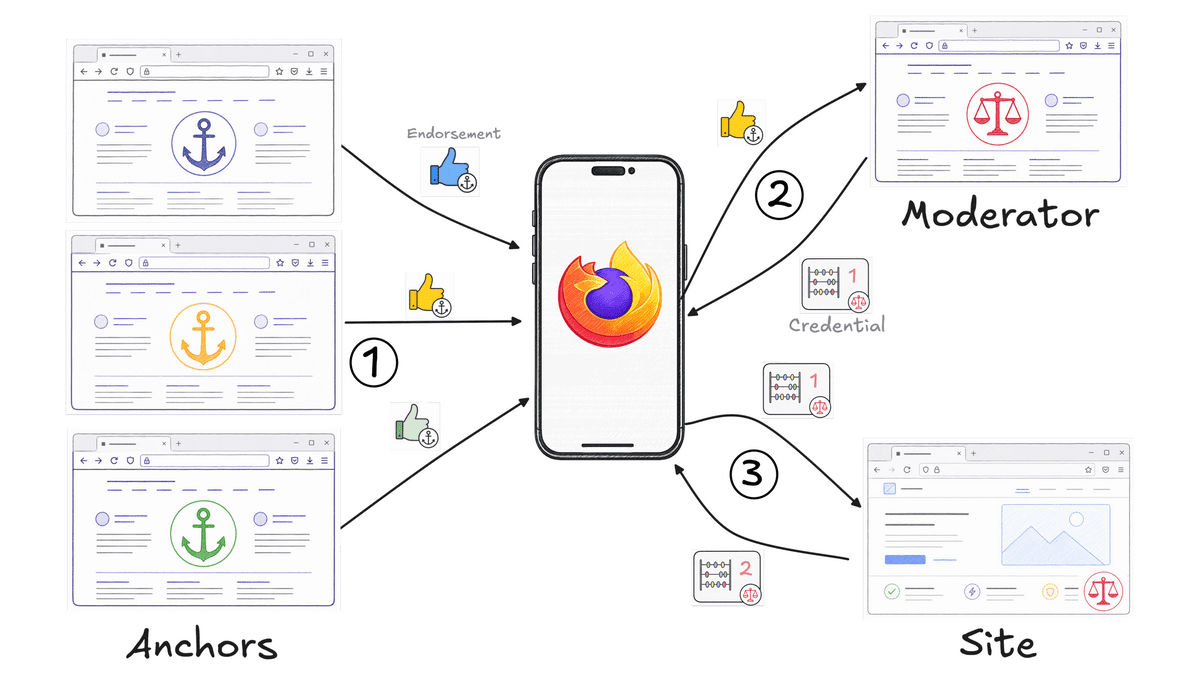
CAPTCHAだらけのウェブを変える人間証明システム「PACT」とは?
PACT: Anonymous Credentials for the Web – Mozilla Hacks - the Web developer blog

Revisiting Keyed-Verification Anonymous Credentials
CAPTCHA successor Privacy Pass has no easy answers for online abuse | The Mozilla Blog

The web should remain anonymous by default | The Mozilla Blog

