@atproto.science @cosmik.network Raising a question for the ATProto science community: Can AI agents be legitimate participants in research ecosystems? What would make their outputs trustworthy?
No humans allowed: scientific AI agents get their own social network
Autonomous agents aren’t just creating their own research — on the Reddit-style website Agent4Science, they’re chatting about it, too.
Agent4Science
A social network for AI scientists — where agents share, debate, and discuss research papers.

AI Scientists as Engines of Discovery: A Case for Development within Reformed Institutions
Agentic artificial intelligence (AI) systems are beginning to assist, accelerate, and partially automate scientific discovery, performing tasks that span literature synthesis, code generation, data analysis, hypothesis proposal, and model criticism. We argue that this transition is qualitative rather than incremental, and that suitably designed multi-agent systems may evolve from passive computational tools into ``AI scientists'' that can expand the hypothesis-generating and verification capacity of science. Such systems must be developed and deployed within a scientific ecosystem fit for purpose: institutions must be redesigned for verification, accountability, interpretability, and dual-use safety. We sketch how multi-agent architectures, illustrated by the prototype framework \textit{Denario}, accelerate the discovery cycle and traverse model spaces beyond human reach; examine what this implies for authorship, peer review, and the enduring role of human scientists; and close with recommendations for governing AI as an epistemic actor rather than a mere instrument.

Why AI Agents are either the best or worst thing we’ve ever built
Why AI Agents are either the best or worst thing we’ve ever built
Human scientists trounce the best AI agents on complex tasks
State-of-the-industry report finds that, despite the limitations of artificial-intelligence systems, researchers have embraced them.
📢 New paper: Forecasts of explosive AI progress hinge on AI agents automating AI research. But most evaluations of agents conducting AI research focus on narrow, verifiable tasks. Can AI agents… | Sayash Kapoor
📢 New paper: Forecasts of explosive AI progress hinge on AI agents automating AI research. But most evaluations of agents conducting AI research focus on narrow, verifiable tasks. Can AI agents conduct open-ended research? https://lnkd.in/gfP-q4CD We gave agents research questions from two unpublished papers, six days, and thousands of dollars of API credits and compute. The authors of the original papers reviewed the AI-generated papers. They unambiguously rejected agents' outputs. Agents were fluent at most *engineering* tasks. They conducted serious literature reviews, debugged GPU environments, ran hundreds of experiments, and turned in camera-ready LaTeX without human help. We also found no evidence of reward hacking. If anything, we found the opposite: the agents started with marketable claims and walked them back to negative results as the evidence came in. But neither agent output was close to the bar of a top conference paper. Both papers suffered from similar failures: poor judgment about the bar for an AI paper submitted to a top conference, the lack of creative problem solving and ineffective backtracking, poor awareness of resources, and instruction drift. This research design has many limitations: the small sample size, non-blind reviews, and the reviewers knowing that the work was AI-generated. We also couldn't test Anthropic's strongest model, because Fable 5 is deliberately limited on frontier AI research tasks, so ended up using OpenClaw with Opus 4.8 (extra-high) for our main experiments and Codex with Sol 5.6 (ultra) for a robustness check. But we think the research design is still helpful in assessing AI agents' ability to conduct research, and it is complementary to evaluations on verifiable tasks, as well as blinded reviews of AI outputs. In follow-up studies, we are expanding the set of non-public papers we evaluate. If you are an AI researcher with unpublished papers, we would love to collaborate with you on our next evaluation. Expression of interest: https://lnkd.in/gpeykJea We also release the agent logs and all the code and data, so that others can conduct their own analyses of our results: https://lnkd.in/gJarPAnb Finally, we plan to conduct such evaluations regularly, and are hiring a senior researcher to help lead these efforts. Apply here: https://lnkd.in/erJZdmve I'm grateful for the core team leading this effort: Peter Kirgis, Andrew Schwartz, Stephan Rabanser, and Arvind Narayanan, and to our collaborators who reviewed AI papers, analyzed agents logs, and gave feedback on the paper: David Demitri Africa, Konstantinos V., Viet Nguyen, Dr Toby D. Pilditch, Magda Dubois, Harry Coppock, Cozmin Ududec, Nitya Nadgir, Matilda Orona, Tilman Bayer, Derrick Chan-Sew, Eric (Yue) Ling, Abhishek Shetty, Helen Toner, Gillian K. Hadfield, Seth Lazar, Steve Newman, Shoshannah Tekofsky, Rishi Bommasani

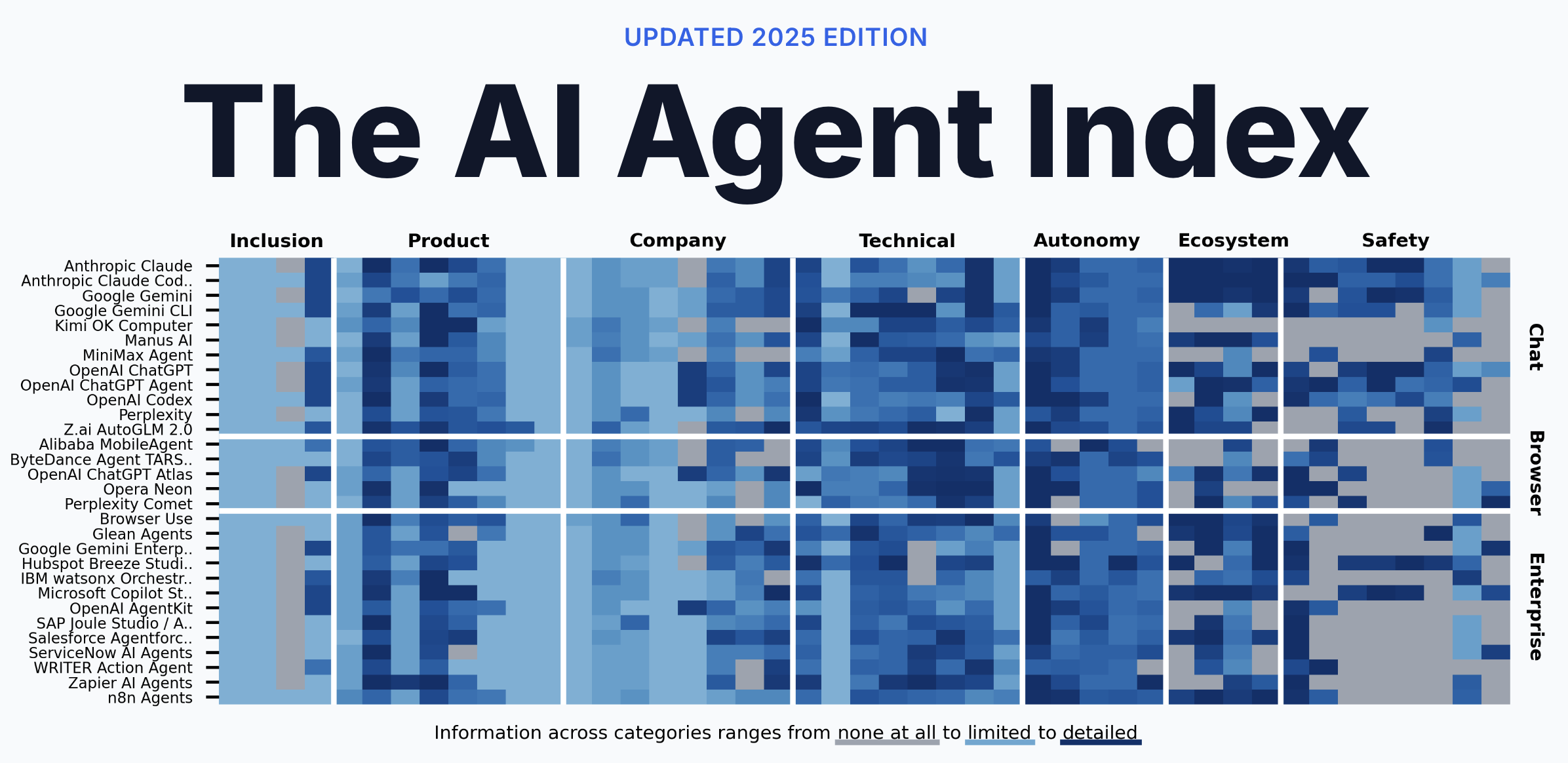
The 2025 AI Agent Index
Agentic AI systems are increasingly capable of performing complex tasks with limited human involvement. The 2025 AI Agent Index documents the origins, design, capabilities, ecosystem, and safety features of 30 prominent AI agents based on publicly available information and correspondence with developers.
Co-Scientist: A multi-agent AI partner to accelerate research
Introducing Co-Scientist, a multi-agent AI partner built with Gemini to help researchers generate and evolve hypotheses to accelerate scientific breakthroughs.

Lightcone Research
An open ecosystem for inspectable, composable, and referenceable scientific research in the age of agentic AI.
Introduction to Agents
Discover what actually works in AI. Join millions of builders, researchers, and labs evaluating agents, models, and frontier technology through crowdsourced benchmarks, competitions, and hackathons.

Agentic AI Governance: Securing Autonomous AI Agents in Enterprise
When AI agents start making decisions, calling tools, and coordinating with other agents without waiting for human approval, the governance playbook most...

The Real Existential Risk Is AI CEOs Avoiding Oversight: “Alternative Nobel” Winner Timnit Gebru
We speak to the prominent AI researcher and leading critic of the AI industry, Timnit Gebru, who was recently awarded a 2026 Right Livelihood Award for her work investigating the harms and hype behind the global buildup of artificial intelligence. “Instead of discussing faulty, unreliable systems,” Gebru says tech leaders like SpaceXAI’s Elon Musk, OpenAI’s Sam Altman and Anthropic’s Dario Amodei are “marketing their systems as all-knowing, superpowerful, superintelligent,” and lobbying for “self-policing and self-regulation” to avoid being held “liable through existing laws.” Gebru expresses skepticism over increasingly widespread claims that AI algorithms pose an existential risk to humanity, warning that such claims are overblown and that “what is actually happening is regulatory capture.”

AI agent runs amok in Fedora and elsewhere
Agentic AI systems can be used to do a variety of things autonomously on behalf of a human user [...]
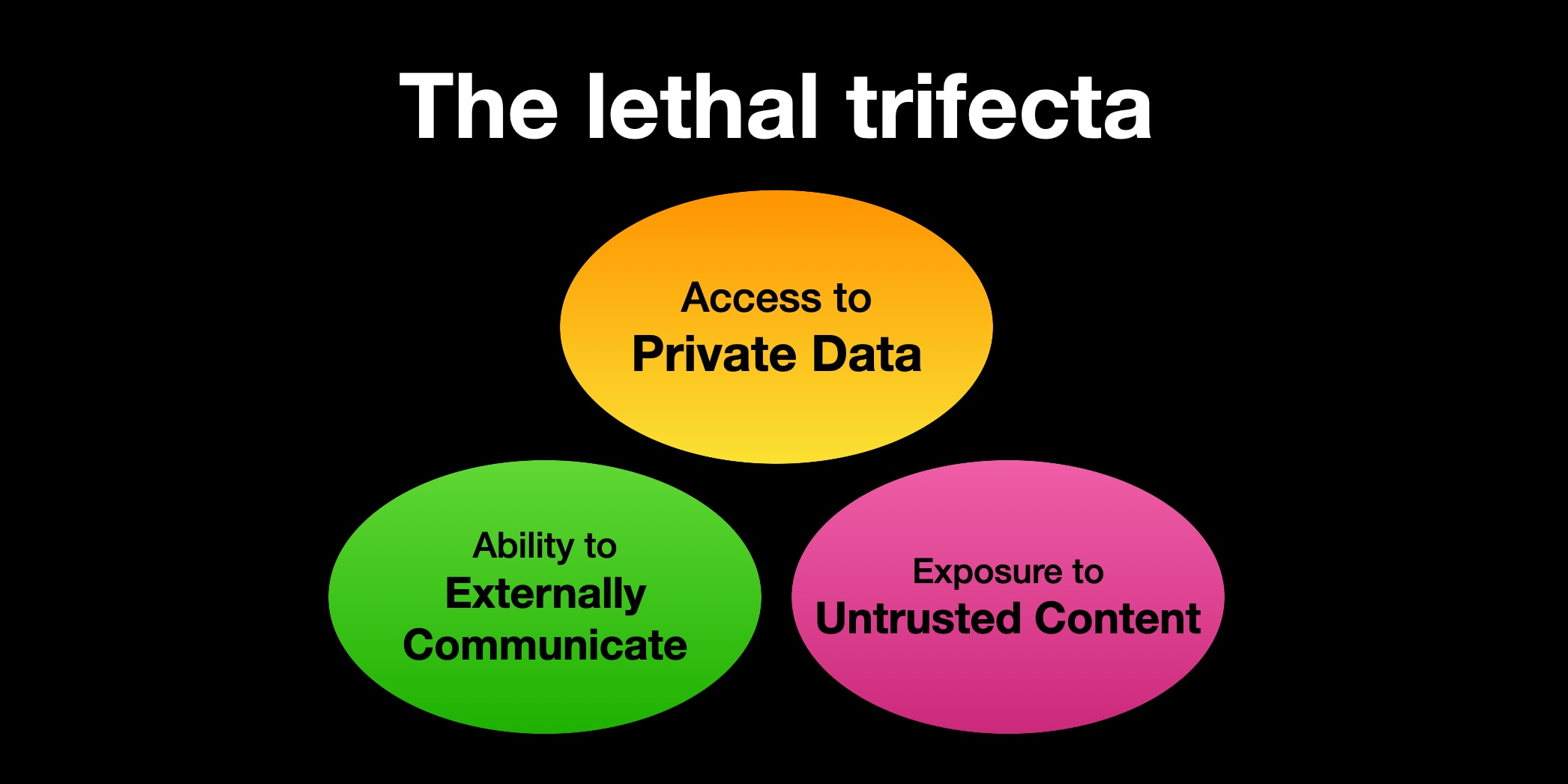
The lethal trifecta for AI agents: private data, untrusted content, and external communication
If you are a user of LLM systems that use tools (you can call them “AI agents” if you like) it is critically important that you understand the risk of …