


This is the first of two posts about a renderer I have been developing, focusing on what I've built and how it works. The second post discusses why I've built it and my plans for the future. I've been developing a custom real-time renderer which uses very small voxels to produce a distinctive visual style that modernizes the look and feel of classic 90's 3D games. By approaching the problem of rendering voxels in an unusual way, I'm able to produce these visuals from conventional art assets — low-poly triangle meshes and textures — that are familiar and efficient to create. [...]
PixelGuys/Cubyz
Voxel sandbox game with a large render distance, procedurally generated content and some cool graphical effects.
Massively Parallel Rendering of Complex Closed-Form Implicit Surfaces
Figure 1: An assortment of implicit surfaces rendered using our technique. Left: an extruded text string, rotated and rendered as a heightmap. Center: a bear head sculpted using smooth blending operations, with normals found by automatic differentiation. Right: a complex architectural model rendered with screen-space ambient occlusion and perspective. All models are rendered directly from their mathematical representations, without triangulation or raytracing.
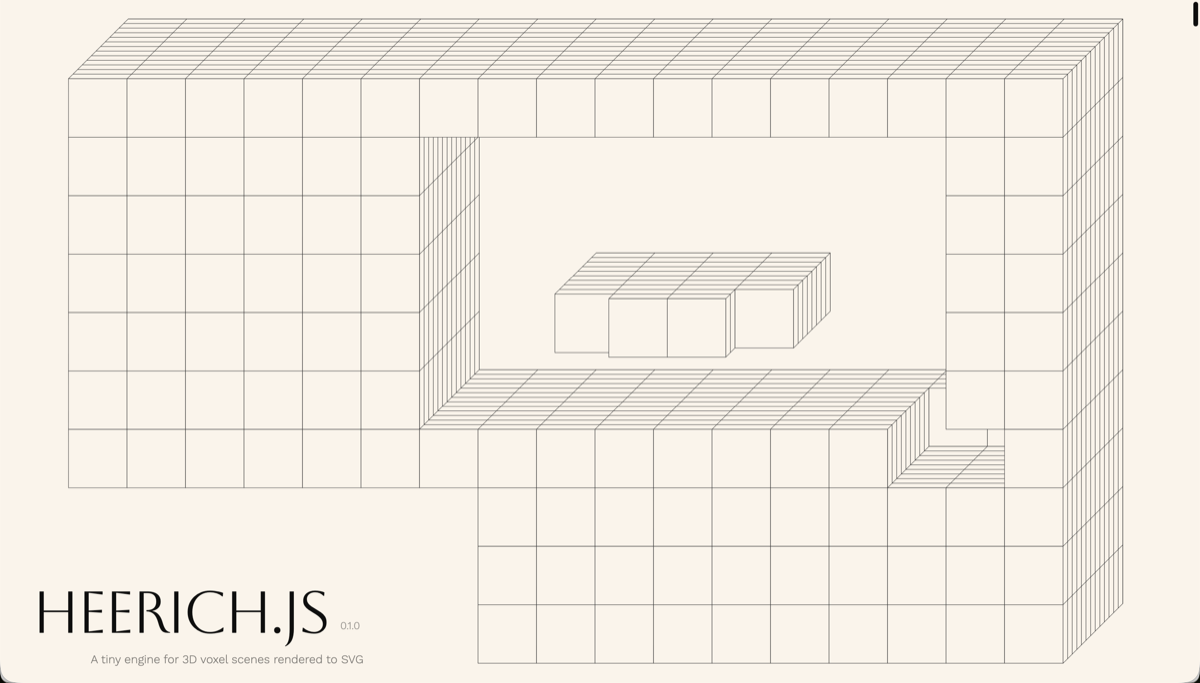
heerich.js
Tiny engine for 3D voxel scenes rendered to SVG — boolean ops, oblique/perspective cameras, zero dependencies.
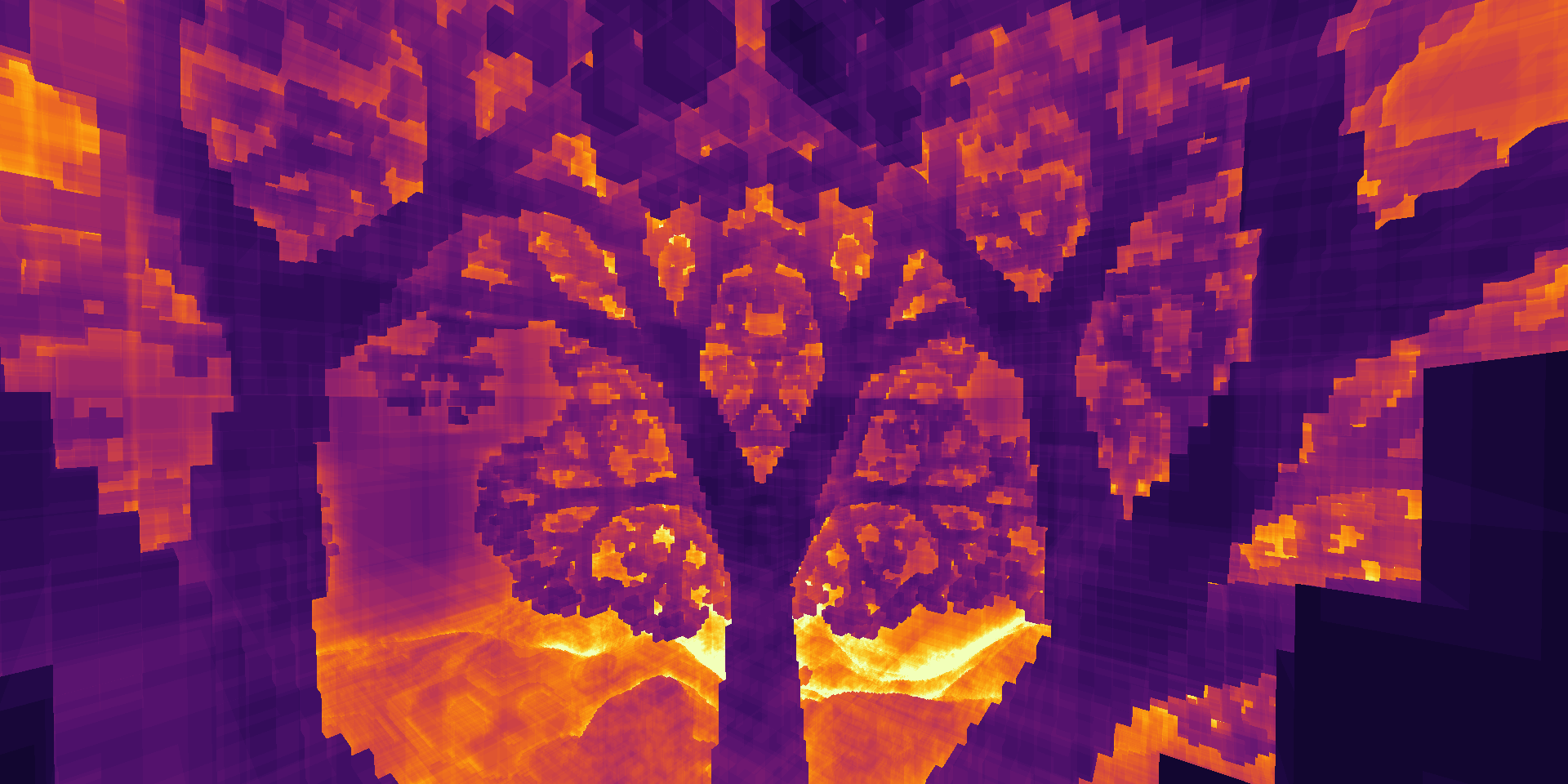
A guide to fast voxel ray tracing using sparse 64-trees
If you have ever tried to ray trace voxels before, you might have heard about Sparse Voxel Octrees. They are one of those ideas that are just simple and clever enough to be intriguing, but not so great to hold in practice at the basic premise.
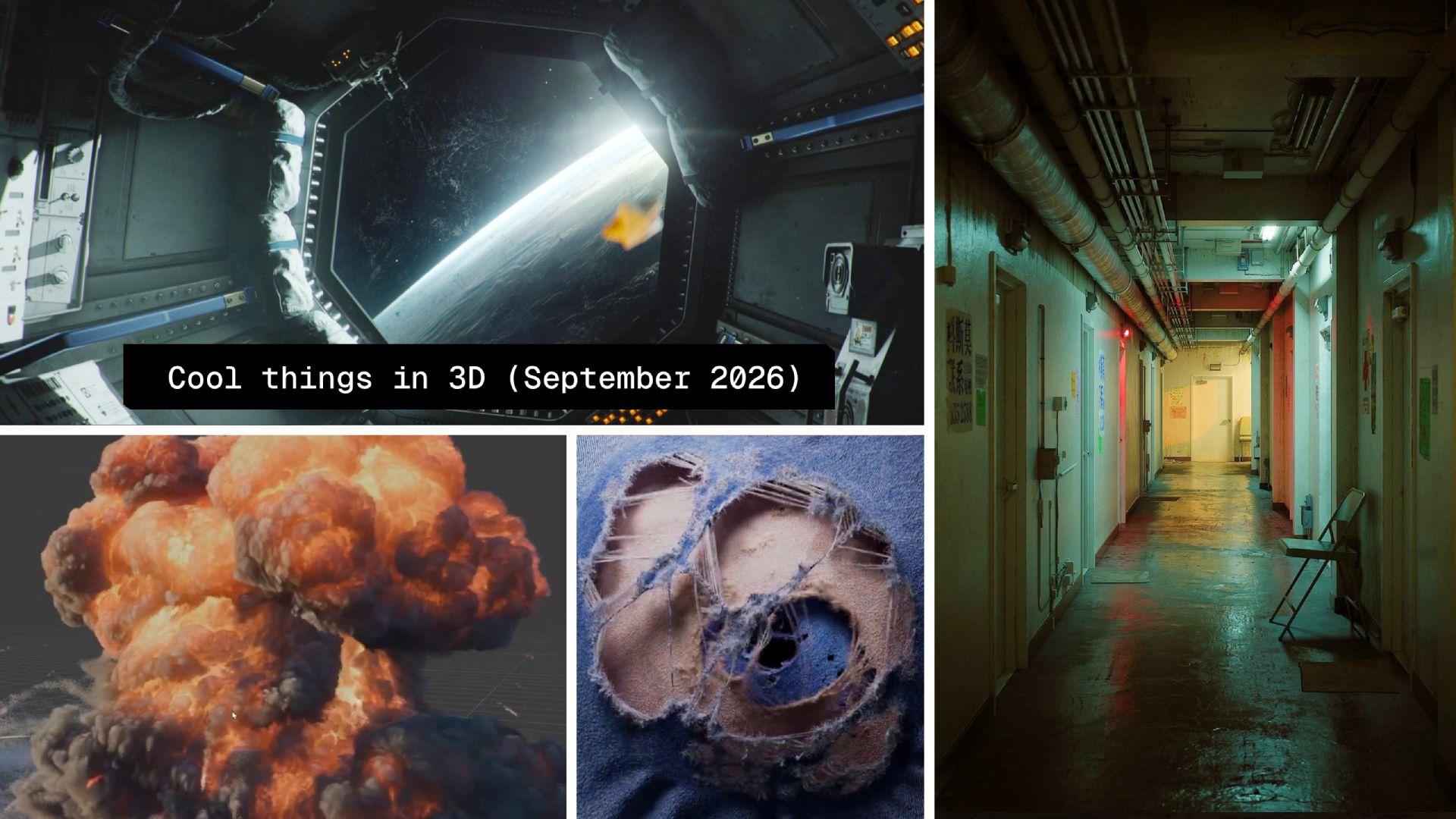
Cool Things in 3D (September 2026) • Creative Shrimp
Here’s a look at some of the coolest things happening in 3D this month - from Gaussian splats in Blender 5.3 and panoramic cameras in EEVEE to dispersion in Cycles, the most realistic Blender short film, and the GPUs the Blender community is actually using.
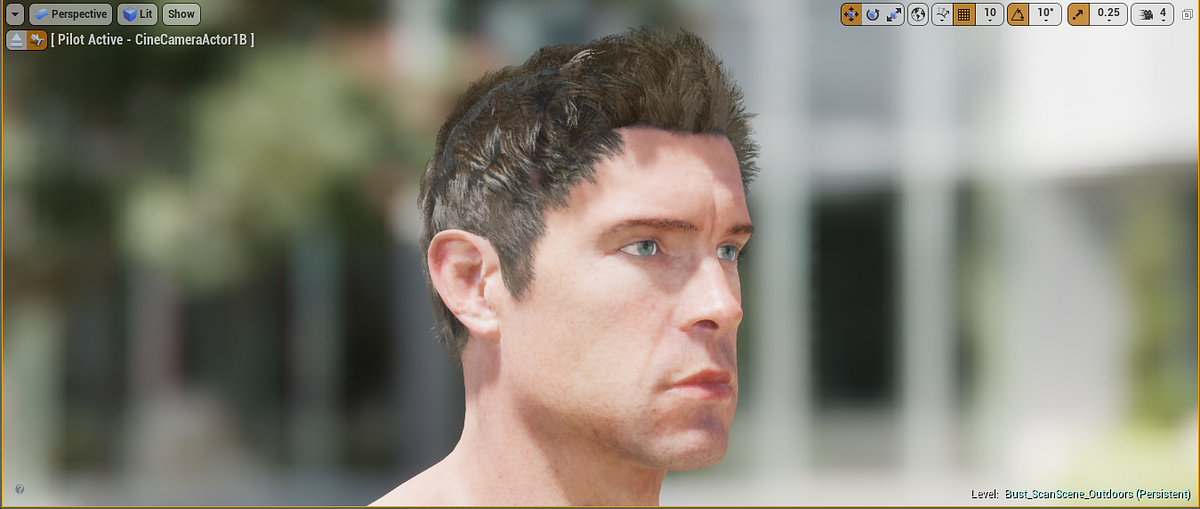
Uniform | Sparseal
General purpose 3D editor with sculpting, modeling, texturing, and rendering capabilities.


Tomb of Glowing Lava - How to Model Ultra Realistic Lava
Pixal3D: Pixel-Aligned 3D Generation from Images
Recent advances in 3D generative models have rapidly improved image-to-3D synthesis quality, enabling higher-resolution geometry and more realistic appearance. Yet fidelity, which measures pixel-level faithfulness of the generated 3D asset to the input image, still remains a central bottleneck. We argue this stems from an implicit 2D-3D correspondence issue: most 3D-native generators synthesize shape in canonical space and inject image cues via attention, leaving pixel-to-3D associations ambiguous. To tackle this issue, we draw inspiration from 3D reconstruction and propose Pixal3D, a pixel-aligned 3D generation paradigm for high-fidelity 3D asset creation from images. Instead of generating in a canonical pose, Pixal3D directly generates 3D in a pixel-aligned way, consistent with the input view. To enable this, we introduce a pixel back-projection conditioning scheme that explicitly lifts multi-scale image features into a 3D feature volume, establishing direct pixel-to-3D correspondence without ambiguity. We show that Pixal3D is not only scalable and capable of producing high-quality 3D assets, but also substantially improves fidelity, approaching the fidelity level of reconstruction. Furthermore, Pixal3D naturally extends to multi-view generation by aggregating back-projected feature volumes across views. Finally, we show pixel-aligned generation benefits scene synthesis, and present a modular pipeline that produces high-fidelity, object-separated 3D scenes from images. Pixal3D for the first time demonstrates 3D-native pixel-aligned generation at scale, and provides a new inspiring way towards high-fidelity 3D generation of object or scene from single or multi-view images. Project page: https://ldyang694.github.io/projects/pixal3d/

Evaluating and Sampling Glinty NDFs in Constant Time
Geometric features between the micro and macro scales produce an expressive family of visual effects grouped under the term 'glints'. Efficiently rendering these effects amounts to finding the highlights caused by the geometry under each pixel. To allow for fast rendering, we represent our faceted geometry as a 4D point process on an implicit multiscale grid, designed to efficiently find the facets most likely to cause a highlight. The facets' normals are generated to match a given micro-facet normal distribution such as Trowbridge-Reitz (GGX) or Beckmann, to which our model converges under increasing surface area. Our method is simple to implement, memory-and-precomputation-free, allows for importance sampling and covers a wide range of different appearances such as anisotropic as well as individually colored particles. We provide a base implementation as a standalone fragment shader.
Gallery | PolyCSS
Explore PolyCSS-rendered OBJ, glTF, GLB, VOX, textured, animated, and generated mesh examples in the DOM.

Polygon memories
Vox sold Polygon on Thursday, which means I’m looking for work. I spent a little over 13 years there, which — on top of almost 10 at 1UP and another…

Adventures in Neural Rendering
In recent years, neural networks have started to find their way into many areas of rendering. While antialiasing and upscaling are probably the most well‑known uses, they’re far from the only ones—…
