

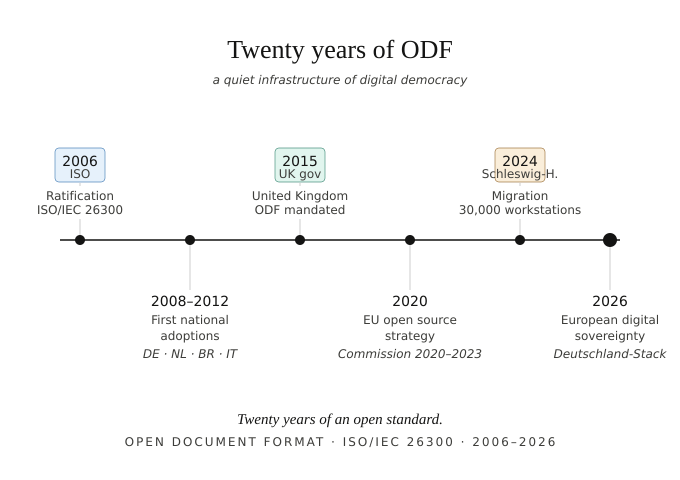
Dear office suite users, In recent days you will have read various articles announcing the arrival of Euro-Office, which is being “marketed” as the first open-source office suite developed in Europe. We feel compelled — reluctantly, since open source should rest on transparency, not deception — to correct this claim. The first open-source office suite developed in Europe was OpenOffice.org in 2001, based on StarOffice’s source code, followed by LibreOffice from 2010. These are two genuine open-source office suites, built from source code that originated in Europe. They are not a freeware clone of MS Office whose code provenance is undisclosed, nor a product that has rebranded itself out of pure opportunism to ride today’s wave of Digital Sovereignty. It is worth remembering that many of those who champion Digital Sovereignty today were silent back in 2006, when the open ISO/IEC ODF standard — the pillar of Digital Sovereignty — was announced: not only did they not listen to us during all these years, but in some cases they greeted us with a condescending smile. If we can speak of Digital Sovereignty in Europe today, it is thanks to The Document Foundation and LibreOffice community members at large, who kept
Euro-Office, Europe's open-source alternative to Microsoft Office and Google Docs, launches June 9
European tech firms will ship the first stable release of Euro-Office next month, giving governments and businesses worldwide a ready-to-run, sovereign alternative to Microsoft Office and Google Docs.

The Rise of Open Source Software in Europe
We are seeing a significant change in the global business landscape, and attention within technology circles has focused on verticals where adoption levels have been surging over the past few months, in areas such as e-commerce, logistics, digital payments, telehealth, or tools enabling remote worki

Open source is the electric vehicle of digital policy
Open source is very popular these days, not least due to the open-source strategy that the European Commission announced last week as part of the tech sovereignty package. While there is a lot to criticise about that strategy (exaggerated goals, misleading numbers etc), the one thing I would like to

EU Open Source Strategy | Shaping Europe’s digital future
The EU Open Source Strategy is a cornerstone of the Tech Sovereignty package, supporting open source ecosystems across the EU - encouraging the development and uptake of European alternatives.
Funding Open Source for Digital Sovereignty
"Open Source alone won't deliver digital sovereignty. Europe must fix procurement and fund those who actually build it."

Elena Rossini 🌈 (@_elena@mastodon.social)
#WSocial will open up their beta program today… and I have a SCOOP for you: it appears that they have quietly gone closed-source! This is ironic, considering that the @EUCommission@ec.social-network.europa.eu just unveiled their Tech Sovereignty Package, emphasizing the importance of #OpenSource. And yet they have migrated their main ATproto accounts to W Social - whose code can no longer be inspected! My full article - with a great analysis by @aral@mastodon.ar.al: 🔗: https://blog.elenarossini.com/w-social-public-institutions-and-the-theater-of-european-digital-sovereignty/ #FOSS #DigitalSovereignty #BigTech
Bulgarian Government Now Requires Custom Software to be Open Source
The Bulgarian government has just passed an amendment to its Electronic Governance Act that mandates all custom software created for the government must be open source. The amendment was voted on i…
Funding Open Source for Digital Sovereignty
Open Source alone won't deliver digital sovereignty. Europe must fix procurement and fund those who actually build it.

FR#166 – No Change
Many people in Europe see the open social web as a path to digital sovereignty. This week demonstrated a problem: the assumption that European governments actually want to be sovereign.

European Commission issues call for evidence on open source
The European Commission has opened a 'call for evidence' to help shape its European Open Digita [...]
Please Help Keep our Language Precise: Single-Vendor Open Source is Neo-Proprietary Source, not Closed Source
When the Open Source Initiative defined open source, it focused only on the license, and ignored the process. Smart entrepreneurs quickly discovered that they could provide to the world their produ…

How open-source software took over the world | TechCrunch
It was just five years ago that there was an ample dose of skepticism from investors about the viability of open source as a business model. Fast-forward to today and we’ve witnessed the growing excitement in the space.
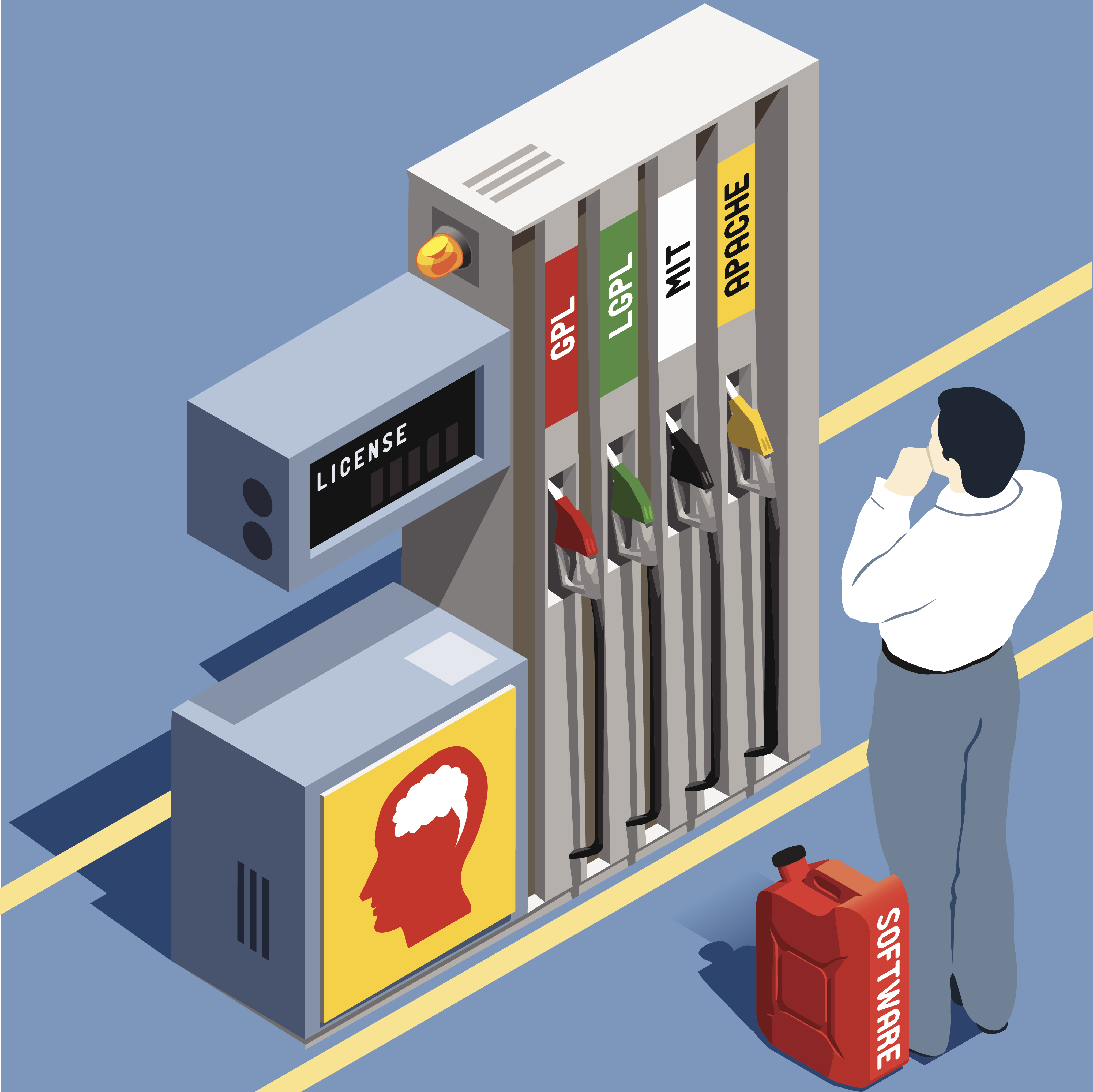
Open Source is Not Enough
by James Halliday // The open source movement has fundamentally changed how software gets written. But in the process, corporations have been given a vast gift of free labor.
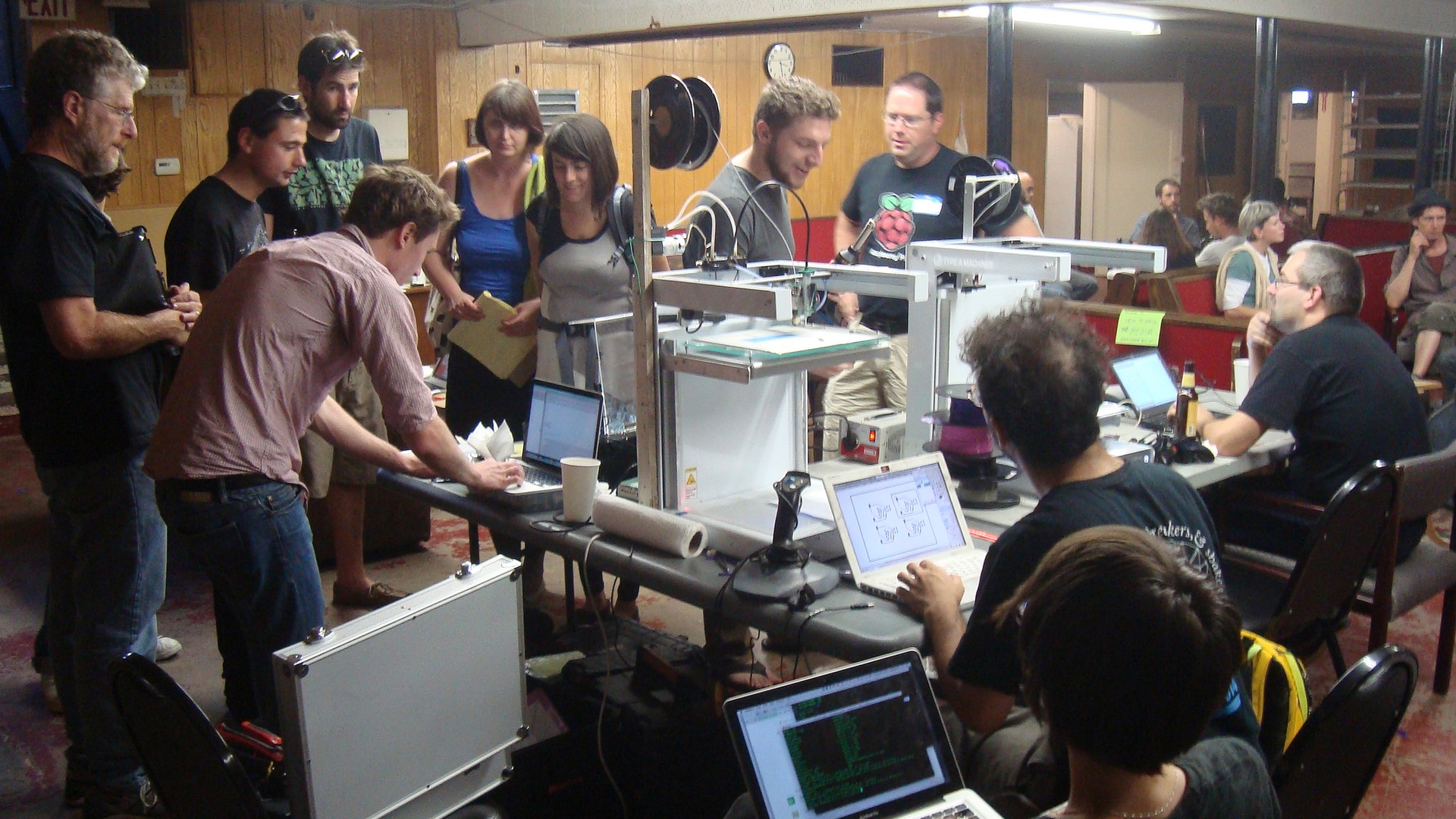
The Politics of Open Infrastructures: Power, Governance, and Justice in Digital Knowledge Practices
This volume examines how openness is designed, governed, contested and lived in contemporary digital knowledge infrastructures. From open source software and internet standards, to citizen science platforms, public sector data systems and alternative computing practices, the book shows that infrastructures are never neutral technical backbones.

A brief 🧵 for all outside the #atproto bubble on why, from a digital industrial policy perspective, this step is deeply bewildering. There's @eurosky.social – open source, non-profit, fully aligned with the EU's open source strategy. It provides all that W has, & more. And yet, the Commission...

European Commission
We have now joined W, a new European social media network. We’re present on 15+ platforms, and are especially happy to join one based in Europe and with the ambition to foster open and safer online conversations. Keep the conversation going - whether from W, Bluesky or other compatible apps.
