

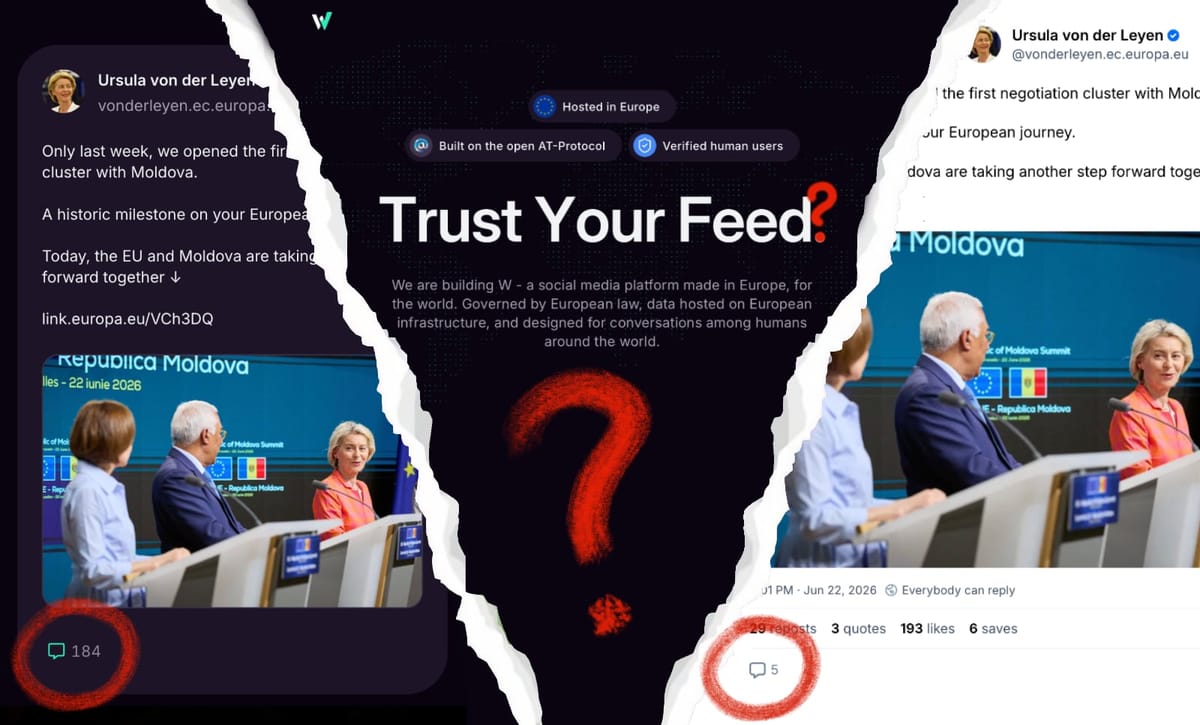
W Social's tagline is "Trust Your Feed" but the company's landing page displays inflated engagement metrics - a misrepresentation that contradicts its own promise.
Elena Rossini 🌈 (@_elena@mastodon.social)
SCOOP: #WSocial is doctoring metrics on its homepage, inflating the number of comments on posts by prominent people on its network. I suppose a more accurate tagline for them should be "Trust your feed?" My article about it: "W Social, Fictional Metrics and the Beauty of Open Data" 🔗 : https://blog.elenarossini.com/w-social-fictional-metrics-and-the-beauty-of-open-data/ #blog #BigTech #EUBigTech #TEP #TrustedEuropeanPlatforms #TrustYourFeed
W — Trust your feed
We believe in the need for a global, trusted social media platform owned, run, and hosted in Europe. W is built on verified human users, transparency, privacy, and free speech.
W — Trust your feed
We believe in the need for a global, trusted social media platform owned, run, and hosted in Europe. W is built on verified human users, transparency, privacy, and free speech.
W — Trust your feed
We believe in the need for a global, trusted social media platform owned, run, and hosted in Europe. W is built on verified human users, transparency, privacy, and free speech.
W — Trust your feed
We believe in the need for a global, trusted social media platform owned, run, and hosted in Europe. W is built on verified human users, transparency, privacy, and free speech.
W — Trust your feed
We believe in the need for a global, trusted social media platform owned, run, and hosted in Europe. W is built on verified human users, transparency, privacy, and free speech.
W — Trust your feed
We believe in the need for a global, trusted social media platform owned, run, and hosted in Europe. W is built on verified human users, transparency, privacy, and free speech.
W Don't Have Time (@wdonthavetime.selfhosted.social)
"Trust community, not wealth" Holding power accountable on the open social web. https://woosh.link/wdonthavetime.selfhosted.social

W Don't Have Time | Offprint
"Trust community, not wealth" Holding power accountable on the open social web.

Elena Rossini 🌈 (@_elena@mastodon.social)
Attached: 1 image 🚨 Important update about my latest #WSocial article 👀 A user on #ATproto cracked the code and came up with a reasonable explanation for the made up number of comments on W Social's homepage. The number next to the speech bubble (comment icon) are an "engagement metric": the sum of boosts and likes. It all makes sense now! https://blog.elenarossini.com/w-social-fictional-metrics-and-the-beauty-of-open-data/ (scroll down to the end of the article for the update)
W Social: Hello World!
Hello World! 🙂 This category is for discussing W Social, a new member on the AT-protocol federation. Launched in conjunction with the World Economic Forum in Davos on January 19, 2026, the project has sparked a lot of praise, interest, rumors and slander. In fact, our social media monitoring console registered 1 billion post views (across all the main social media) for posts mentioning #wsocial within the first week. As I write this, W Social is not yet open for business. There i...
Value misalignment in X’s feed algorithm is a reflection of value tensions in engagement
Social media feed algorithms rank content that is purported to be preferred by users, but the engagement behaviors that drive these algorithms are (at best) indirect proxies for users’ explicitly self-stated values. Are the resulting feeds value aligned, and if not, why? We investigate this question by annotating the basic human values expressed in participants’ X (Twitter) feeds (N = 715 US users), analyzing the relationship between the posts’ value expressions and the posts’ amplification in the ranked “For You” Page feed, and then comparing the amplified values to users’ own values. We observe that the inventory of posts from followed accounts reflects users’ self-stated values—but that there is an overall negative correlation (misalignment) between users’ explicit values and the value expressions the algorithm is more likely to amplify. We turn to engagement behavior to understand this misalignment and observe that users’ engagement behaviors can be misaligned with their stated values—likely causing the algorithm to learn and reflect these misaligned values. We also detect partisan differences consistent with this theory: While the algorithm amplifies values negatively correlated with both Democrats’ and Republicans’ self-stated values, they are more misaligned for Democrats. And in fact replying, a heavily weighted form of engagement, is associated with values that are less aligned for both Democrats’ and Republicans’ self-stated values, and is even more misaligned for Democrats. Taken together, these findings offer a glimpse into the tensions between the values that people hold and those that provoke reactions, and how these value tensions can produce misaligned outcomes.

Value misalignment in X’s feed algorithm is a reflection of value tensions in engagement
Social media feed algorithms rank content that is purported to be preferred by users, but the engagement behaviors that drive these algorithms are (at best) indirect proxies for users’ explicitly self-stated values. Are the resulting feeds value aligned, and if not, why? We investigate this question by annotating the basic human values expressed in participants’ X (Twitter) feeds (N = 715 US users), analyzing the relationship between the posts’ value expressions and the posts’ amplification in the ranked “For You” Page feed, and then comparing the amplified values to users’ own values. We observe that the inventory of posts from followed accounts reflects users’ self-stated values—but that there is an overall negative correlation (misalignment) between users’ explicit values and the value expressions the algorithm is more likely to amplify. We turn to engagement behavior to understand this misalignment and observe that users’ engagement behaviors can be misaligned with their stated values—likely causing the algorithm to learn and reflect these misaligned values. We also detect partisan differences consistent with this theory: While the algorithm amplifies values negatively correlated with both Democrats’ and Republicans’ self-stated values, they are more misaligned for Democrats. And in fact replying, a heavily weighted form of engagement, is associated with values that are less aligned for both Democrats’ and Republicans’ self-stated values, and is even more misaligned for Democrats. Taken together, these findings offer a glimpse into the tensions between the values that people hold and those that provoke reactions, and how these value tensions can produce misaligned outcomes.
Public by Design: How W Social Makes Their Verified Users’ Personal Details Visible on the Open Web
A blog post explaining how the social network W Social is publishing as a record on the open social web the full names, nationalities and approximate birthdays of their verified users - who may be unaware this information is available for all to see, outside of the social network.
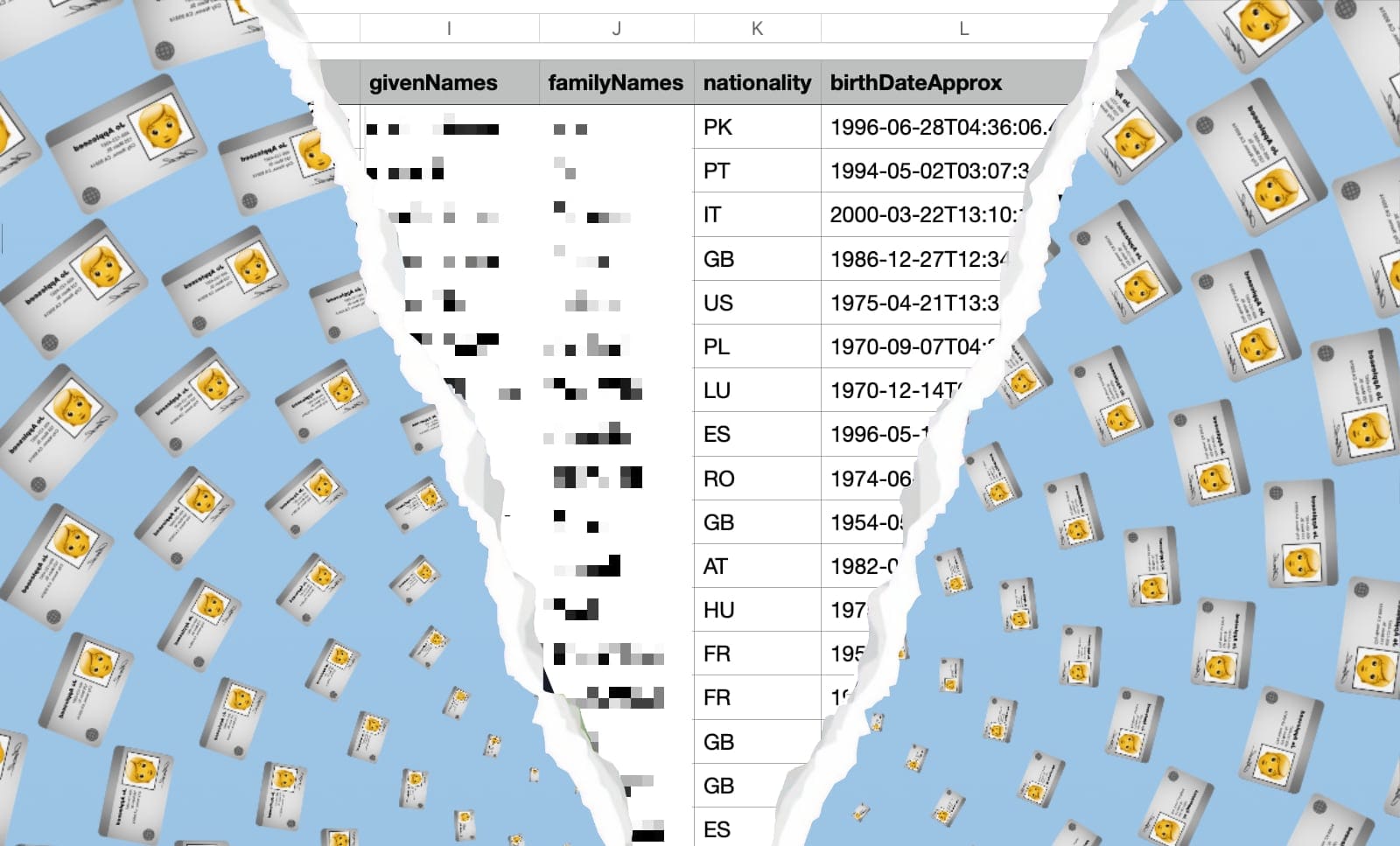
Have you been Wned? W Social says it respects your #privacy. But how much of your personally identifiable information is published by them to the open web for anyone to find? wdonthavetime.tngl.io/wsocial-wned/ #WSocialFacts #WSocial

Have you been Wned: Has W Social made your personal information public?
wdonthavetime.tngl.ioLATEST: on #WSocial's website, comment counts for posts by prominent users are incorrectly displayed, showing artificially elevated numbers. @opfuchs.gay came up with an interesting theory for it. "W Social, Fictional Metrics and the Beauty of Open Data": blog.elenarossini.com/w-social-fictional-metrics-an…

W Social, Fictional Metrics and the Beauty of Open Data
blog.elenarossini.com
