

Something that always annoyed me of the current state of technology is how easy and pervasive we let tracking become. Tens of connections to 3rd parties carrying Referer and Cookies just to load an article. (We give up our users to social media websites just to show a like button that looks worse anyway in a iframe than it would natively, wtf.) But I digress.
Analytics on the Open Social Web • RocheBit
I’ve been spending a lot of time thinking about analytics on the open social web. I would love to hear how others approach this topic, and share my own perspective.
bsky.app | WhoTracks.Me
Explore the tracking landscape of bsky.app on WhoTracks.Me, revealing the most common trackers like Sentry and their impact on privacy

Big Help or Big Brother? Auditing Tracking, Profiling, and Personalization in Generative AI Assistants
Generative AI (GenAI) browser assistants integrate powerful capabilities of GenAI in web browsers to provide rich experiences such as question answering, content summarization, and agentic navigation. These assistants, available today as browser extensions, can not only track detailed browsing activity such as search and click data, but can also autonomously perform tasks such as filling forms, raising significant privacy concerns. It is crucial to understand the design and operation of GenAI browser extensions, including how they collect, store, process, and share user data. To this end, we study their ability to profile users and personalize their responses based on explicit or inferred demographic attributes and interests of users. We perform network traffic analysis and use a novel prompting framework to audit tracking, profiling, and personalization by the ten most popular GenAI browser assistant extensions. We find that instead of relying on local in-browser models, these assistants largely depend on server-side APIs, which can be auto-invoked without explicit user interaction. When invoked, they collect and share webpage content, often the full HTML DOM and sometimes even the user's form inputs, with their first-party servers. Some assistants also share identifiers and user prompts with third-party trackers such as Google Analytics. The collection and sharing continues even if a webpage contains sensitive information such as health or personal information such as name or SSN entered in a web form. We find that several GenAI browser assistants infer demographic attributes such as age, gender, income, and interests and use this profile--which carries across browsing contexts--to personalize responses. In summary, our work shows that GenAI browser assistants can and do collect personal and sensitive information for profiling and personalization with little to no safeguards.

A better web
The web as it is today is, by design, ridden with hostility. The problems faced by its users fall into three main categories: ownership of identity, ownership of data, and surveillance capitalism. Websites want to own the identity of their users. This results in compromising either the convenience by having to log in to every site separately – or security and privacy, by outsourcing identity control to other third-party sites (“Would you like to log in with your Google or Facebook account?”), thus disclosing movements throughout the internet.
Here’s What Your Browser is Telling Everyone About You
Your browser sends a lot of information with each website you visit. That can be used to track you across the internet.

EFFecting Change: How to Build a Decentralized Web That Truly Works for All
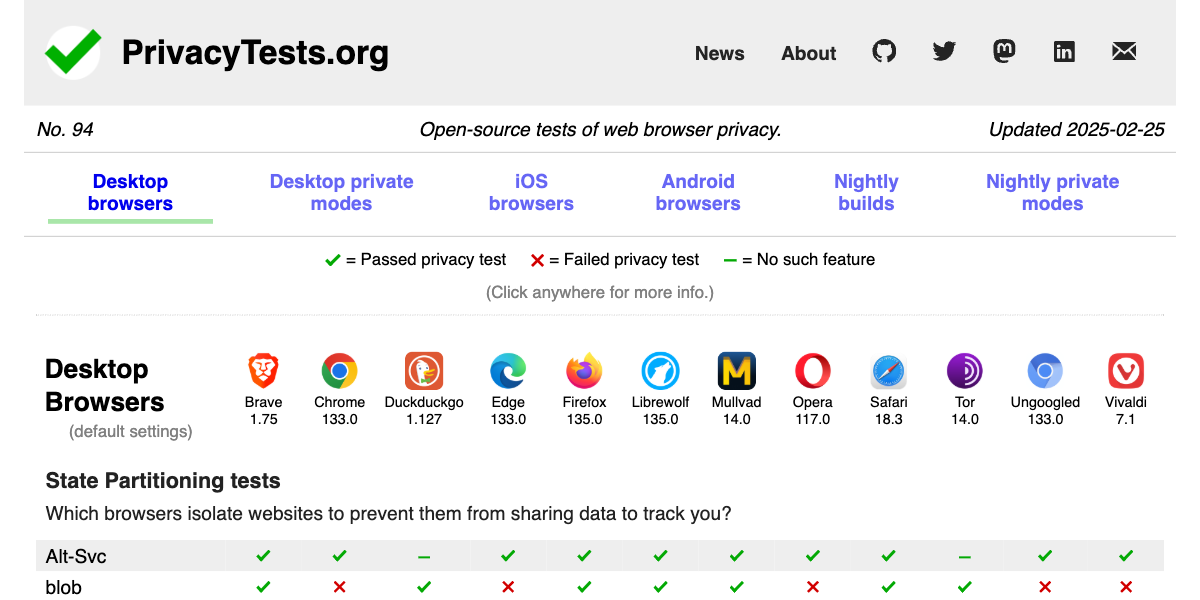
Which browsers are best for privacy?
An open-source privacy audit of popular web browsers.
The web should remain anonymous by default | The Mozilla Blog
The unique architecture of the web enables a much higher degree of user privacy than exists on other platforms. Many factors contribute to this, but an ess


The Algorithm, Apparently Chronological
A German court has explicitly named Mastodon and Bluesky as positive examples of social networks that could retain hosting protection. It gets Bluesky’s feeds wrong, but its reasoning about user control might be more useful than it realises.

Paper Skygest: Personalized Academic Recommendations on Bluesky
We build, deploy, and evaluate Paper Skygest, a custom personalized social feed for scientific content posted by a user's network on Bluesky and the AT Protocol. We leverage a new capability on emerging decentralized social media platforms: the ability for anyone to build and deploy feeds for other users, to use just as they would a native platform-built feed. To our knowledge, Paper Skygest is the first and largest such continuously deployed personalized social media feed by academics, with over 50,000 weekly uses by over 1,000 daily active users, all organically acquired. First, we quantitatively and qualitatively evaluate Paper Skygest usage, showing that it has sustained usage and satisfies users; we further show adoption of Paper Skygest increases a user's interactions with posts about research, and how interaction rates change as a function of post order. Second, we share our full code and describe our system architecture, to support other academics in building and deploying such feeds sustainably. Third, we overview the potential of custom feeds such as Paper Skygest for studying algorithm designs, building for user agency, and running recommender system experiments with organic users without partnering with a centralized platform.
Thank you for ad blocking | thankyouforadblocking.com is a public awareness campaign focused on increasing awareness about the danger associated with online advertising.
I became interested with the topics of privacy and internet user rights more than 20 years ago in my native Finland, which at the time was toted as the first information society in the world. I was one of the first commercial internet developers, and became fascinated with the user data aspect of the internet the moment I saw awstats for the first time. It was an early server-log based web analytics solution, in the time when there were no tracking tag based solutions available. The idea of allowing 3rd-party tags on websites came later. Today it is not hard to find premium websites with more than 100 such 3rd-party tags.
Self-Host & Tech Independence: The Joy of Building Your Own
Why I self-host my websites, newsletter, and homelab—and the satisfaction that comes from building and using your own digital tools.

@cozylittle.house has been advocating for something like this for a bit! I think it's tricky to get right but if we *do* it could be really awesome! There's an opportunity here to have *better* analytics and information shared than the web analytics status quo

Andrew Lisowski 💻
I’m still open to hitting an an xrpc endpoint so you can track the traffic 🙂
