

The book The Burning World by J.G. Ballard is a post-apocalyptic science fiction tale about the near complete dissipation of water from the surface of the Earth.
After the Deluge: What Future for Climate Fiction? - Public Books
Even in a world remade, the past defines the present.

Beyond Catastrophe: A New Climate Reality Is Coming Into View (Published 2022)
There's plenty of bad news. But thanks to real progress, we're headed toward a less apocalyptic future.

A Better World Is Not Possible | Los Angeles Review of Books
Did the Weather Underground have a point?

Our Changing Climate
The Secret World of Weather
In The Tristan Gooley Weather Book, bestselling author …

Collections: The Fremen Mirage, Part II: Water Spilled on the Sand
This is part II of our four-part series (I, IIIa, IIIb, interlude, IV) looking at what I’ve termed ‘the Fremen mirage,’ after the fiction people from the science fiction novel Dun…

Water Rhythms | Susie Ibarra
Water rhythms is a story of climate change told by ice and water. It is a story about the dualism of water, the universal connector of nature and humans. It is also an intergenerational story of the rapid change and depletion of our glaciers and freshwater sources worldwide.

That Winter the Wolf Came — Oakland Public Library
That Winter the Wolf Came — Spahr, Juliana — <p>That Winter the Wolf Came is written for this era of global struggle. It finds its ferment at the intersection of ecological and economic catastrophe. Its feminist and celebratory energy is fueled by street protests and their shattered windows. Amid oil spills and austerity measures and shore birds and a child holding its mother’s hand and hissing teargas canisters, it reminds us exactly what we must fight to defend with a wild ferocity, and what we’re up against.</p><br /><p>"In her poems, love does not resist the world beyond; love lets it in. Politics demands feeling rather than denuding it." —<i>Los Angeles Review of Books</i></p><p>"Geography, economics, ecology, hydrology, local and international history; repetition, flat limited diction, lengthy chant; intersections of incompatible discourses, such as a field biologist’s checklist plus memoir, medical record plus ode, incantation plus site report: Spahr draws on these resources and procedures to make poems that feel like bizarre, careful essays, and essays that feel like sad, extended poems." —<i>The Nation</i></p><p>"...a work of crisp wit, bizarre conjunctions and ultimately enduring moral authority." —<i>Publisher’s Weekly</i></p><br /><br />Excerpt:<br /><br /> It was Non-Revolution. Or it was me. Or it was Non-Revolution and me. I was unsure what it really was. Maybe it was my thoughts. My thoughts at one minute about Non-Revolution. About the smell of Non-Revolution. Sweat, urine, sage, pot, rotting food, hay, all mixed together. Perhaps about Non-Revolution’s body. I am sure I am not the only one who has thought it exceptional, but I am also just as sure that by the standards of bodies, Non-Revolution’s is fine but not exceptional. That is the point. That is why Non-Revolution is called Non-Revolution, why they have revolution as a possibility in their name but it is a modified and thus negated possibility so as to suggest they are possibly neither good nor fucked. Still something about Non-Revolution’s smell and body had gotten into me.<br /><br/>Renewed poetry of struggle at the intersection of ecological and economic catastrophe—feminist, ferocious, and finally celebratory.<br />
A Blackened Ecology for the End of the Summer
Every summer in the past 16 years Europe and North America—and not only—is affected by global warming evident through the heat waves and wildfires they experience while research from the past decad…

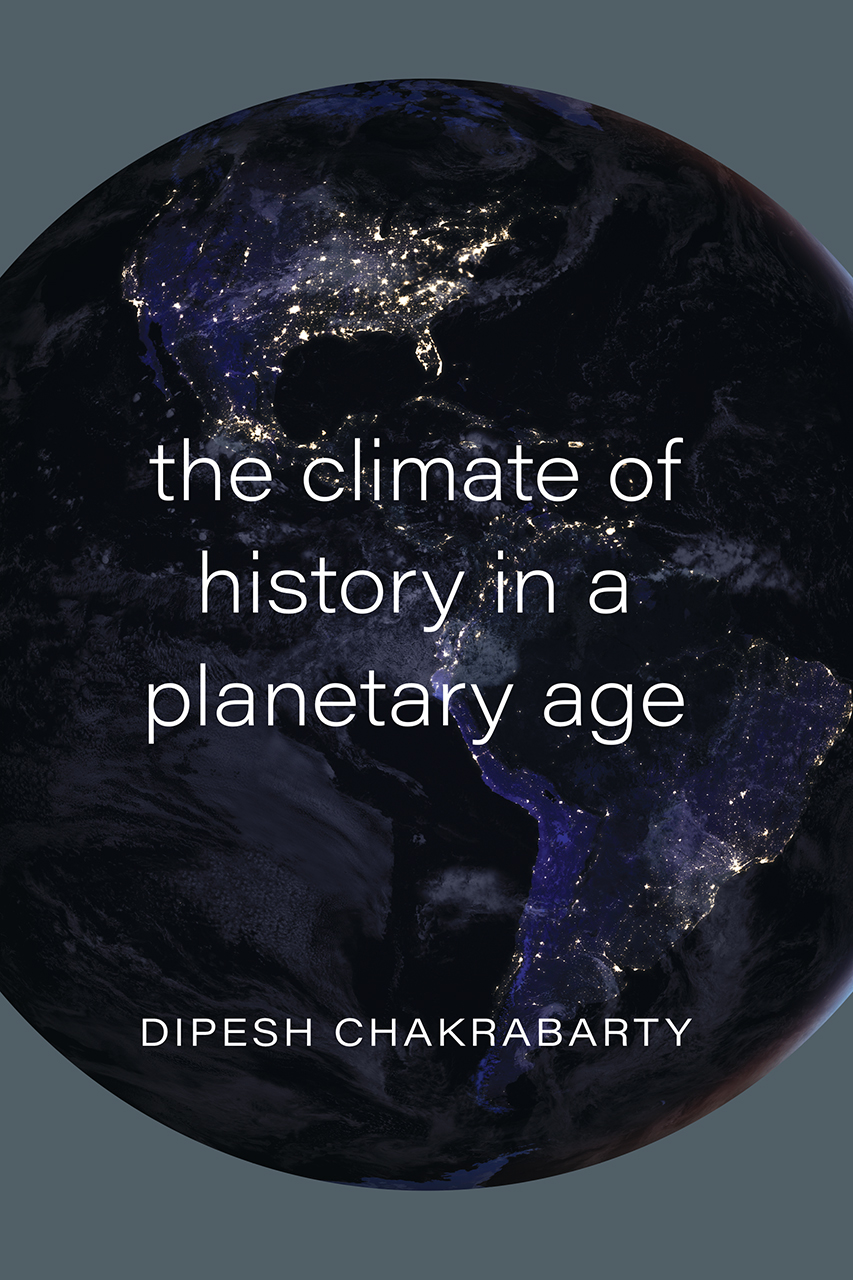
The Climate of History in a Planetary Age
For the past decade, historian Dipesh Chakrabarty has been one of the most influential scholars addressing the meaning of climate change. Climate change, he argues, upends long-standing ideas of history, modernity, and globalization. The burden of The Climate of History in a Planetary Age is to grapple with what this means and to confront humanities scholars with ideas they have been reluctant to reconsider—from the changed nature of human agency to a new acceptance of universals. Chakrabarty argues that we must see ourselves from two perspectives at once: the planetary and the global. This distinction is central to Chakrabarty’s work—the globe is a human-centric construction, while a planetary perspective intentionally decenters the human. Featuring wide-ranging excursions into historical and philosophical literatures, The Climate of History in a Planetary Age boldly considers how to frame the human condition in troubled times. As we open ourselves to the implications of the Anthropocene, few writers are as likely as Chakrabarty to shape our understanding of the best way forward.
A Fire Upon the Deep (Zones of Thought, #1)
Alternate Cover Edition can be found here. A Fire upo…

The climate crisis: a war on the world
The climate crisis is a self-destructive war, with aggressors and victims

Visualising Climate 2026 — Conference
A global conference on climate data visualization, storytelling, and science. Bologna, Italy • 4–6 November 2026.
Disasters are Distracting but work has to continue
Writing at the end of the world, from Hveragerði, Iceland
If you were curious about Tooze's new climate book, check out this convo with @kaiserkuo.bsky.social “This is the material dethroning of the west as the central driver of world history. This is really what the provincialization of the west really looks like" sinicapodcast.com/p/the-thing-we-still-cant-say…

Albert Pinto
Adam Tooze's book Carbon is finally going to be out in February 2027. Pre-order here! Climate Crisis and the Eclipse of the West