


We’re introducing AlphaGenome Atlas, a database predicting the effects of every possible single nucleotide variant in the human genome.
Organism-scale annotation with Pan-human Azimuth
Single-cell atlases now span many human tissues, but inconsistent annotations across studies limit their utility as a unified reference. We introduce Pan-human Azimuth, a supervised neural network that maps human cells from diverse tissues and datasets onto a single hierarchical organism-scale typology.
Single-Nucleus Multi-Omic Atlas Maps Regulatory Architecture and Non-Coding Variant Effects across Adult Human Tissues
Diverse human cell types establish specialized functions through lineage- and context-specific regulatory programs. Interpreting non-coding genetic risk requires integrated multi-omic reference maps that directly connect regulatory DNA to cellular expression across human tissues.
LLM-Assisted Reanalysis of Unsolved Rare Disease Genomes Increases Diagnostic Yield
Rare and undiagnosed genetic disorders affect millions of patients globally, and many patients endure years of inconclusive testing. Conventional genomic interpretation can be insufficiently sensit...

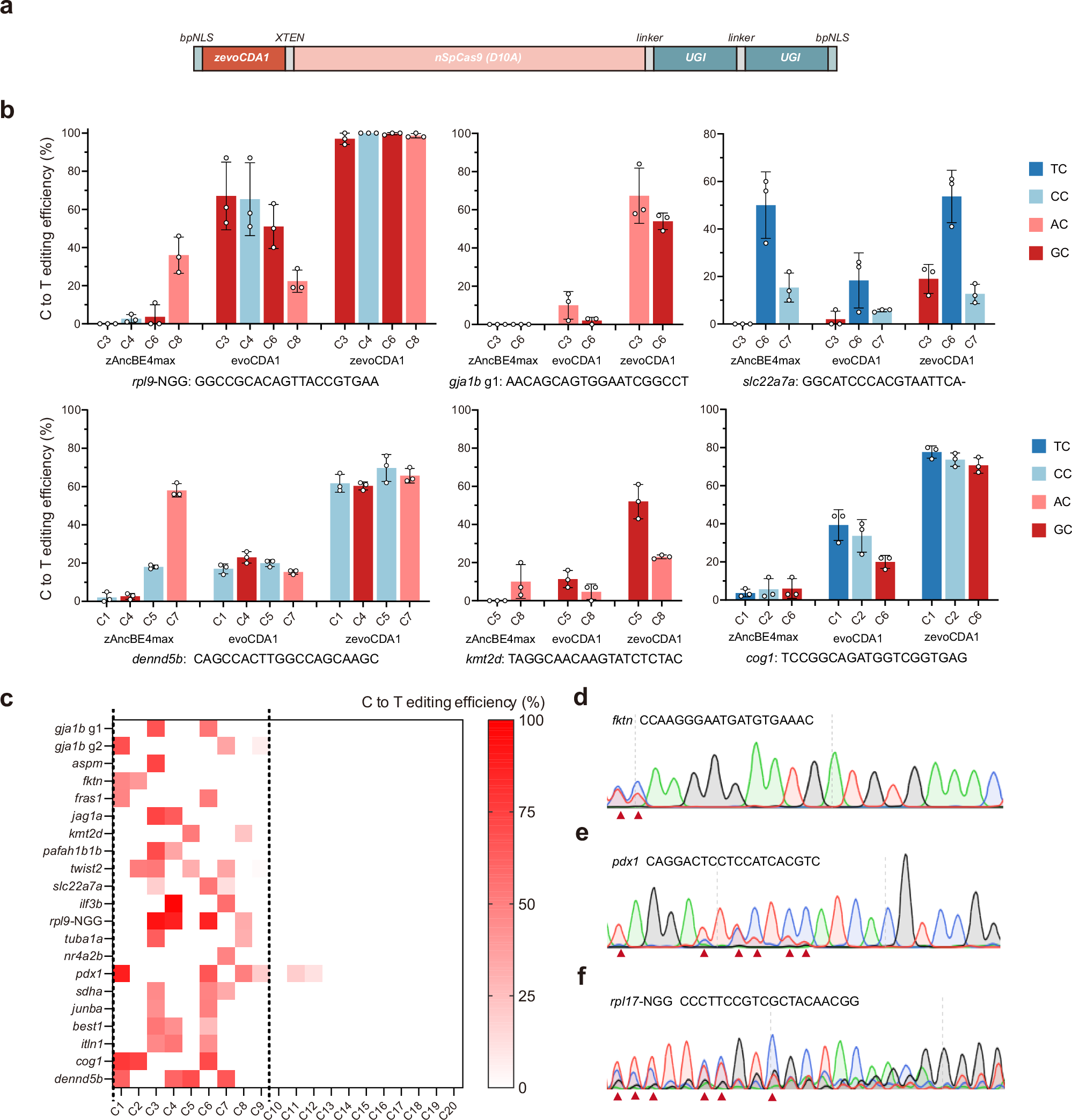
Cytosine base editors with increased PAM and deaminase motif flexibility for gene editing in zebrafish
Cytosine base editing is a powerful tool for making precise single nucleotide changes in cells and model organisms like zebrafish, which are valuable for studying human diseases. However, current base editors struggle to edit cytosines in certain DNA contexts, particularly those with GC and CC pairs, limiting their use in modelling disease-related mutations. Here we show the development of zevoCDA1, an optimized cytosine base editor for zebrafish that improves editing efficiency across various DNA contexts and reduces restrictions imposed by the protospacer adjacent motif. We also create zevoCDA1-198, a more precise editor with a narrower editing window of five nucleotides, minimizing off-target effects. Using these advanced tools, we successfully generate zebrafish models of diseases that were previously challenging to create due to sequence limitations. This work enhances the ability to introduce human pathogenic mutations in zebrafish, broadening the scope for genomic research with improved precision and efficiency.
Notes on Rastair, a variant and methylation caller
In the last year, I’ve had the pleasure to work on Rastair , a bioinformatics project by Benjamin Schuster-Böckler from the Ludwig Institute for Cancer Research at the University of Oxford. It is a …
DeepMind releases structure predictions for nearly every known protein
Database powered by AlphaFold algorithm now boasts predicted structures for over 200 million proteins

Martin Krzywinski - Data Visualization, Design, Science and Art - Canada's Michael Smith Genome Sciences Centre
I present clearly, connect broadly, spark imagination and encourage enthusiasm for inquiry and explanation. I create visuals with analytical clarity and artistic dimensions.
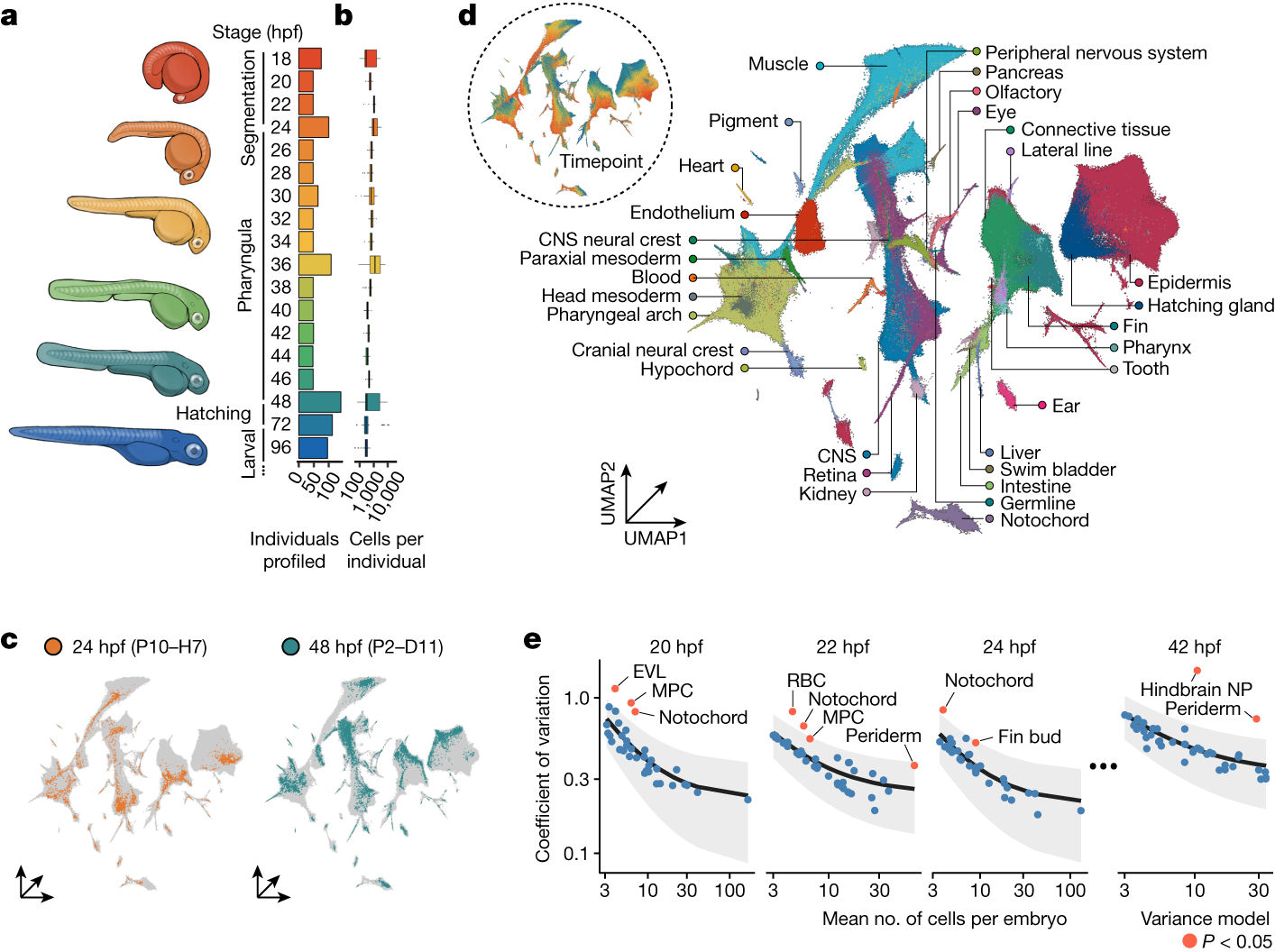
Embryo-scale reverse genetics at single-cell resolution
The maturation of single-cell transcriptomic technologies has facilitated the generation of comprehensive cellular atlases from whole embryos1–4. A majority of these data, however, has been collected from wild-type embryos without an appreciation for the latent variation that is present in development. Here we present the ‘zebrafish single-cell atlas of perturbed embryos’: single-cell transcriptomic data from 1,812 individually resolved developing zebrafish embryos, encompassing 19 timepoints, 23 genetic perturbations and a total of 3.2 million cells. The high degree of replication in our study (eight or more embryos per condition) enables us to estimate the variance in cell type abundance organism-wide and to detect perturbation-dependent deviance in cell type composition relative to wild-type embryos. Our approach is sensitive to rare cell types, resolving developmental trajectories and genetic dependencies in the cranial ganglia neurons, a cell population that comprises less than 1% of the embryo. Additionally, time-series profiling of individual mutants identified a group of brachyury-independent cells with strikingly similar transcriptomes to notochord sheath cells, leading to new hypotheses about early origins of the skull. We anticipate that standardized collection of high-resolution, organism-scale single-cell data from large numbers of individual embryos will enable mapping of the genetic dependencies of zebrafish cell types, while also addressing longstanding challenges in developmental genetics, including the cellular and transcriptional plasticity underlying phenotypic diversity across individuals.
PRIDE - PRoteomics IDEntifications Database
PRIDE - PRoteomics IDEntifications Database
Designing RNA sequencing experiments: A practical guide to reproducible gene expression analysis
RNA sequencing (RNA-seq) has become a cornerstone of modern biotechnology, offering a comprehensive and high-resolution view of gene expression that enables the discovery of novel transcripts across diverse biological systems. Its applications extend beyond basic transcriptomics, providing powerful tools for uncovering molecular mechanisms underlying disease, environmental responses, and chemical toxicity. In biotechnology and biomedical research, RNA-seq facilitates the identification of regulatory networks and biomarkers that inform therapeutic development, risk assessment, and precision medicine.

Carbon-A: Finding genes in known and unknown genomes
A Blog post by Hugging Face Biology Research on Hugging Face

Cytoscape: An Open Source Platform for Complex Network Analysis and Visualization
Cytoscape Official Web Site

An atlas-scale generative model for unified representation learning of bulk RNA-seq data
Public bulk RNA-seq repositories contain hundreds of thousands of samples, creating opportunities for large-scale representation learning, but integration across studies remains challenging because of heterogeneous annotations, experimental protocols, and technical variation. While pre-trained foundation models are now widely available for single-cell RNA-seq, comparable resources for bulk RNA-seq remain scarce, motivating a model that learns a unified, tissue-aware representation directly from bulk data. We trained a supervised variational autoencoder (VAE) on a compendium of 118,263 bulk RNA-seq samples that we assembled from TCGA, GTEx, and ARCHS4 and mapped to 42 tissue categories. The model classifies tissue of origin at 94.9% balanced accuracy (weighted F1 96.2%) and compresses 16,115 genes into a 121-dimensional latent space. Tissue identity is the primary organizing axis of the latent space, while source effects remain secondary. To assess the impact of data volume, we constructed training sets at three different scales (38K, 75K, and 118K samples). Our results demonstrated that reconstruction fidelity improved incrementally with each expansion of the dataset, but with diminishing returns. We validated the model on an independent cohort of 734 paediatric tumour samples from TARGET, achieving 84.6% agreement with the expected tissue of origin. The trained model and code are available at GitHub ([https://github.com/BIMSBbioinfo/flexynesis\_tissue\_vae_manuscript][1]) with an interactive web application. ### Competing Interest Statement The authors have declared no competing interest. [1]: https://github.com/BIMSBbioinfo/flexynesis_tissue_vae_manuscript

Sid Sijbrandij's Osteosarcoma Data
Explore Sid Sijbrandij's osteosarcoma research data: single-cell transcriptomics, tissue imaging, cell clusters, and gene set enrichment analysis from his own tumor samples.
