


Our new quantum chip demonstrates error correction and performance that paves the way to a useful, large-scale quantum computer.
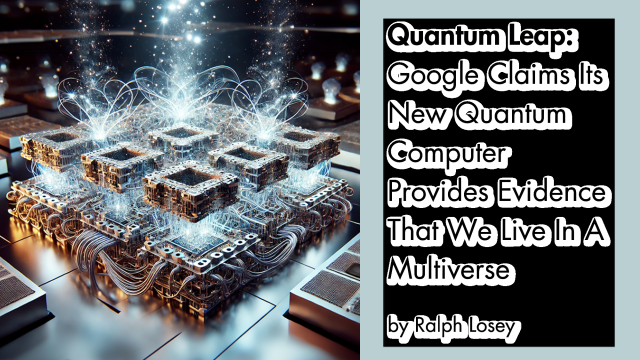
Quantum Leap: Google Claims Its New Quantum Computer Provides Evidence That We Live In A Multiverse
Google's quantum computer, Willow, suggests evidence for a multiverse by leveraging computations across parallel universes.
DEF CON 33 - Post Quantum Panic: When Will the Cracking Begin, & Can We Detect it? - K Karagiannis

A Cryptography Engineer’s Perspective on Quantum Computing Timelines
The risk that cryptographically-relevant quantum computers materialize within the next few years is now high enough to be dispositive, unfortunately.

More on whether useful quantum computing is “imminent”
These days, the most common question I get goes something like this: A decade ago, you told people that scalable quantum computing wasn’t imminent. Now, though, you claim it plausibly is immi…
A Post-Quantum Future for Let's Encrypt
Let’s Encrypt is committed to a post-quantum-safe Web PKI. The path we’re planning to take is Merkle Tree Certificates (“MTCs”), a new approach that adds post-quantum authentication to the web without sacrificing the speed and reliability that have made TLS universal. This post is about these plans and why we believe MTCs are worth pursuing as a key to a post-quantum future. An increasingly urgent problem For much of the last several years, the conversation about post-quantum cryptography has been a conversation about encryption. The reasoning was straightforward: an attacker who records encrypted traffic today might be able to decrypt it years from now once quantum computers can break the underlying math. Authentication, the part of TLS that indicates a server is who it says it is, has been a less urgent problem. A quantum computer needs to forge a signature in real time, not retroactively, so threats to authentication hinge on the existence of a cryptographically relevant quantum computer (CRQC).
Node.js Cryptography Overhaul: Migrating from SHA-256 to Post-Quantum Algorithms | Markaicode
Learn how to upgrade your Node.js applications from SHA-256 to quantum-resistant cryptographic algorithms with practical code examples and migration strategies.

Eric on Twitter / X
Qwen3.5 27B is awesome (the entire family above 9B is impressive). You can now try it directly in your browser at SOTA speeds with whatever GPU you have: https://t.co/avWxUd8vNLMy previous research in practice - The `Intel/Qwen3.5-27B-int4-AutoRound` is particularly good. https://t.co/QVSVNKM0Nk— Eric (@Ex0byt) March 21, 2026
Sirraya One | Enterprise Decentralized Identity Platform
NIST-certified quantum-resistant identity with zero-knowledge proofs. Government & military-grade verifiable credentials.

A look at the latest post-quantum signature standardization candidates
NIST has standardized four post-quantum signature schemes so far, and they’re not done yet: there are fourteen new candidates in the running for standardization. In this blog post we take measure of them and discover why we ended up with so many PQ signatures.

ZETIC | On-Device AI for Everything - for any model, on any device, in any framework
Built by ex-Qualcomm AI Engineer. Automate on-device AI deployment with full NPU optimization. Benchmark on 100+ physical devices and ship in hours with just 3 lines of code.
A 30B Qwen Model Walks Into a Raspberry Pi… and Runs in Real Time
ByteShape's device-optimized release of Qwen3-30B-A3B-Instruct-2507.

Benchmarks | EXO
Transparent benchmarks for LLMs tested on real hardware. Coming soon.
Qwen 3.8 27B is excellent, but it defaults to wildly overthinking things
Friday’s big release was Qwen 3.8 27B, an Apache 2 licensed 27B parameter vision-capable LLM from Alibaba’s Qwen research lab. I’ve been looking forward to this one: 27B is an …

Tauri vs. Electron: performance, bundle size, and the real trade-offs
A breakdown of the choice between Tauri and Electron for cross-platform apps, backed by practical comparisons and benchmark data.
