

jQuery: The Write Less, Do More, JavaScript Library
Rich JavaScript Applications – the Seven Frameworks (Throne of JS, 2012)
Steve Sanderson's Blog

State of the Art JavaScript in 2016
State of the Art JavaScript in 2016 So, you’re starting a brand new JavaScript front end project or overhauling an old one, and maybe you haven’t kept up with the breakneck pace of the ecosystem …


Damn. @littlecalculist's Effective JavaScript is easily one of the best tech books I've read. JavaScript pros go get this.
Damn. @littlecalculist's Effective JavaScript is easily one of the best tech books I've read. JavaScript pros go get this.— Steven Levithan (@slevithan) January 1, 2013
Brenda Eich on JavaScript at 18: Legal to Gamble - Fluent 2013
State of JS 2020
The annual survey about the latest trends in the JavaScript ecosystem.
The State of JavaScript 2019
Discover the most popular JavaScript features & technologies of the year.
State of JavaScript 2022
The 2022 edition of the annual survey about the latest trends in the JavaScript ecosystem.
☔ Lightweight javascript library for DOM manipulation and events
:umbrella: Lightweight javascript library for DOM manipulation and events

A New Code of Conduct and License for ml5.js
Today we are excited to announce two new parts of ml5.js: a new and improved Code of Conduct and our very own software license.

Original implementation of Javascript in CL
Thanks to a tweet from Tiago Charters de Azevedo, I learned today that Mozilla’s CVS tree still contains the original implementation of Javascript written in Common Lisp. I always found inter…

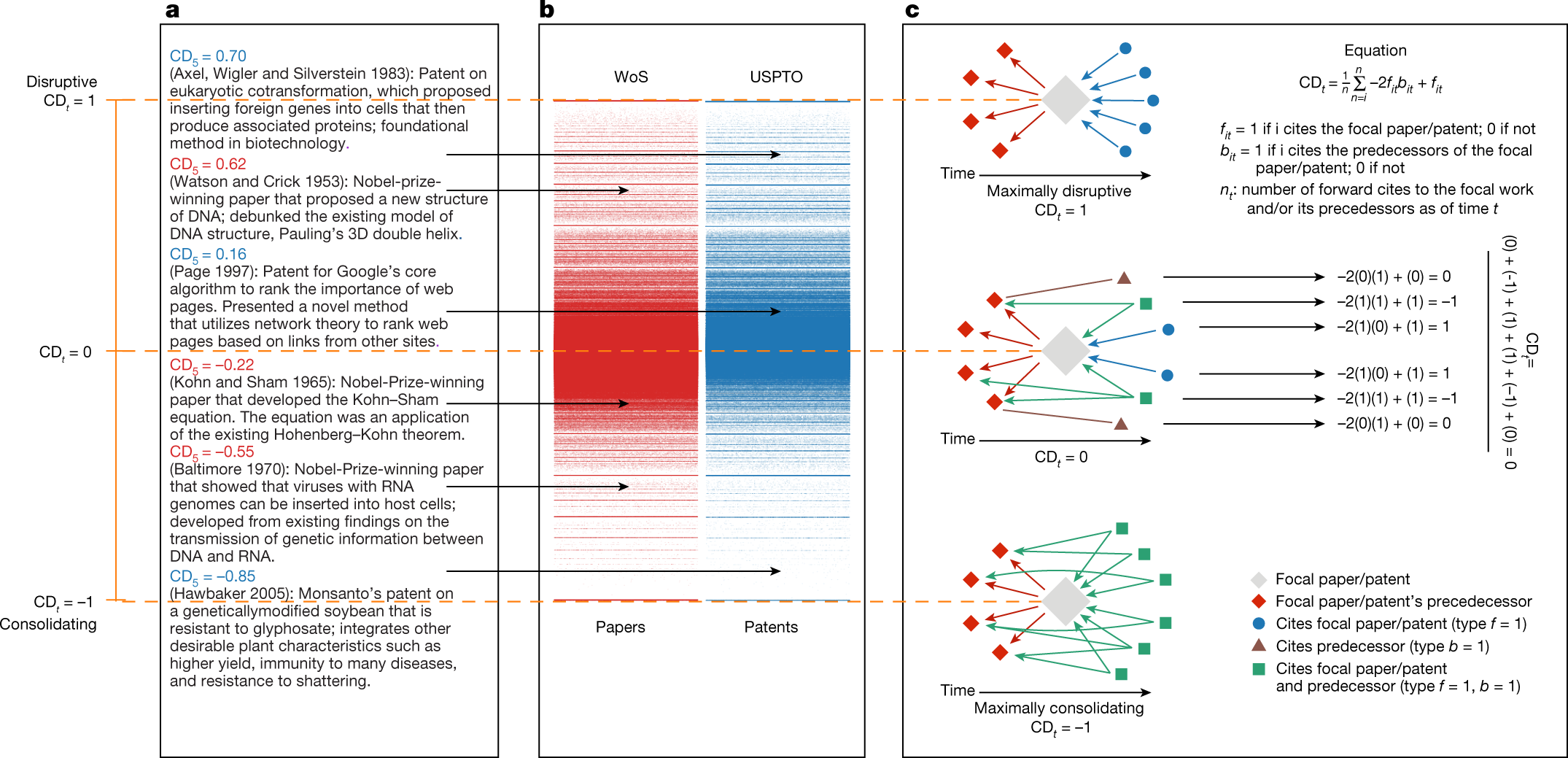
Papers and patents are becoming less disruptive over time
Theories of scientific and technological change view discovery and invention as endogenous processes1,2, wherein previous accumulated knowledge enables future progress by allowing researchers to, in Newton’s words, ‘stand on the shoulders of giants’3–7. Recent decades have witnessed exponential growth in the volume of new scientific and technological knowledge, thereby creating conditions that should be ripe for major advances8,9. Yet contrary to this view, studies suggest that progress is slowing in several major fields10,11. Here, we analyse these claims at scale across six decades, using data on 45 million papers and 3.9 million patents from six large-scale datasets, together with a new quantitative metric—the CD index12—that characterizes how papers and patents change networks of citations in science and technology. We find that papers and patents are increasingly less likely to break with the past in ways that push science and technology in new directions. This pattern holds universally across fields and is robust across multiple different citation- and text-based metrics1,13–17. Subsequently, we link this decline in disruptiveness to a narrowing in the use of previous knowledge, allowing us to reconcile the patterns we observe with the ‘shoulders of giants’ view. We find that the observed declines are unlikely to be driven by changes in the quality of published science, citation practices or field-specific factors. Overall, our results suggest that slowing rates of disruption may reflect a fundamental shift in the nature of science and technology.
How Baseline Can Help You Ship Less JavaScript — Smashing Magazine
The gap between “you need a library for this” and “the browser does this” keeps closing. A practical guide to auditing your dependencies and finding what the web platform can now handle for you.

Moddable Blog | Why Moddable supports JS0/JSSugar
Proposed changes to how the JavaScript language evolves have generated a lot of discussion recently. The proposal, titled "Language Evolution: Problems, and What Can We Do About It?" was delivered by Shu-yu Guo of Google and supported by Apple, Moddable, Mozilla, and Sony. "Language Evolution" explains that JavaScript engine developers are increasingly struggling with the competing goals of supporting the latest language features and protecting users running JavaScript especially in the browser. While the creators of every JavaScript engine have long made large investments to support developers, ultimately the privacy, security, and safety of users must take priority given the many critical ways JavaScript is used today. The proposal lays out a path forward that balances these competing priorities.
Rethinking Isomorphic JavaScript with SolidStart by Ryan Carniato