


After the EU AI Act’s transparency guidelines went into effect, and following the announcement that most major AI labs will soon be watermarking their text output to comply, there has been some debate about how much of an impact this is going to have, if any, on the quality of the text produced by AI models.
How Claude's text watermarking works
Future Claude models will generate text that contains a watermark. This is a way of determining the likelihood that Claude was involved in writing the text, and we, along with several other major AI providers, are implementing this change to comply with the EU AI Act. In this article, we share answers to some of the questions we’ve received about how our chosen watermarking method works, whether it affects Claude’s outputs, and why we’re making this change.
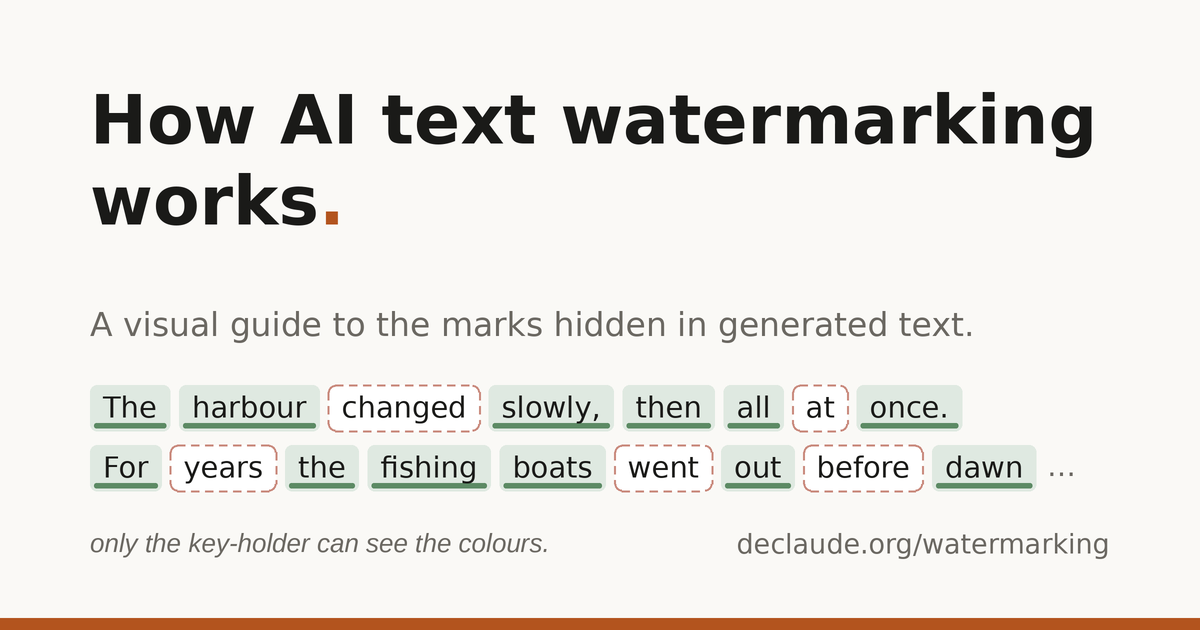
How AI text watermarking works
A gentle visual guide to how a statistical mark hides inside generated text, and what erases it.
Watermarks aren’t the silver bullet for AI misinformation
Digital watermarks are easily broken and abused.

Alex Cui on Twitter / X
Claude's watermark probably doesn't work how you think. As the CTO of GPTZero, I'll explain how Anthropic, Google and OpenAI are building text watermarking in this brief explainer and whether it can be defeated.Almost all forms of watermarking that are fast and cheap enough for… https://t.co/3Ghcz3PTwJ— Alex Cui (@alexcdot) August 11, 2026
Code of Practice on Transparency of AI-generated Content
This code of practice supports compliance with the AI Act transparency obligations related to marking and labelling of AI-generated content.
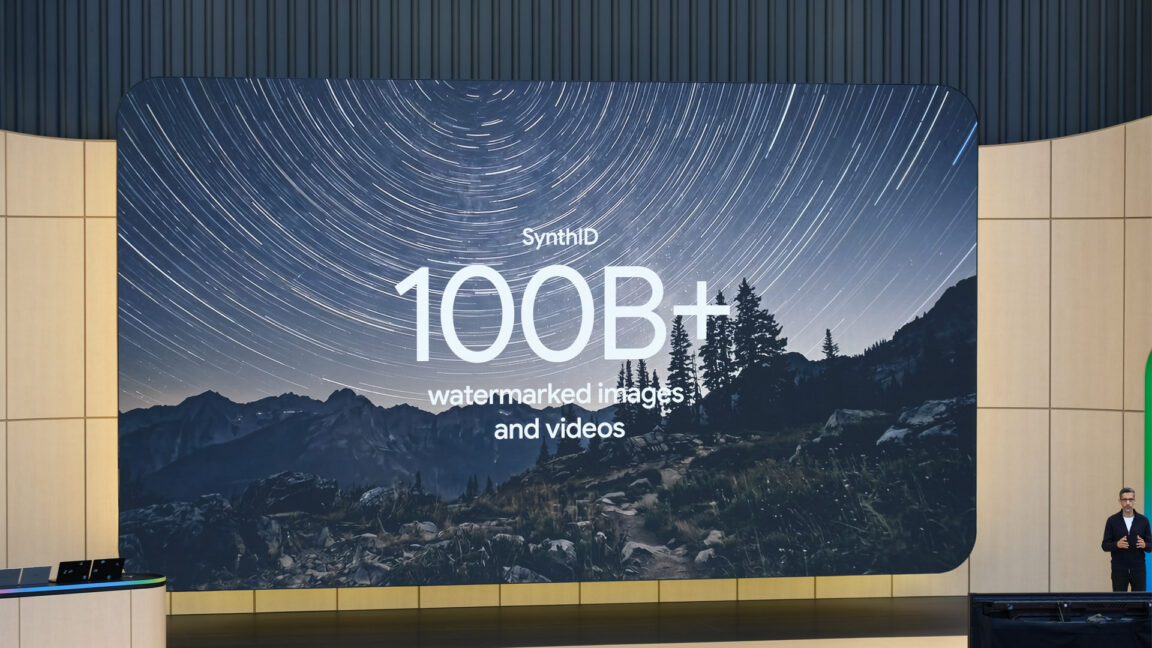
Google's SynthID AI watermarking tech is being adopted by OpenAI, Nvidia, and more
AI content is getting good, but SynthID might be able to help tell truth from fiction.
AI-text detection tools are really easy to fool
A recent crop of AI systems claiming to detect AI-generated text perform poorly—and it doesn’t take much to get past them.

How Claude marks AI-generated content | Claude Help Center
Anthropic has signed the EU AI Act's Article 50(2) Code of Practice on Transparency of AI-Generated Content, as a provider of both generative AI models and generative AI systems. This article describes how we’re planning to put those commitments into practice, how marking works, and what its limitations are. We’ll update this article and publish more detailed technical guidance as it becomes available.

AI watermarking has a decentralisation problem
With AI watermarking inference providers mark their output as AI generated. But for the system to become useful, lots of independent providers need to collaborate together in a decentralised system without overarching governance.
Google's SynthID watermark is hard to break, but it doesn't solve AI disinformation
Deciding what's real on the Internet won't be easy in the future.
The Often Overlooked Water Footprint of AI Models
… and what that means for individuals, newsrooms, and journalists
Scalable watermarking for identifying large language model outputs
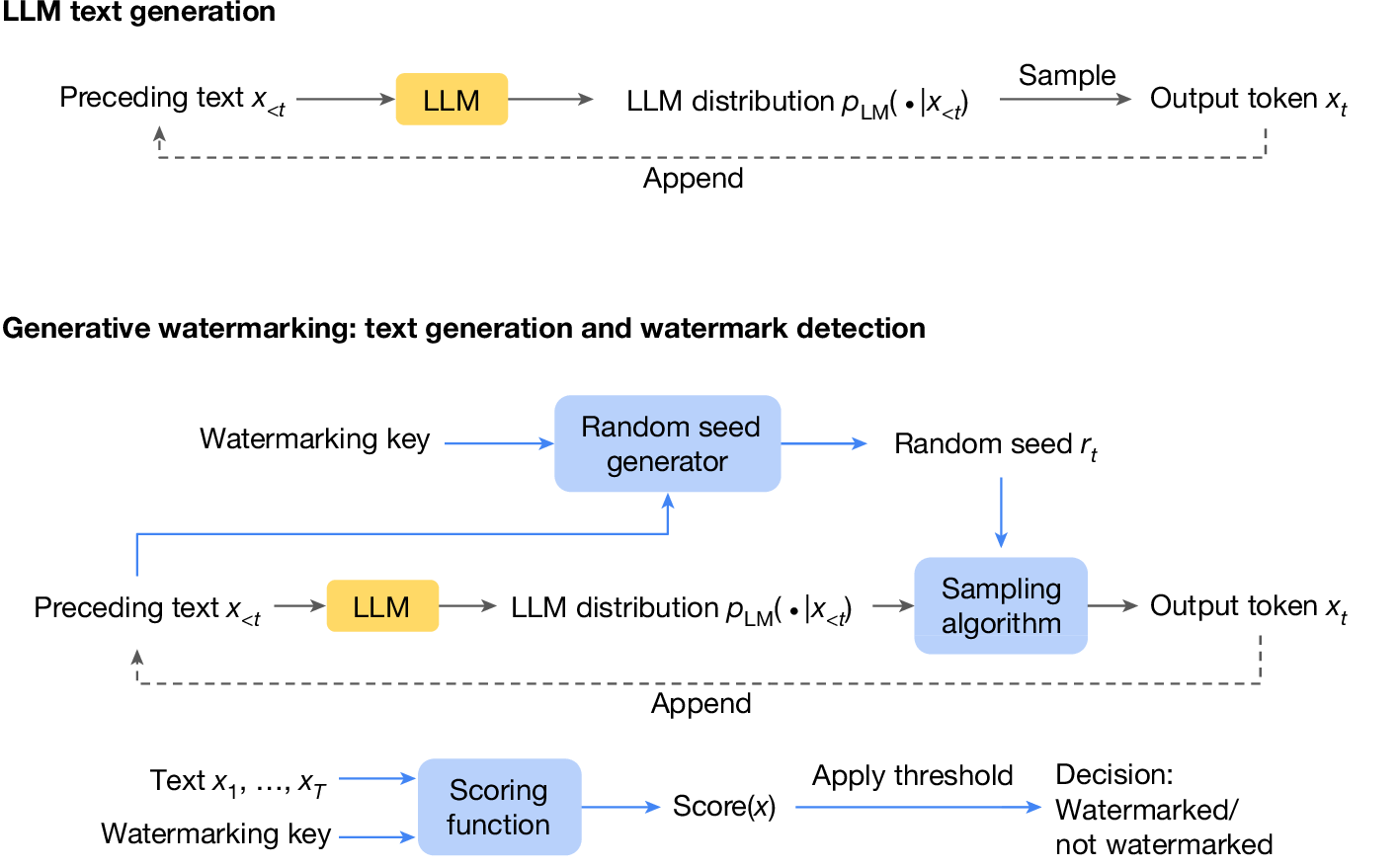
Large language models (LLMs) have enabled the generation of high-quality synthetic text, often indistinguishable from human-written content, at a scale that can markedly affect the nature of the information ecosystem1–3. Watermarking can help identify synthetic text and limit accidental or deliberate misuse4, but has not been adopted in production systems owing to stringent quality, detectability and computational efficiency requirements. Here we describe SynthID-Text, a production-ready text watermarking scheme that preserves text quality and enables high detection accuracy, with minimal latency overhead. SynthID-Text does not affect LLM training and modifies only the sampling procedure; watermark detection is computationally efficient, without using the underlying LLM. To enable watermarking at scale, we develop an algorithm integrating watermarking with speculative sampling, an efficiency technique frequently used in production systems5. Evaluations across multiple LLMs empirically show that SynthID-Text provides improved detectability over comparable methods, and standard benchmarks and human side-by-side ratings indicate no change in LLM capabilities. To demonstrate the feasibility of watermarking in large-scale-production systems, we conducted a live experiment that assessed feedback from nearly 20 million Gemini6 responses, again confirming the preservation of text quality. We hope that the availability of SynthID-Text7 will facilitate further development of watermarking and responsible use of LLM systems.
Google’s invisible AI watermark will help identify generative text and video
New AI tools to generate videos and detect them as well.

Can AI Detectors Be Trusted?
Society has always trusted editors, teachers, peer reviewers, and readers to set acceptable standards for writing. In the past, the biggest challenge was detecting plagiarism and cracking down on other forms of cheating. Now, AI detectors are rewriting the script: they assign a score based on the likelihood that the text was created by a human or a large language model (LLM).
