

SciPy 2015 is over, meaning that many non-participants like myself are now busy catching up with what happened by watching the videos. Today's dose for me was Jake VanderPlas' keynote entitled "State of the Tools". It's about the history, current state, and potential future of what is now generally known as the Scientific Python ecosystem: the large number of libraries and tools written in or for Python that scientists from many disciplines use to get their day-to-day computational work done.
The Story of Python and how it took over the world | Python: The Documentary
Python Tutorial | Learn Python Programming Language - GeeksforGeeks
Your All-in-One Learning Portal: GeeksforGeeks is a comprehensive educational platform that empowers learners across domains-spanning computer science and programming, school education, upskilling, commerce, software tools, competitive exams, and more.

Investing in the Python ecosystem
Vercel welcomes the Gel Data team and deepens support for the Python ecosystem through PSF sponsorships, community funding, and improved Python developer tools.
My life in a Python Package: a Human Programming Interface, by karlicoss
Linking the world's research to the code it runs on - OpenAlex blog
Research relies on software. Software written by scientists, for science, runs through the entire modern research stack: NumPy and SciPy, R and ggplot2, Jupyter, BLAST, ImageJ, AlphaFold. Yet in the scholarly record, that software is nearly invisible. Software is not usually cited formally in publications and is usually just mentioned in the text, which means […]

Project Jupyter
The Jupyter Notebook is a web-based interactive computing platform. The notebook combines live code, equations, narrative text, visualizations, interactive dashboards and other media.
Kevin Weil 🇺🇸 on Twitter / X
💥 Today we’re introducing Prism—a free, AI-native workspace for scientists to write and collaborate on research, powered by GPT-5.2.Accelerating science requires progress on two fronts:1. Frontier AI models that use scientific tools and can tackle the hardest problems2.… pic.twitter.com/cnLysHixuQ— Kevin Weil 🇺🇸 (@kevinweil) January 27, 2026
Deep Learning with Python
Start building deep learning applications with Python and Keras today!

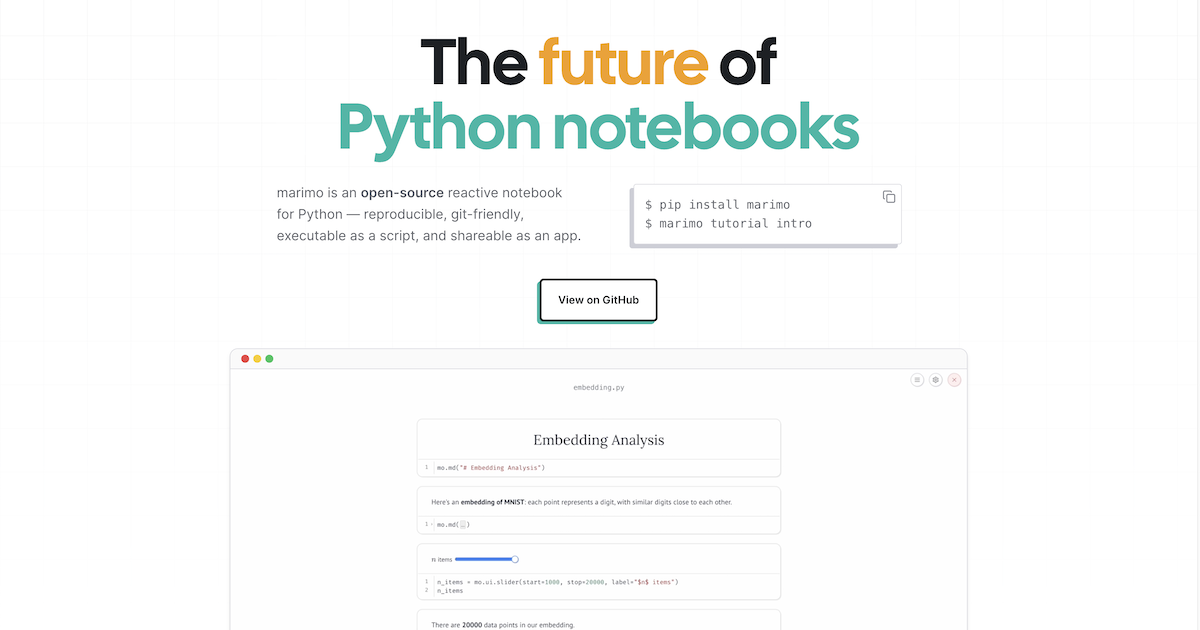
marimo | a next-generation Python notebook
Explore data and build apps seamlessly with marimo, a next-generation Python notebook.
uv is the best thing to happen to the Python ecosystem in a decade - Blog - Dr. Emily L. Hunt
Released in 2024, uv is hands-down the best tool for managing Python installations and dependencies. Here's why.

Video course: Python for journalists | DataJournalism.com
The course Python for Journalists is meant for journalists looking to learn the most common uses of Python for data journalism. During four modules the…
Julia vs. Python: A comprehensive comparison
The debate between Julia and Python sparks intense discussions. Julia, known for its compiled nature, boasts remarkable speed, while…
A Research Lab for Open Source ✸ Software Stewardship Lab
Today, we're launching a world-class research lab dedicated to Open Source sustainability with a team of some of the most experienced people in the world.
OpenAI to acquire Astral
Accelerates Codex growth to power the next generation of Python developer tools

This morning, I had the distinct honour of giving the opening keynote at #RSECon26: "Where does the rigour go? Research software and the future of trustworthy science" The core argument: AI is… | Arfon Smith
This morning, I had the distinct honour of giving the opening keynote at #RSECon26: "Where does the rigour go? Research software and the future of trustworthy science" The core argument: AI is making it dramatically cheaper to produce plausible scientific outputs, without necessarily making them cheaper to check. The scarce resources are shifting towards attention, judgment, and verification. This is no doubt a disruptive time for research software engineers and research more generally. For Research Software Engineers specifically I think that creates some important new opportunities around: encoding domain judgment, building verification infrastructure, connecting agents to reality, and helping ensure that the emerging verification layer for science remains open. Thanks to everyone at RSECon26 for the thoughtful discussion, and especially to the many people whose work and ideas I that heavily influenced this talk. Link to slides in first comment
