

Thirty years after my first contact with computational (ir)reproducibility, I am happy to note that many things have improved. Reproducibility, computational and otherwise, is increasingly recognized as an important aspect of scientific quality control, and mostly considered worth striving for. However, I also note that more and more people, including reproducibility activists, have lost contact with the day-to-day reality in which reproducibility matters. Reproducibility is becoming an item on a checklist, and its precise incarnation the subject of political bickering aimed at making it easy to check off that item. So let's take a look at why computational reproducibility matters for researchers.
Reproducibility in Machine Learning-based Research: Overview, Barriers and Drivers
The concept of reproducibility can have different interpretations across various research fields and even within the same field [39]. To avoid confusion, we first specify our terms, broadly defining reproducibility and then further categorizing it into various types and degrees. The first distinction comes from Goodman et al. [42], who specify a fundamental division between whether we (i) mean reproducible in principle (termed “methods” reproducibility) due to sufficient description/sharing of methodologies, materials, etc., or (ii) whether results/conclusions actually prove to be reproducible when experiments or analyses are re-done. In the second category, they distinguish “results” and “inferential” reproducibility, depending on whether the analyses or inferences to broader conclusions are reproduced.
Keynote: Reproducibility and replicability of computer simulations | Canal U
Since the early days of the reproducibility crisis, much progress has been made in understanding and improving computational reproducibility and replicability (R and R)...

ReScience organization
Reproducible Science is good. Replicated Science is better. - ReScience organization

Konrad Hinsen's blog
How can we document software and computational analyses in such a way that others can convince themselves of their validity, and build on them for their own work? The question has been around for many years, and a number of attempts have been made to provide partial answers. This post provides a brief review and describes my own tentative answer, inviting you to play with it.
Where does the rigor go? Research software and the future of trustworthy science.
Generative AI now makes it dramatically easier to produce something that looks like research: analysis code, figures, literature reviews, even whole pap…
Science has been in a “replication crisis” for a decade. Have we learned anything?
Bad papers are still published. But some other things might be getting better.

GRN · German Reproducibility Network
Working together for trustworthy and useful research
Unreproducible Research is Reproducible
The apparent contradiction in the title is a wordplay on the different meanings attributed to the word reproducible across different scientific fields. What we imply is that unreproducible findings can be built upon reproducible methods. Without denying the importance of facilitating the reproduction of methods, we deem important to reassert that reproduction of findings is a fundamental step of the scientific inquiry. We argue that the commendable quest towards easy deterministic reproducibility of methods and numerical results should not have us forget the even more important necessity of ensuring the reproducibility of empirical findings and conclusions by properly accounting for essential sources of variations. We provide experiments to exemplify the brittleness of current common practice in the evaluation of models in the field of deep learning, showing that even if the results could be reproduced, a slightly different experiment would not support the findings. We hope to help clarify the distinction between exploratory and empirical research in the field of deep learning and believe more energy should be devoted to proper empirical research in our community. This work is an attempt to promote the use of more rigorous and diversified methodologies. It is not an attempt to impose a new methodology and it is not a critique on the nature of exploratory research.
The Bazaar of Scientific Knowledge | shishyko!
Is the current form of the scientific paper still optimal in 2025? How do we preserve, and efficiently leverage, the uncut gems of the scientific process?
Konrad Hinsen's blog
By now, most scientists have probably seen figures, tables, and even entire journal articles made by so-called "generative AI", containing more or less subtle mistakes or inconsistencies. What I haven't seen yet, but expect to see soon, is the scientific equivalent of deepfakes: made-up results that come with made-up code that reproduces them. This is likely to become a new challenge for reproducible research.
Andreas De Block on Twitter / X
It took Nature three years to publish this rebuttal, which clearly demonstrates the fundamental flaws in the original paper. In the meantime, the paper's conclusions influenced scientific debate and policy decisions. Such delays in correcting flawed research do real damage. https://t.co/QI3Ei3PE70— Andreas De Block (@DeblockBlock) August 13, 2026
New Studies: How Commercial Forces Make Science Less Reliable
Computational social science has been distorted by commercial forces, and AI is making it worse.

Prof. Lee Cronin on Twitter / X
It is easy to see that biology does things that cannot be computed in advanced because the future is not controlled by statistics, it is controlled by creative actions. This means today’s statistically-driven GenAI is fundamentally unintelligent.— Prof. Lee Cronin (@leecronin) March 28, 2026
The Discovery Engine: A Framework for AI-Driven Synthesis and Navigation of Scientific Knowledge Landscapes
Scientific progress relies on the effective accumulation, synthesis, and critical evaluation of knowledge. Traditionally, the well-documented, peer reviewed publication served as the primary standard for filtering and disseminating credible findings within the scientific community. Recently, however, we are witnessing an unprecedented acceleration in research output, a veritable explosion of scientific publications across all disciplines [1]. Yet, this very abundance creates a paradox: the sheer volume threatens to overwhelm the mechanisms designed for its assimilation and synthesis. Researchers, even within highly specialized subfields, face an almost insurmountable challenge in keeping abreast of relevant developments, integrating disparate findings, and identifying the truly novel signals amidst the noise [2]. This information overload contributes to disciplinary fragmentation, hindering the cross-pollination of ideas essential for disruptive innovation [3]. Furthermore, persistent concerns regarding "reproducibility crisis" [2], predatory journals, inflation of research areas[4], growing retractions and the potential influences of bibliometrics on research direction [5] highlight systemic challenges in validating and prioritizing scientific contributions to fundamental knowledge.
AI’s Growing Role as Scientific Peer Reviewer | Stanford HAI
Stanford computer scientist James Zou is exploring how AI can accelerate scientific research and peer review. His finding: AI excels at spotting gaps, but judgment calls still need humans.

Computational reproducibility

The why and how of making scientific computations reproducible
Konrad Hinsen's blog
Home Page - Software Heritage
GNU Guix transactional package manager and distribution — GNU Guix
Keynote: Reproducibility and replicability of computer simulations | Canal U

Reproducible research: methodological principles for transparent…
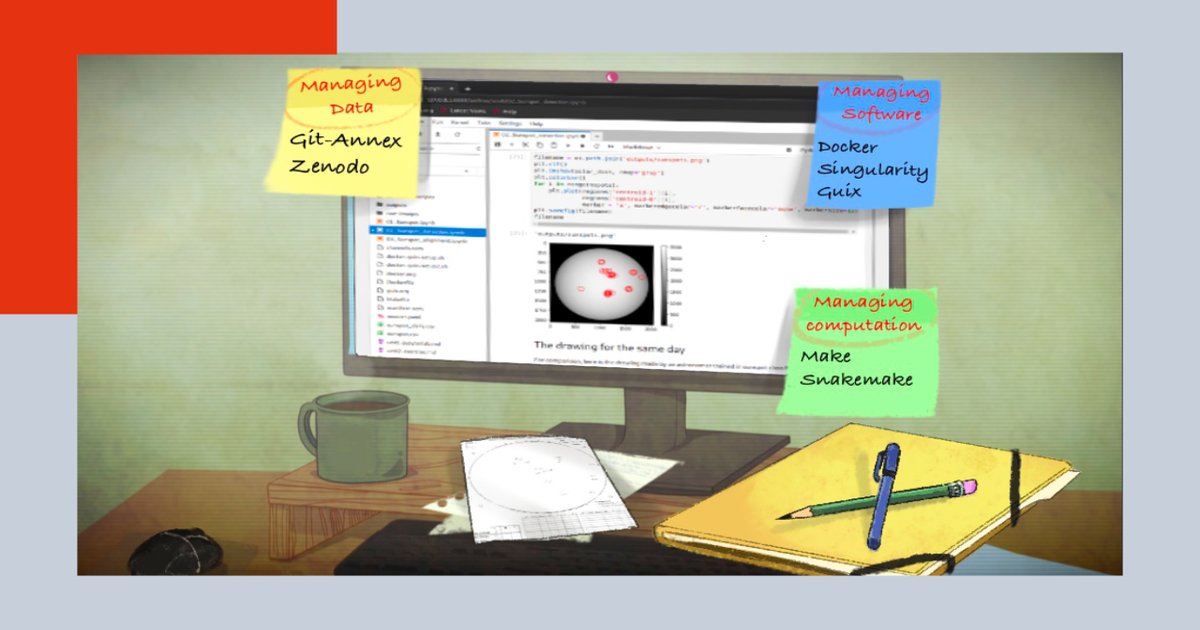
Reproducible Research II: Practices and tools for managing compu…