


Explore how Holacracy's integrative decision-making process can help teams develop proposals together.
Decision-making software for groups and organizations
Make important decisions together without endless meetings. Loomio keeps discussion, voting, outcomes, and the reasoning behind them in one clear place.


Holacracy Is Fundamentally Broken
Holacracy is a top-down, bureaucratic, big government framework. It is completely the opposite of what agile, scalable organizations need in the 21st century.

The Holacracy Community of Practice is now the Self-Management Accelerator | Holacracy
A new identity for a new direction A new identity for a new direction

Using Loomio to govern a self-organising community
…without ever having everyone at a meeting

Deliberate beyond current data. Decide what holds.
Hunome gives organisations a way to deliberate collectively and build the deliberative intelligence their decisions rest on: what their people work out together, held in a form they can act on.

HoloChats: Matthew Schutte and Brian Robertson
Design principles for long-lived circular organization: An Ostromian perspective
Circular organizational templates such as holacracy and sociocracy have gained popularity. In such organizations, all members have rights to participate in decision-making. Which factors enable such organizations to sustain their circular form? We investigate 18 highly diverse circular organizations to answer this question. Our findings show that Elinor Ostrom’s design principles for avoiding the tragedy of the commons may also explain circular organizations’ longevity. With regard to their relevance, we sort these principles into three groups: indispensable, queasy, and quite unproblematic principles. Our main theoretical contribution is to show that circular organizations can be understood as commons, and thus to make research on the governance of commons fruitful for the design of circular organizations. We show that implementing circular forms has to mind especially the queasy design principles of monitoring, graduated sanctions, conflict resolution mechanisms, and balancing individual contributions and rewards.
Autopsy of a Failed Holacracy: Lessons in Justice, Equity, and Self-Management | Nonprofit Quarterly | Civic News. Empowering Nonprofits. Advancing Justice.
As many nonprofits look at the enormous potential benefits of building shared leadership in and around their organizations, they will surely stumble across the holacracy model, but does it offer a real path forward? In this article, a veteran of one change process intelligently critiques the model, providing guidance on what other organizations may wish to avoid. This is the first of a 3-part series on shared leadership we will run over the coming month.

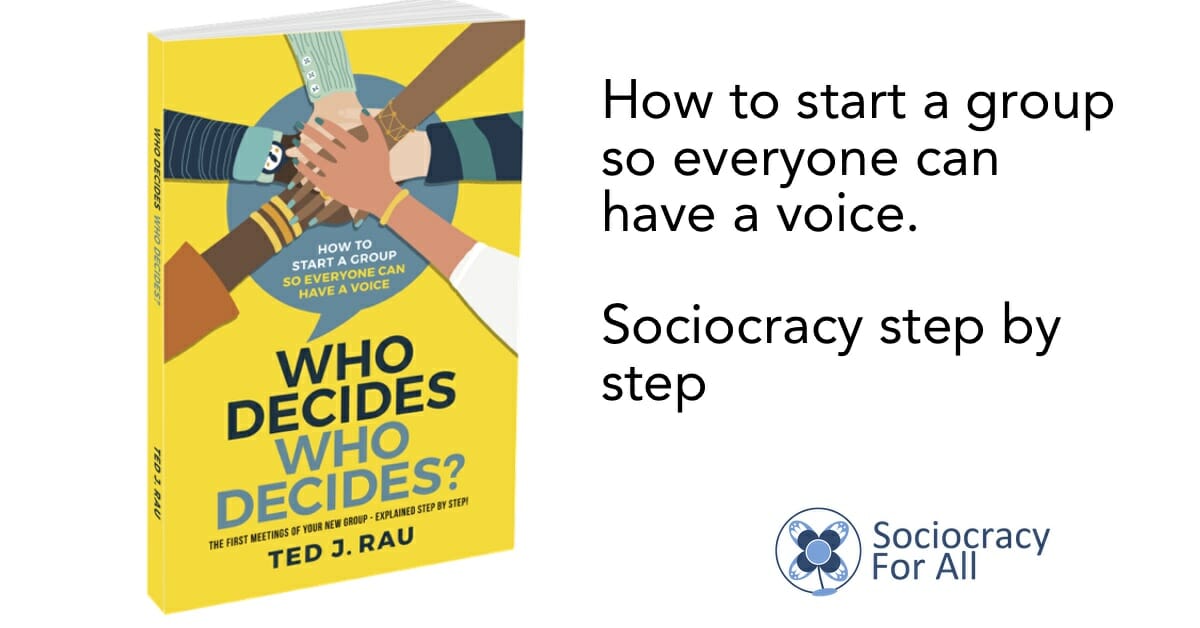
Who Decides Who Decides? - Sociocracy For All
Who Decides Who Decides is a book for starting groups with sociocracy - a guide for governance and decision-making that's clear and inclusive.
Workshop: Creating Shared Goals with Emergent Strategy
Join us for the first of our Direct Democracy workshop series 📅 Creating Shared Group Goals · February 18, 2022 12:00 AM → February 18, 2022 1:30 AM (UTC) Starting in February, the Brigade Network will be convening a series of six public, monthly workshops on community organizing and how to create distributed leadership, deliberation, and clear decisionmaking processes. This workshop is free and open to the public. Its lessons will be specific to Brigade organizing, but applicable to people who...

Binding Chaos: Mass Collaboration on a Global Scale
The world is long overdue for a completely new system of governance. If there was ever a need for political representation or a paternalistic and opaque authority, it has been removed by technology. Every political system we have tried has proven incapable of protecting human rights and dignity. Every political system we have tried has devolved into oligarchy. To effect the change we require immediately, to give individuals control and responsibility, to bring regional systems under regional governance, allow global collaboration and protect the heritage of future generations, we need a new political model.
Holacracy, Zappos and Employment Law (LMFTFY)
Holacracy is a non-hierarchical management philosophy that is getting a lot of attention these days. As readers might know, Zappos recently adopted this ideology, famously eliminating bosses and j…

Digital Democracy in Decentralised Autonomous Organisations
Decentralised autonomous organisations (DAOs) are institutional technologies that enable democratic governance innovation. They inherit key democratic principles such as procedural transparency and immutable records from being based on blockchain technology. This paper conducts a systematic literature review to examine governance mechanisms and challenges of digital democracy in DAOs. While issues like power concentration and coordination failures exist in current implementations, we argue that the concept of DAOs offers new opportunities for transparent governance and participatory decision-making. As testbeds for governance experiments, we find that DAOs have the potential to reshape democratic processes and foster innovative governance models in the digital era. Calling for interdisciplinary collaboration, further research is needed around Sybil-resistant voting mechanisms, ideological path dependencies and deliberation mechanisms.
