Fine-grained synchronization, deep pipelines, and zero kernel launch overheads, automatically.
The seL4 Microkernel | seL4
seL4 is both the world's most highly assured and the world's fastest operating system kernel. Its uniqueness lies in the formal mathematical proof that it behaves exactly as specified, enforcing strong security boundaries for applications running on top of it while maintaining the high performance that deployed systems need.
Compile to Architecture - The Phoenix Architecture
For a long time we’ve treated frameworks as the target of software development. But if systems are meant to be regenerated and replaced safely, the real compilation target has to be the architecture itself.
Benchmarks | EXO
Transparent benchmarks for LLMs tested on real hardware. Coming soon.
Running local models on an M4 with 24GB memory | jola.dev
Experiments with getting usable outputs out of local models on a standard Macbook

Production Is a Compiler Input - The Phoenix Architecture
Compiling Match Statements to Bytecode
Full pipeline deep dive for purple garden: AST, BB SSA IR, Bytecode, Optimisations
NativeLink — Build infrastructure for the agentic era
When agents write your code, your build system is the bottleneck. NativeLink is the high-performance remote build cache and execution platform for Bazel and beyond.
Introducing LFM2: The Fastest On-Device Foundation Models on the Market | Liquid AI
Today, we release LFM2, a new class of Liquid Foundation Models (LFMs) that sets a new standard in quality, speed, and memory efficiency for on-device deployment. Built on a hybrid architecture, LFM2 delivers 200% faster decode and prefill performance than Qwen3 and Gemma 3 on CPU. It also significantly outperforms models in each size class on instruction-following and function calling—the core capabilities that make LLMs reliable for building AI agents.

Smarter Operating Systems Will Use Wasm - The Coming OS Revolution by Jonas Kruckenberg @ Wasm I/O
Language Tour — Dependently-Typed BEAM Language
Dependently typed programming for the BEAM through one kernel-checked compiler pipeline.

Introducing gpt-oss
We’re releasing gpt-oss-120b and gpt-oss-20b—two state-of-the-art open-weight language models that deliver strong real-world performance at low cost. Available under the flexible Apache 2.0 license, these models outperform similarly sized open models on reasoning tasks, demonstrate strong tool use capabilities, and are optimized for efficient deployment on consumer hardware.

Magicoder: Empowering Code Generation with OSS-Instruct
We introduce Magicoder, a series of fully open-source (code, weights, and data) Large Language Models (LLMs) for code that significantly closes the gap with top code models while having no more...

Artur Chakhvadze on Twitter / X
We are releasing our first quantized checkpoints for the Qwen3.5 series of models, co-designed jointly with our inference engine to achieve maximum possible performance on Apple hardwareStarting from 0.8B, 2B and 4B modelshttps://t.co/2R8BdhAfzv— Artur Chakhvadze (@norpadon) June 8, 2026
clem 🤗 on Twitter / X
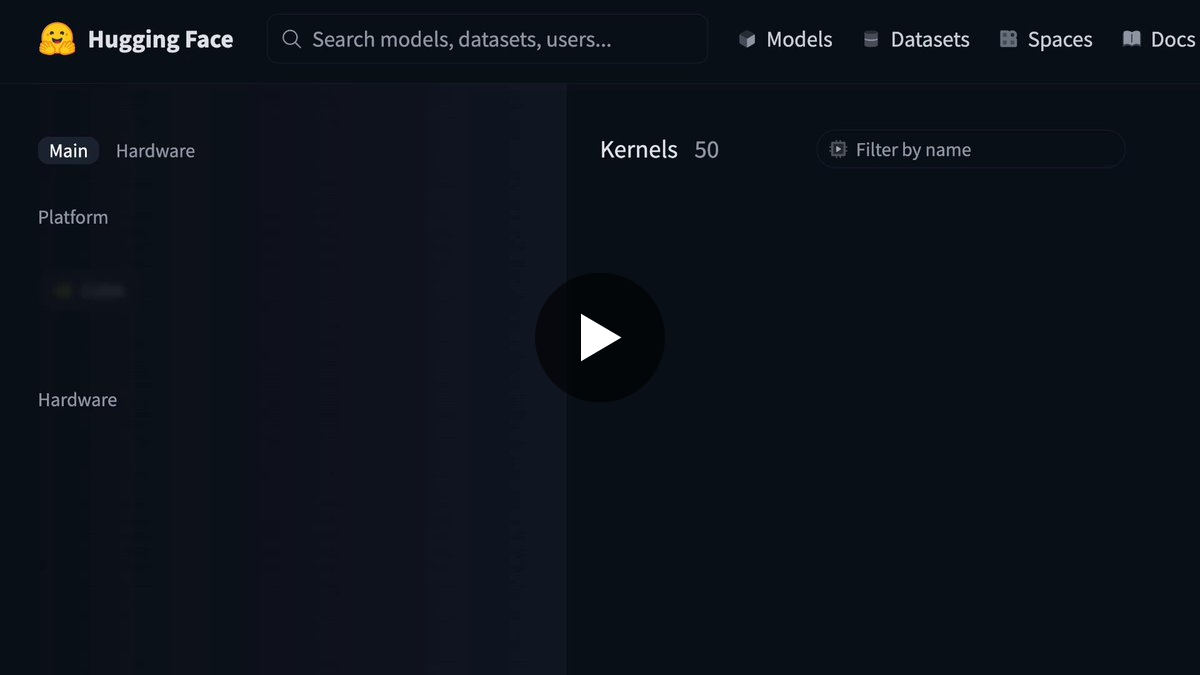
Introducing Kernels on the Hugging Face Hub ✨What if shipping a GPU kernel was as easy as pushing a model?- Pre-compiled for your exact GPU, PyTorch & OS- Multiple kernel versions coexist in one process- torch.compile compatible- 1.7x–2.5x speedups over PyTorch baselines pic.twitter.com/U0qDdxCWkd— clem 🤗 (@ClementDelangue) April 14, 2026
LLMs Can Now Write GPU Kernels That Beat torch.compile - Break AI Scaling Limits in 7 Days
We're now seeing multi-agent systems that take your PyTorch code and produce CUDA or Triton kernels with 2x to 14x speedups over torch.compile(mode='max-autotune-no-cudagraphs'). Not on toy benchmarks. On real models like Llama-3.1-8B, Whisper, and Stable Diffusion. Learn proven techniques to shift the scaling law intercept and achieve 10-50% performance gains.