(To read the complete analysis as well as the results of each language model, visit the mozilla.ai blog here.) Over the past few months, Mozilla.ai has eng
Qwen: Redefining the Future of Large Language Models (LLMs)
Introduction: A New Challenger in the AI Space A few key players, such as OpenAI, Google, and Meta, have dominated the AI landscape. However, the rise of Qwen, developed by Alibaba, signals a new shift in the competitive dynamics of large language models (LLMs).

OpenAI, Google, Anthropic admit they can’t scale up their chatbots any further
Once you’ve trained your large language model on the entire written output of humanity, where do you go? Here’s Ilya Sutskever, ex-OpenAI, admitting to Reuters that they’ve plateaued: [Reuters] The…

Maintaining the love for coding in the time of AI
By Alex Band Over the last year, we have seen the profound effects Large Language Models (LLMs) have on our open-source software work at NLnet Labs. These can be grouped into two main areas: community contributions and security reports. Before we dive into this topic, let me first give

Responsibly empowering developers with AI on MDN | The Mozilla Blog
Generative AI technologies powered by Large Language Models (LLMs), such as OpenAI’s ChatGPT, have shown themselves to be both a big boon to productivity

Who makes money when AI reads the internet for us? - Engadget
Instead of displaying links, Arc Search's "Browse for Me" feature reads the first handful of pages and summarizes them into a single, custom-built, Arc-formatted web page using large language models from OpenAI and others. Critics say that's a problem.

Mozilla Releases Local Machine Translation Tools - Slashdot
Longtime Slashdot reader Artem S. Tashkinov writes: "In January of 2019, Mozilla joined the University of Edinburgh, Charles University, University of Sheffield and University of Tartu as part of a project funded by the European Union called Project Bergamot," writes Mozilla Speech and AI engineer ...

LLM: A CLI utility and Python library for interacting with Large Language Models
A CLI tool and Python library for interacting with OpenAI, Anthropic’s Claude, Google’s Gemini, Qwen, Gemma, Kimi, DeepSeek, Mistral, and dozens of other Large Language Models, both via remote APIs and with models that can be installed and run on your own machine.
Curated retrieval versus open web search in public AI information...
Public institutions increasingly use large language models (LLMs) to answer citizens' questions, often pairing a curated knowledge base with live web search, yet whether the sources behind these...

What comes next with open models
Markets, capabilities, cope, and bewilderment in the industrialization of language models.

Community Catalyst
In my nearly 5 years of contributions to Mozilla, one thing remained at the core is community. When I first came across the Mozilla communi...

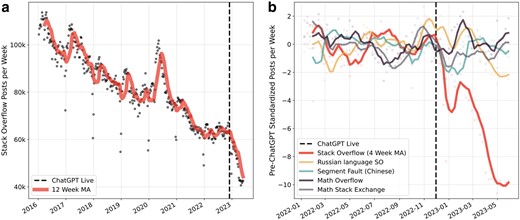
Large language models reduce public knowledge sharing on online Q&A platforms
Abstract. Large language models (LLMs) are a potential substitute for human-generated data and knowledge resources. This substitution, however, can present
Is Misinformation More Open? A Study of robots.txt Gatekeeping on the Web
Web scraping, the automated process of extracting information from websites, has long played a foundational role in the Internet ecosystem (Gray, 1995). It supports services such as search engine indexing, price comparison tools, and competitive intelligence. More recently, it has become a core component in the development of large-scale generative AI models. These Large Language Models (LLMs) require enormous volumes of training data, often in the terabyte range (Kaplan et al., 2020; Lehane, 2025), and the public web remains a low-cost, attractive source. Major model developers, including those behind OpenAI’s Chat-GPT (OpenAI, 2025), Google’s Bard (now known as Gemini) & Vertex AI (Romain, Danielle, 2023), and Anthropic’s Claude (Romain, Danielle, 2025), openly acknowledge the use of web scraping to construct their training corpora (Abdin et al., 2024; Brown et al., 2020; Chowdhery et al., 2023; Grattafiori et al., 2024; Team et al., 2024; Touvron et al., 2023).
Join | Mozilla Data Collective
Mozilla Data Collective is rebuilding the AI data ecosystem with communities at the centre.
Join | Mozilla Data Collective
Mozilla Data Collective is rebuilding the AI data ecosystem with communities at the centre.
Mozilla’s Inaugural ‘State of Open Source AI’ Report Is Here | The Mozilla Blog
Open source AI has crossed a threshold. For years the debate has centered around whether open models could ever compete with closed ones. This is no longer