Mindfully growing a non-extractive company towards a 'steward ownership' end state.
What's steward ownership? - Purpose
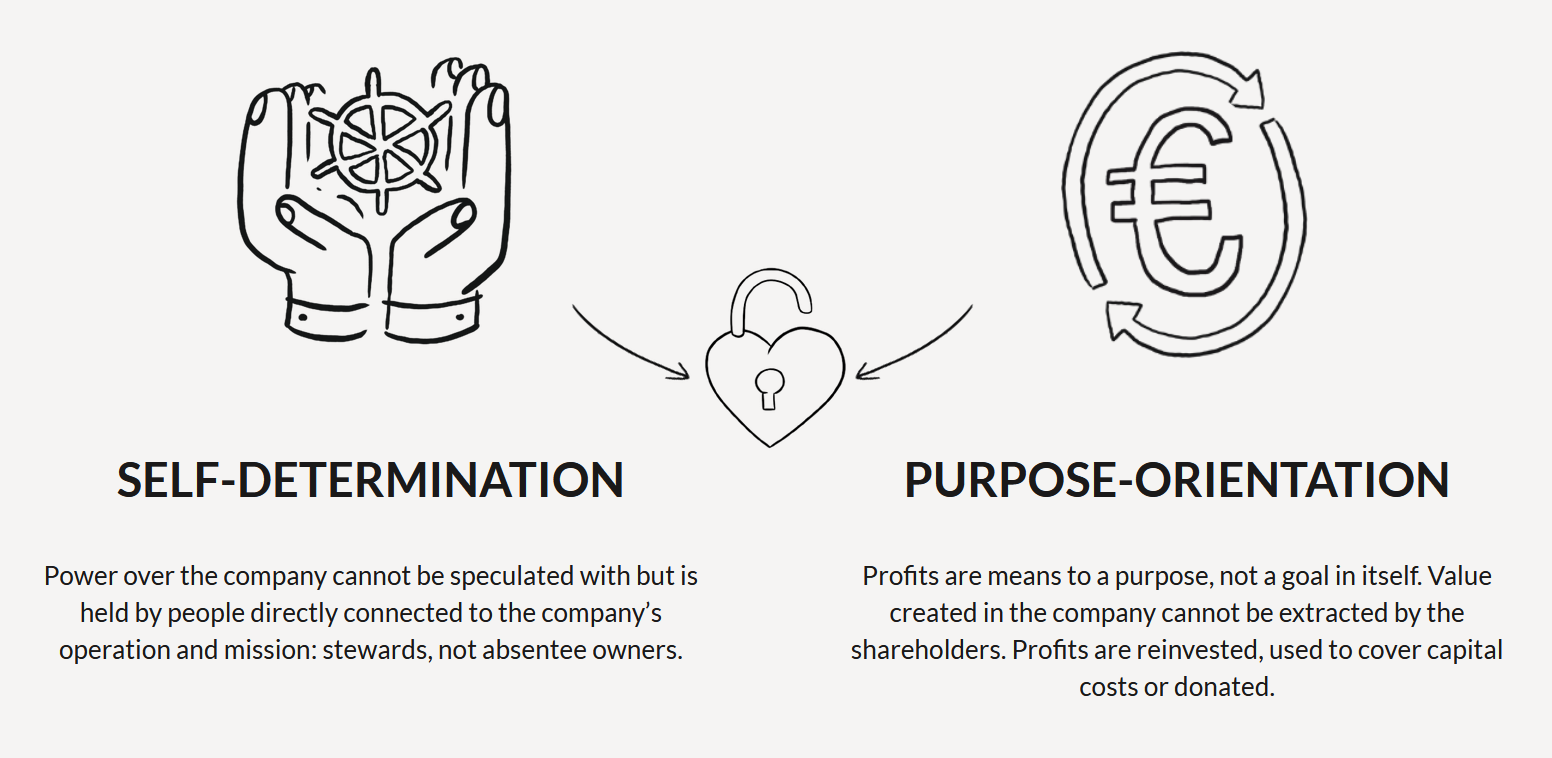
Steward ownership is a proven ownership model that has been in place for many decades – having been implemented by companies like Zeiss (Germany), Novo Nordisk (Denmark), Patagonia (USA), Bosch (Germany), Signal (USA), BuurtzorgT (Netherlands), Carlsberg (Denmark) and many others around the world.
Steward Ownership, Sustainability, and Capitalism: Part 1
Steward-ownership
Steward-ownership structures a company's ownership in a way that separates economic rights (related to money) from voting rights (related to decision-making power).[1] Steward-ownership is considered an alternative to shareholder primacy models.[2] Steward-ownership can be implemented using different legal forms depending on the type of company and jurisdiction.[3]
Steward-ownership is capitalism 2.0
In my previous post, I explained why we need to change incentive structures if we want to build companies that are a force for good in…

Company as a Commons
What if excess wealth derived from business couldn't be privatized? Through the levers of steward-ownership, companies can protect their purpose-oriented long term mission from the maligned incentives of absentee stakeholders.
The corporation—a return to origins?
This paper contributes to contemporary debates in political theory about the power of business corporations by offering a genealogy of the corporation through the lens of a series of historical mutations of the corporate form. Originally, there were two corporate forms, both non-profit: member corporations (today's associations) and property corporations (today's charitable foundations). The contemporary business corporation arguably is a hybrid of both of these original forms, introducing unique commercial features (shares with profit distribution rights that are transferable). These commercial features are largely responsible for the corporation's extractive nature, that is, its tendency to prey on non-shareholder interests. The future of the corporation may well lie in a partial return to the two original non-profit forms. Two corporate forms developed in the nineteenth century can provide the format for such a return: cooperatives (which reinforce the idea of membership) and foundation-owned companies. The cooperative structure is a halfway house between a business corporation and a member corporation (association), and in a parallel fashion, a foundation-owned company is a halfway house between a business corporation and a property corporation (foundation). If we want to reduce corporations’ extractive nature, facilitating the spread of cooperatives and foundation-owned companies seems the way forward.

Democratic Ownership Funds: Creating Shared Wealth and Power
Recent decades have seen a rapid and little-discussed transformation in corporate ownership structure, with vital consequences for company behaviour and inequality.

WSJ News Exclusive | Private-Equity Giants Back New Nonprofit Promoting Employee Ownership
More than 60 groups, including banks and pension funds, have also signed on to support Ownership Works, which aims to promote broad-based stock ownership as a means of curbing income inequality.

Shareholder Democracy Is a Corporate Governance Myth That Won’t Die
In a new article, we challenge one of corporate law’s most persistent narratives: the concept of “shareholder democracy.” With people on opposing sides of recent high-profile battles at compa…

Managing and resisting ‘degeneration’ in employee-owned businesses: A comparative study of two large retailers in Spain and the United Kingdom
Employee-owned businesses have recently enjoyed a resurgence of interest as possible ‘alternatives’ to the somewhat tarnished image of conventional investor-owned capitalist firms. Within the context of global economic crisis, such alternatives seem newly attractive. This is somewhat ironic because, for more than a century, academic literature on employee-owned businesses has been dominated by the ‘degeneration thesis’. This suggested that these businesses tend towards failure—they either fail commercially, or they relinquish their democratic characters. Bucking this trend and offering a beacon—especially in the United Kingdom —has been the commercially successful, co-owned enterprise of the John Lewis Partnership whose virtues have seemingly been rewarded with favourable and sustainable outcomes. This article makes comparisons between John Lewis Partnership and its Spanish equivalent Eroski—the supermarket group which is part of the Mondragon cooperatives. The contribution of this article is to examine in a comparative way how the managers in John Lewis Partnership and Eroski have constructed and accomplished their alternative scenarios. Using longitudinal data and detailed interviews with senior managers in both enterprises, it explores the ways in which two large, employee-owned, enterprises reconcile apparently conflicting principles and objectives. The article thus puts some new flesh on the ‘regeneration thesis’.
Introducing The Unusual Method
From Unusual Ventures’ inception, our mission has been clear: to redefine seed stage investing and build a firm that would provide founders with a distinct advantage through the hardest leg of a startup journey—from Idea to Product Market fit. Today we’ve taken an important step towards fulfilling our mission. We are proud to officially make available The Unusual Method and our Unusual Field Guide.

The Real Retail Killer
How private equity is gouging some of the country’s best-known corporate brands

What’s Unusual about Unusual Ventures?
We were recently on NBC’s Sand Hill Road podcast hosted by Scott McGrew. Here are some highlights from our conversation.

Ex-Valve employee describes ruthless internal politics at 'self-organizing' companies
He doesn't name the company in question, but it doesn't take any stretching to figure out who he's talking about in cases.

Directors of Firms Linked to Sanctioned Cambodian Conglomerate Bought Properties in Japan
Company directors connected to Cambodia’s Prince Group — which the U.S. has designated a “transnational criminal organization” — acquired luxury Tokyo properties.