


It’s no secret that we at Phoenix R&D are big fans of the Messaging Layer Security (MLS) protocol, having helped it to come into existence. It’s a versatile group key agreement and messaging protocol that’s used to power both asynchronous and real-time applications. MLS is
What is Messaging Layer Security (MLS)?
Messaging Layer Security (MLS) is an IETF working group building a modern, efficient, secure group messaging protocol.

Decentralized Pairwise MLS — Germ Network
Today, MLS is predominantly used in a centralized context, where a central entity hosts group state. Germ now leverages this powerful technology for decentralized 1:1 conversations, by letting users cooperatively advance group state.

Investigation into Message Layer Security (MLS)
This article investigates Message Layer Security (MLS), the IETF standard protocol (RFC 9420) for Signal-style end-to-end encryption. Through a practical analysis of OpenMLS (the Rust reference implementation) and a demonstration CLI chat application (mls-chat), the post reveals the substantial gap between protocol specification and production deployment. Introduction MLS (Message Layer …

Autonomous Communicator (AC) Protocol — Germ Network
“Hi, I’m Mark, here’s how you can send a message to me.” Our Autonomous Communicator (AC) Protocol empowers people to autonomously define identities which they can exchange with others to form relationships for communicating over end-to-end encrypted (E2EE) messaging channels.

Key Agreement for Decentralized Secure Group Messaging with Strong Security Guarantees
Secure group messaging protocols, providing end-to-end encryption for group communication, need to handle mobile devices frequently being offline, group members being added or removed, and the possibility of device compromises during long-lived chat sessions. Existing work targets a centralized network model in which all messages are routed through a single server, which is trusted to provide a consistent total order on updates to the group state. In this paper we adapt secure group messaging for decentralized networks that have no central authority. Servers may still optionally be used, but they are trusted less. We define decentralized continuous group key agreement (DCGKA), a new cryptographic primitive encompassing the core of a decentralized secure group messaging protocol; we give a practical construction of a DCGKA protocol and prove its security; and we describe how to construct a full messaging protocol from DCGKA. In the face of device compromise our protocol achieves forward secrecy and post-compromise security. We evaluate the performance of a prototype implementation, and demonstrate that our protocol has practical efficiency.

BeeKEM: Decentralized, Secure and Efficient Group Key Agreement
Group key agreement protocols are essential for modern secure messaging. Most existing group key agreement protocols assume a centralized model with a semi-trusted service that mediates the communication. This is efficient, but problematic for some important applications, since a central service can be a choke point for surveillance and censorship. There is a nascent literature on decentralized group key agreement that avoids such reliance, but existing proposals either do not scale, with update costs linear or quadratic in the group size, or lack proofs of security. Centralized protocols can offer much lower (logarithmic) cost. We present BeeKEM, the first decentralized group key agreement protocol with logarithmic update cost in the common case (degrading to linear in the worst case) and proofs of security. We provide an open-source implementation and demonstrate that it is competitive with OpenMLS. BeeKEM opens the door for a range of communication and collaboration applications offering not only end-to-end encryption, but also metadata privacy and censorship resistance.
ATOM: AT Protocol Over MoQ Transport
This document specifies how the Authenticated Transfer (AT) Protocol can leverage Media over QUIC Transport (MOQT) for efficient data synchronization across decentralized social networks. The AT Protocol's firehose event stream and repository synchronization mechanisms map naturally to MOQT's publish/subscribe model, enabling scalable relay infrastructure, priority-based delivery, and improved resilience for large-scale social data distribution. This specification addresses the challenges of the current WebSocket- based transport and demonstrates how MOQT's relay architecture, group-based caching, and multiplexed streams provide significant benefits for AT Protocol deployments at scale.
DIDComm: The Future of Secure and Decentralized Communication
How the W3C-Defined DIDComm Protocol is Revolutionizing Digital Messaging
ATSMS — end-to-end encrypted group messaging
Encrypted group messaging on AT Protocol identities, with no server ordering anything.
Alex Albert on Twitter / X
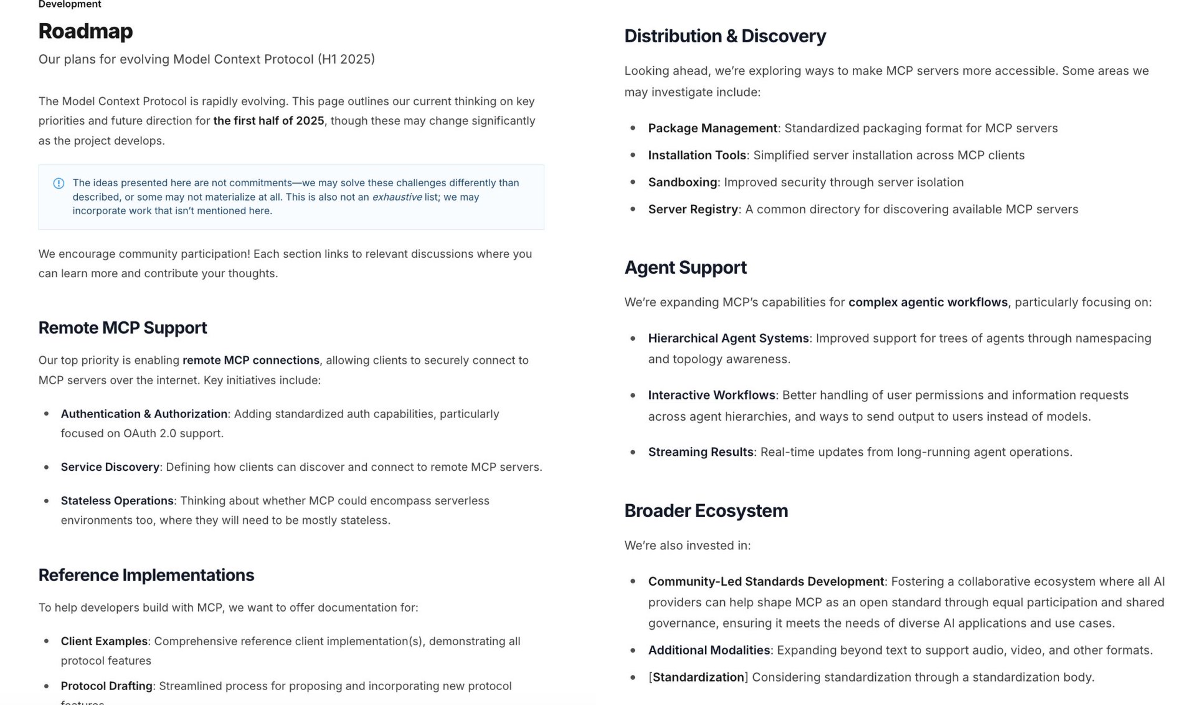
We just published a near-term development roadmap for the model context protocol (MCP)Some highlights:- Remote support (and auth!)- Reference implementations- Better package management- Agent support pic.twitter.com/SflJi1RapH— Alex Albert (@alexalbert__) January 2, 2025
XMPP - The universal messaging standard
XMPP is the Extensible Messaging and Presence Protocol, a set of open technologies for instant messaging, presence, multi-party chat, voice and video calls, collaboration, lightweight middleware, content syndication, and generalized routing of XML data.
Matrix and Element: a case study of funding an open protocol for real time chat
Matrix is a distributed comms protocol for real-time chat that looks like it is taking off.