


Walkthrough guides can be really boring so we've laced ours with spicy memes to keep those dopamine receptors firing while while we subliminally teach you the basics of our reading software. We hope you don't mind a little fun.
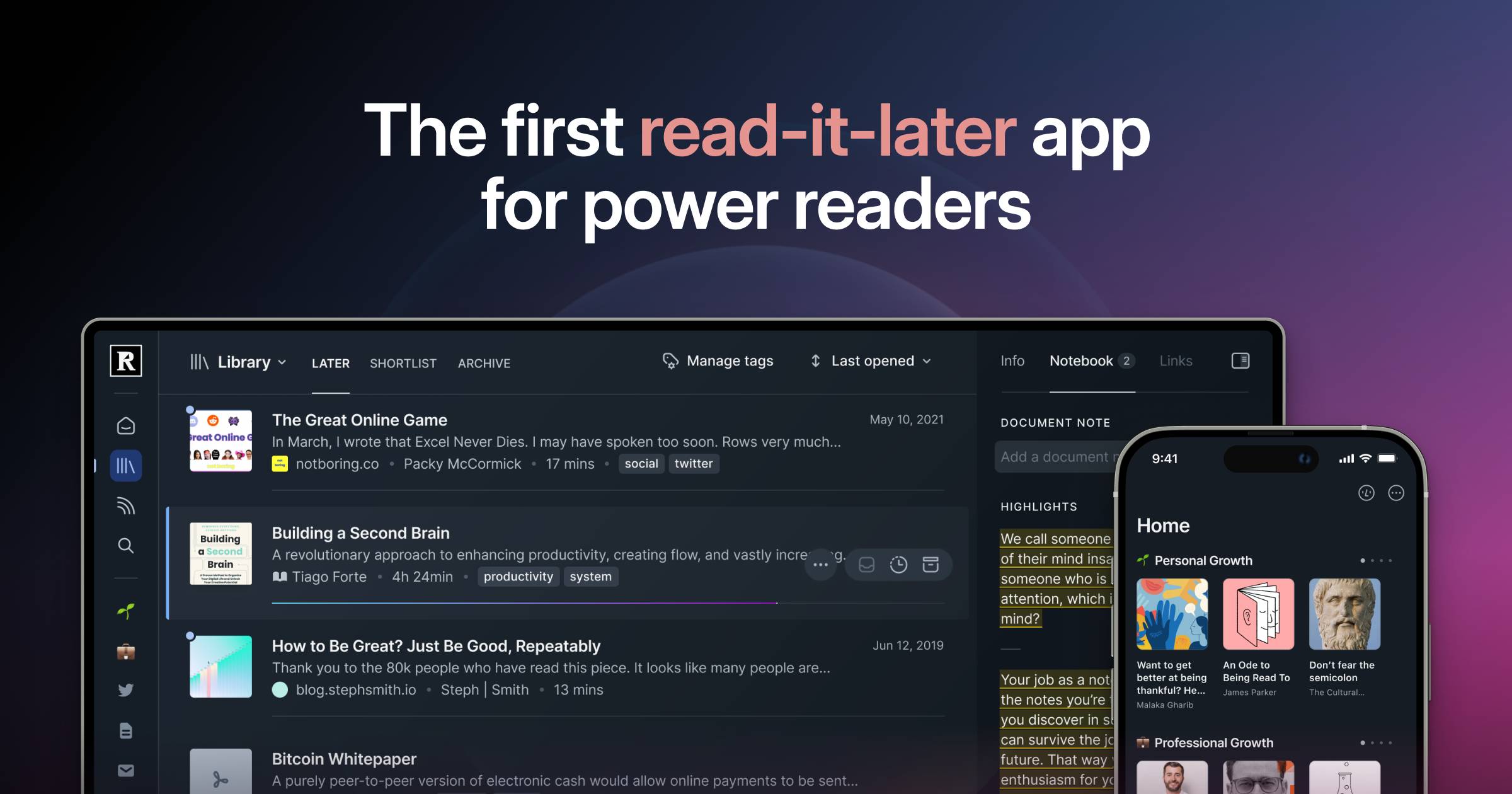
Readwise Reader: The first read-it-later app built for power readers.
Save everything to one place to overcome content overload, search instantly, and highlight like a pro.
Reader guide · Standard Reader
How to use Standard Reader — following, reading, listening, and making it yours. No technical knowledge needed.
Reader: Frequently Asked Questions
Pro Tip: Use Ghostreader on this doc 👻 One of the coolest features of Reader is an AI reading assistant called Ghostreader. Ghostreader enables you to define terms, look up encyclopedia entries, simplify complex language, and much more, but one of its most powerful functions is asking a document a question.

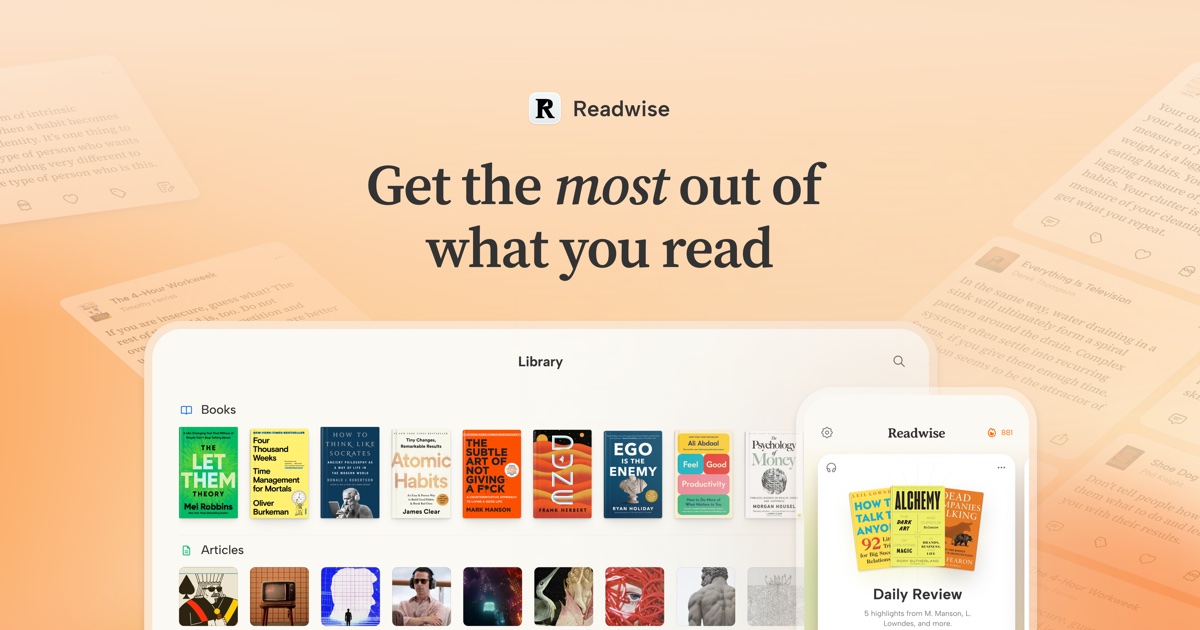
Readwise: Get the most out of what you read
Easily revisit and learn from your highlights and annotations.
Chasing RATs: Tracing Reading for and as Creative Activity
Creativity research has privileged making over the interpretive labor that precedes and shapes it. We introduce Reading Activity Traces (RATs), a proposal that treats reading -- broadly defined to include navigating, interpreting, and curating media across interconnected sources -- as creative activity both for future artifacts and as a form of creation in its own right. By tracing trajectories of traversal, association, and reflection as inspectable artifacts, RATs render visible the creative work that algorithmic feeds and AI summarization increasingly compress and automate away. We illustrate this through WikiRAT, a speculative instantiation on Wikipedia, and open new ground for reflective practice, reader modeling, collective sensemaking, and understanding what is lost when human interpretation is automated -- towards designing intelligent tools that preserve it.

Oatmeal - Screen readers
The aim here isn’t to teach you how to use a screen reader, nor really about how screen readers work. My aim is to help build a mental model of

Creative Reading: Scaffolding Reading for Transformation
Reading augmentation systems increasingly help readers process text at scale. While these tools address real constraints of time and cognitive load, they often implicitly frame reading as...
Reading List: AI and the Future of Human Autonomy
Open-source reading list from a discussion group hosted by the Liberty Fund

Letting things build
This week I put together a reading list for my digital aura series. I recall starting to write around Thanksgiving — but when I looked back at my reading, I’d started reading for it months earlier. (No wonder it’s felt like such a big endeavor!)
How I Choose What To Read - David Perell
David shares how he chooses what to read and how to build a reading habit. Read here.

Connecting with your readers on Semble [Patterns of Sensemaking #2] - Cosmik Labs
On how the references you make help your writing find its natural audience
How to create reading experiences that "go beyond information transmission and toward reader transformation.” Great paper by @blue-phia.bsky.social @lepidopterane.bsky.social @yijunliu.bsky.social Sarah Sterman @sh1m.bsky.social @maxkreminski.bsky.social arxiv.org/abs/2606.04308 >
I made a reader for standard.site called "Standard Reader" Partially inspired by Google Reader (or what i remember of it) it provides a place to browse, discover, read and subscribe to standard site publications Also has some cool features like article dictation (I like to listen to longform)

Standard Reader
Introducing Standard Reader: a calm, text-first home for long-form writing on the Atmosphere. Read standard.site publications, follow the writers you love, and find new voices across the network. standard-reader.app

