

hearkening back to the cozy vibes of old-web neighborhoods

Cozy Community Software — Open Indie
As Commune edges closer to an early-access release, I've been musing on the concept of the cozy web vibes that we intend to cultivate in ...

A space to converse and connect.
An X/Twitter Spaces alternative for Bluesky and the open web. Creating good vibes in the friendly skies.
Ambient Co-presence
Creating a subtle, peripheral, and synchronous sense of shared space and context on the web
Neighborhood Steward Fellowship | New_ Public
An eight-week program bringing together leaders of local-oriented online spaces to experiment with fun new practices and ideas

The Dark Forest and the Cozy Web
An illustrated diagram exposing the inner layers of the dark and cozy web
Architecture and the Internet: Designing places in cyberspace
Cyberspace, as the information space is called, has become accessible in the past decade through the World Wide Web. And although it can only be experienced through the mediation of computers, it is quickly becoming an alternative stage for everyday economic, cultural, and other human activities. As such, there is a potential and a need to design it according to place–like principles. Making places for human inhabitation is, of course, what architects, landscape architects, and town planners have been doing in physical space for thousands of years. It is curious, therefore, that Cyberspace designers have not capitalized on the theories, experiences, and practices that have been guiding physical place–making. While most 3D environments closely mimic physical spaces, they are, by and large, devoid of the essential characteristics that differentiate a ‘place’ from mere ‘space.’ And only rarely are they sensitive to, and take advantage of, the peculiarities of Cyberspace. We believe that this state of affairs is temporary, characteristic of early adoption stages of new technologies. As the Web matures, and as it assumes more fully its role as a destination rather than as means of communication, there will be a growing need to design it according to place–making principles. By looking at physical architecture as a case study and metaphor for organizing space into meaningful places, this paper explores the possibility of organizing Cyberspace into spatial settings that not only afford social interaction, but, like physical places, also embody and express cultural values. At the same time, because Cyberspace lacks materiality, is free from physical constraints, and because it can only be ‘inhabited’ by proxy, these ‘places’ may not necessarily resemble their physical counterparts.
Creating a Flourishing Digital Public Space for Your Local Area | Notion
A how-to guide for admins and moderators of inclusive, uplifting, and public-spirited local Facebook groups, Discord servers, subreddits, and more...

Digital Spaces Directory | New_ Public
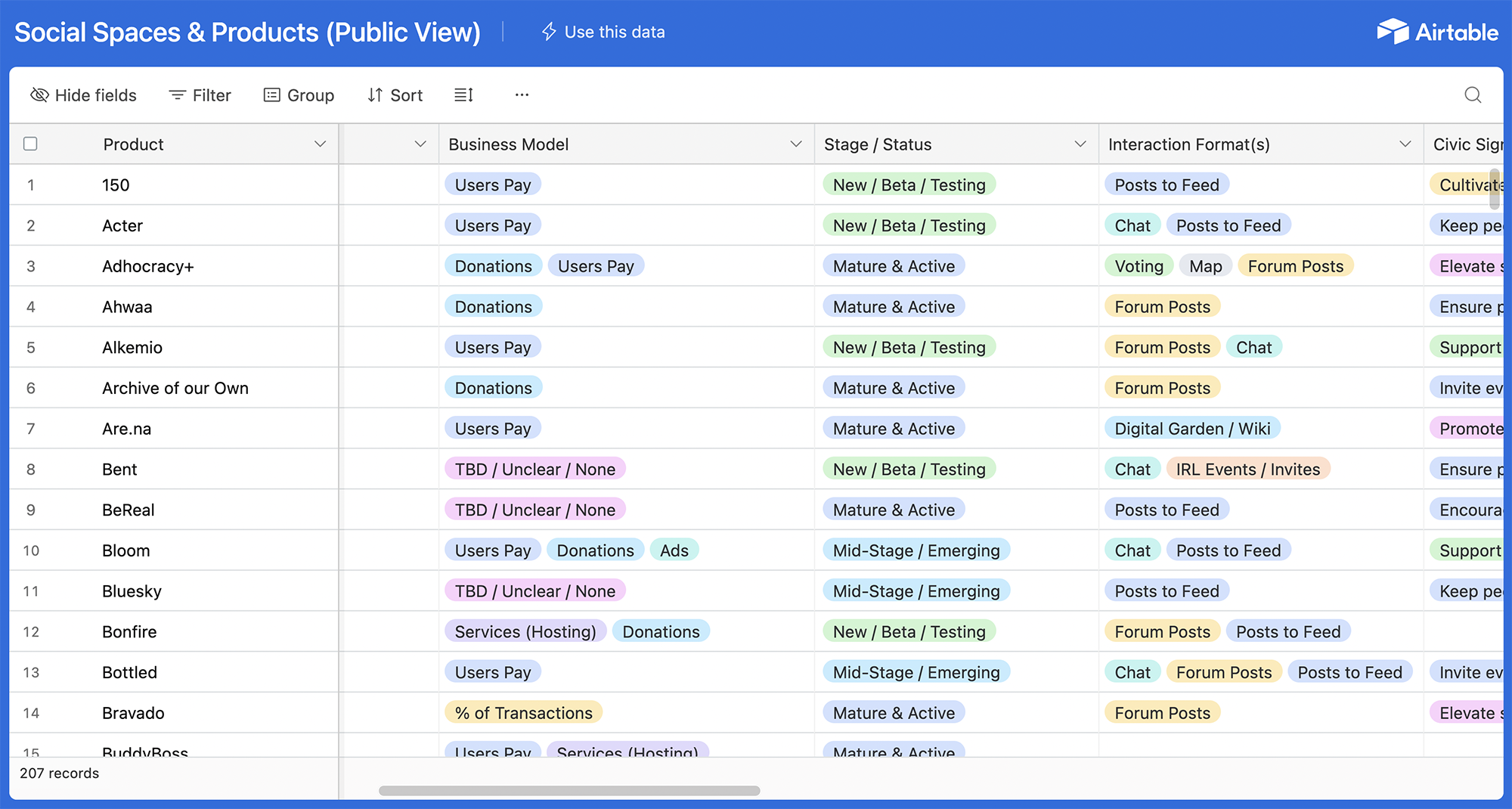
As the social media landscape changes and a new wave of digital spaces emerges, this Directory is meant to be a resource for our field — a jumping-off-point for further exploration and research for anyone who’s interested in studying, building, stewarding, or simply using digital social platforms. We hope this will inspire creative exploration, spark new collaborations, and highlight important progress.
The Local Connection Crisis: New Data on What Communities Need
Gradients of intimacy and creating shelter: An interview with Erin Kissane
How might we use nature as an inspiration for creating online communities?


hey so, @roomy.space is now generally available for real-world use! 🥳 make atmospheric group spaces for friends & community, chat in real-time, progressively structure emergent topics into evergreen threads and cultivate enduring knowledge.

Roomy is generally available
blog.roomy.space