


Recursive types, generics (sometimes called parametric polymorphism), and subtyping are all essential features for modern programming languages across numerous paradigms. However, structural subtyp…
A theory of type polymorphism in programming
The aim of this work is largely a practical one. A widely employed style of programming, particularly in structure-processing languages which impose n…
Generic deriving of generic traversals | Proceedings of the ACM on Programming Languages
Functional programmers have an established tradition of using traversals as a design pattern to work with recursive data structures. The technique is so prolific that a whole host of libraries have been designed to help in the task of automatically ...

Subtyping is Overrated - Caleb Meredith aka @calebmer at @ReactEurope 2018
Theorems for free! | Proceedings of the fourth international conference on Functional programming languages and computer architecture
The polymorphic blame calculus integrates static typing, including universal types, with dynamic typing. The primary challenge with this integration is preserving parametricity: even dynamically-typed code should satisfy it once it has been cast to a ...
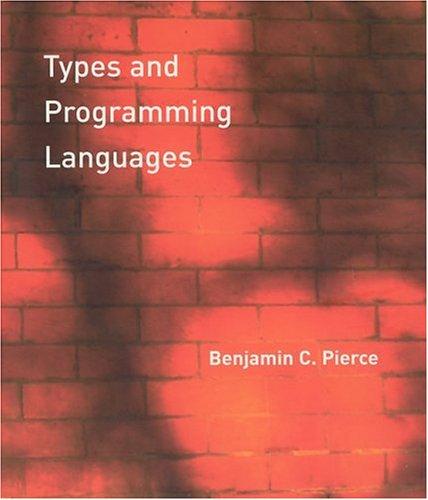
Types and Programming Languages
A type system is a syntactic method for automatically checking the absence of certain erroneous behaviors by classifying program phrases according to the kinds of values they compute. The study of type systems--and of programming languages from a type-theoretic perspective -- -has important applications in software engineering, language design, high-performance compilers, and security. This text provides a comprehensive introduction both to type systems in computer science and to the basic theory of programming languages. The approach is pragmatic and operational; each new concept is motivated by programming examples and the more theoretical sections are driven by the needs of implementations. Each chapter is accompanied by numerous exercises and solutions, as well as a running implementation, available via the Web. Dependencies between chapters are explicitly identified, allowing readers to choose a variety of paths through the material. The core topics include the untyped lambda-calculus, simple type systems, type reconstruction, universal and existential polymorphism, subtyping, bounded quantification, recursive types, kinds, and type operators. Extended case studies develop a variety of approaches to modeling the features of object-oriented languages.
Syntax and Semantics of Linear Dependent Types
A type theory is presented that combines (intuitionistic) linear types with type dependency, thus properly generalising both intuitionistic dependent type theory and full linear logic. A syntax...

Paramorphism
In formal methods of computer science, a paramorphism (from Greek παρά, meaning "close together") is an extension of the concept of catamorphism first introduced by Lambert Meertens[1] to deal with a form which “eats its argument and keeps it too”,[2][3] as exemplified by the factorial function. Its categorical dual is the apomorphism.
Simply Typed Reverse-Mode Automatic Differentiation with Variants: Denotational Correctness via Idempotent Completion
Reverse-mode automatic differentiation can be derived denotationally as a structure-preserving interpretation of program syntax. In the usual simply typed model, each source type has one cotangent type. Variants break this representation because the valid cotangent space depends on the branch selected at run time; established correctness results therefore use primal-indexed families of cotangent spaces, whose direct internal language is dependent.
A modal analysis of staged computation | Journal of the ACM
We show that a type system based on the intuitionistic modal logic S4 provides an expressive framework for specifying and analyzing computation stages in the context of typed λ-calculi and functional languages. We directly demonstrate the sense in which ...

Categories of Containers
We introduce the notion of containers as a mathematical formalisation of the idea that many important datatypes consist of templates where data is stored. We show that containers have good closure properties under a variety of constructions including the formation of initial algebras and final coalgebras. We also show that containers include strictly positive types and shapely types but that there are containers which do not correspond to either of these. Further, we derive a representation result classifying the nature of polymorphic functions between containers. We finish this paper with an application to the theory of shapely types and refer to a forthcoming paper which applies this theory to differentiable types.
The Principal Type-Scheme of an Object in Combinatory Logic
R. Hindley, The Principal Type-Scheme of an Object in Combinatory Logic, Transactions of the American Mathematical Society, Vol. 146 (Dec., 1969), pp. 29-60
Syntax and semantics of dependent types
In this chapter we fix a particular syntax for a dependently typed calculus and define an abstract notion of model as well as a general interpretation function mapping syntactical objects to entities in a model. This interpretation function is shown to be sound with respect to the syntax.
Abstract syntax and variable binding
We develop a theory of abstract syntax with variable binding. To every binding signature we associate a category of models consisting of variable sets endowed with compatible algebra and substitution structures. The syntax generated by the signature is the initial model. This gives a notion of initial algebra semantics encompassing the traditional one; besides compositionality, it automatically verifies the semantic substitution lemma.
Principal type-schemes for functional programs | Proceedings of the 9th ACM SIGPLAN-SIGACT symposium on Principles of programming languages
As part of the Digital Library's transition to Open Access, new features for researchers are available in the Premium Edition. Click here to learn more.
A formulation of the simple theory of types
The purpose of the present paper is to give a formulation of the simple theory of types which incorporates certain features of the calculus of λ-conversion. A complete incorporation of the calculus of λ-conversion into the theory of types is impossible if we require that λx and juxtaposition shall retain their respective meanings as an abstraction operator and as denoting the application of function to argument. But the present partial incorporation has certain advantages from the point of view of type theory and is offered as being of interest on this basis (whatever may be thought of the finally satisfactory character of the theory of types as a foundation for logic and mathematics).For features of the formulation which are not immediately connected with the incorporation of λ-conversion, we are heavily indebted to Whitehead and Russell, Hilbert and Ackermann, Hilbert and Bernays, and to forerunners of these, as the reader familiar with the works in question will recognize.The class of type symbols is described by the rules that ı and o are each type symbols and that if α and β are type symbols then (αβ) is a type symbol: it is the least class of symbols which contains the symbols ı and o and is closed under the operation of forming the symbol (αβ) from the symbols α and β.
Implementing a Hindley-Milner Type System (Part 1) | Blog
First part of a tutorial on implementing a Hindley-Milner type system for a simple, purely functional programming language in Haskell. We go over syntax representation, how the Hindley-Milner type system is defined, polymorphism vs. monomorphism, generalization, and instantiation.