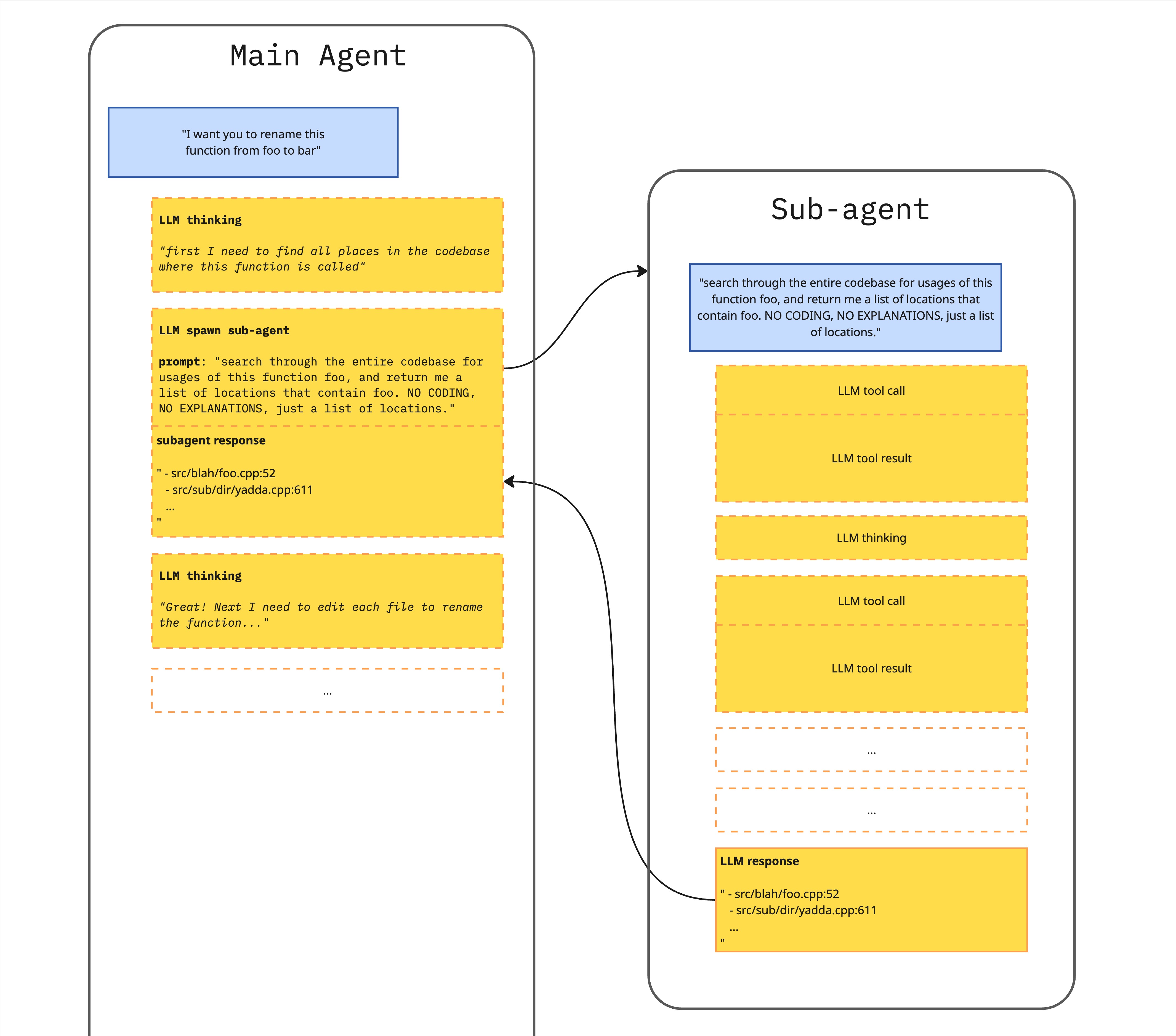
Managing your coding agent's context is super important - a bloated context window will erode the quality of your agent's work over time. Learn some new techniques for trimming irrelevant details from your conversation history while retaining what matters.
Context Engineering
Context engineering strategies for AI agents: write, select, compress, and isolate context to optimize performance and manage long-running tasks.
Supermemory
The memory layer for AI agents. Context engineering platform powering enterprise APIs, developer plugins, and a personal app that remembers everything.

Context Constitution
Today we are releasing the Context Constitution: a set of principles governing how AI agents manage context to learn from experience.

Agentic Context Management: Solving Agent Memory and Cost by Treating Them as Lifecycle and Architecture Problems
Production AI agents' failures are less often due to an inability to reason well and more often because they cannot manage what is in their reasoning context: conversation histories, large prompts, large tool definitions, and ballooning tool outputs. Agents drown in their own accumulating history while paying a token cost that grows every turn, producing missing recalls within and across conversations. The incumbent response treats this as a storage-and-retrieval problem. We argue that framing is too narrow. Actively managing what an agent holds in mind is a lifecycle, not merely a store: it spans deciding what to remember, extracting and structuring it, choosing the right store per data type, consolidating and forgetting while preserving provenance, deciding what is relevant now, anticipating what is needed next, and compacting context to a budget without losing what matters. In serious production this operates not over a single user but across an organizational scope hierarchy. We name this discipline Agentic Context Management (ACM) and decompose it into five primitives: architecting, ingesting, scoping, anticipating, and compacting & consolidation. We then make the economic case: naive context accumulation grows token cost quadratically in conversation length, crude summarization buys linear cost at the price of an accuracy cliff, and only validated compaction achieves linear cost with preserved fidelity. We describe a reference implementation, Maximem Synap, that realizes the five primitives as a multi-tenant service and reports 92% on LongMemEval and 93.2% on LoCoMo under the configuration detailed in Section 6. We close with dimensions existing benchmarks do not yet capture, latency, token efficiency, and context-rot resistance, and the frontier of decision-level and organization-level context the category points toward.

Code execution with MCP: building more efficient AI agents
Learn how code execution with the Model Context Protocol enables agents to handle more tools while using fewer tokens, reducing context overhead by up to 98.7%.

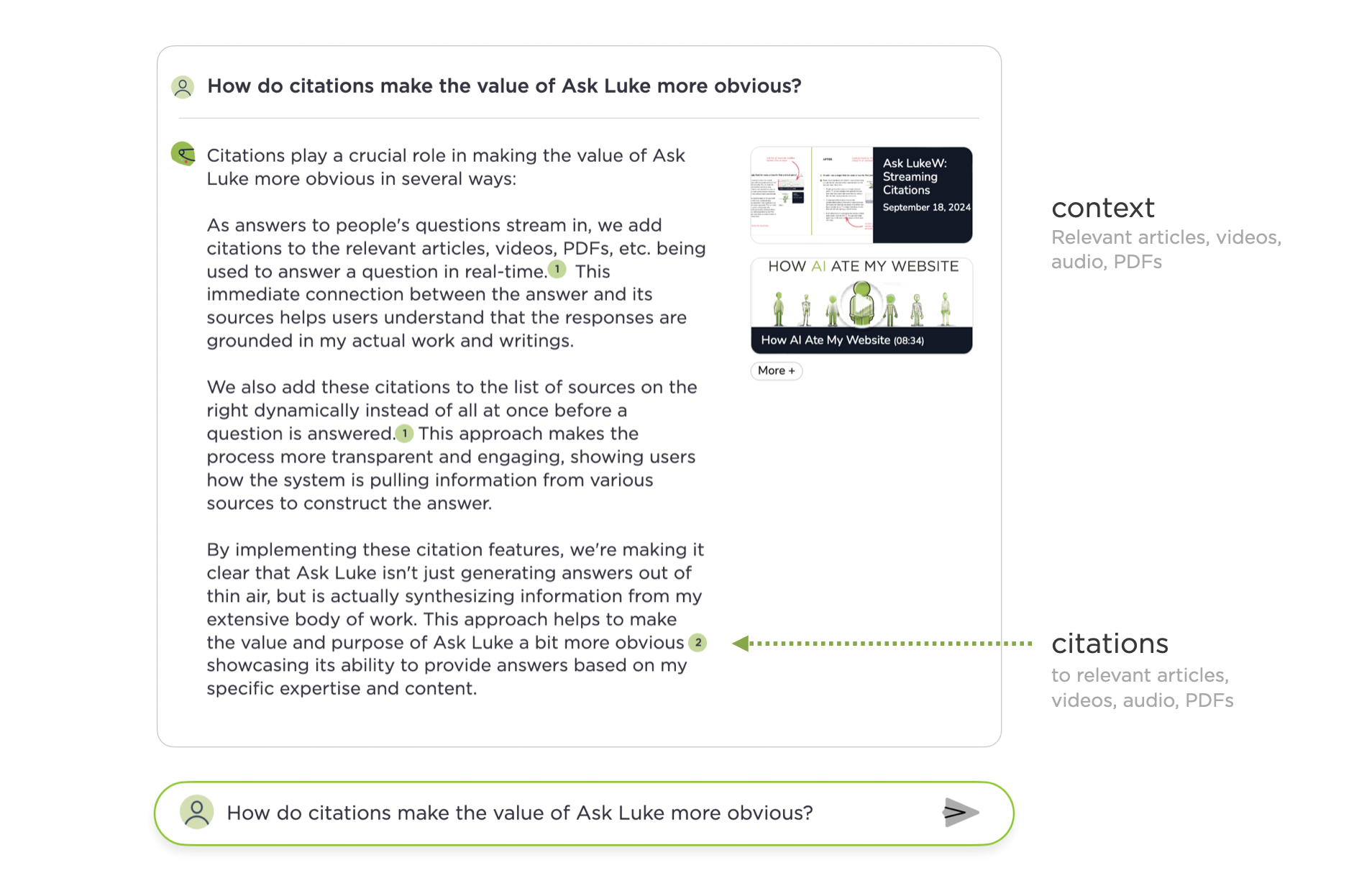
LukeW | Context Management UI in AI Products
They say context is king and that's certainly true in AI products where the content, tools, and instructions applications provide to AI models shape their behav...
AI Agent Memory: Complete Guide & Architecture
AI agent memory: what it is, how it works, architecture, memory types, and how to add persistent long-term context.

AI Code
As AI Coding Agents write more code, it's more important than ever that we're intentional about the code it writes.
yzfly/awesome-context-engineering
A curated collection of resources, papers, tools, and best practices for Context Engineering in AI agents and Large Language Models (LLMs).
Dynamic context discovery · Cursor
As models improve as agents, we've found success by providing fewer details up front, making it easier for the agent to pull relevant context on its own.

MemGPT: Towards LLMs as Operating Systems
Large language models (LLMs) have revolutionized AI, but are constrained by limited context windows, hindering their utility in tasks like extended conversations and document analysis. To enable using context beyond limited context windows, we propose virtual context management, a technique drawing inspiration from hierarchical memory systems in traditional operating systems that provide the appearance of large memory resources through data movement between fast and slow memory. Using this technique, we introduce MemGPT (Memory-GPT), a system that intelligently manages different memory tiers in order to effectively provide extended context within the LLM's limited context window, and utilizes interrupts to manage control flow between itself and the user. We evaluate our OS-inspired design in two domains where the limited context windows of modern LLMs severely handicaps their performance: document analysis, where MemGPT is able to analyze large documents that far exceed the underlying LLM's context window, and multi-session chat, where MemGPT can create conversational agents that remember, reflect, and evolve dynamically through long-term interactions with their users. We release MemGPT code and data for our experiments at https://memgpt.ai.
Agentic Context Engineering: Evolving Contexts for Self-Improving Language Models
Large language model (LLM) applications such as agents and domain-specific reasoning increasingly rely on context adaptation: modifying inputs with instructions, strategies, or evidence, rather than weight updates. Prior approaches improve usability but often suffer from brevity bias, which drops domain insights for concise summaries, and from context collapse, where iterative rewriting erodes details over time. We introduce ACE (Agentic Context Engineering), a framework that treats contexts as evolving playbooks that accumulate, refine, and organize strategies through a modular process of generation, reflection, and curation. ACE prevents collapse with structured, incremental updates that preserve detailed knowledge and scale with long-context models. Across agent and domain-specific benchmarks, ACE optimizes contexts both offline (e.g., system prompts) and online (e.g., agent memory), consistently outperforming strong baselines: +10.6% on agents and +8.6% on finance, while significantly reducing adaptation latency and rollout cost. Notably, ACE could adapt effectively without labeled supervision and instead by leveraging natural execution feedback. On the AppWorld leaderboard, ACE matches the top-ranked production-level agent on the overall average and surpasses it on the harder test-challenge split, despite using a smaller open-source model. These results show that comprehensive, evolving contexts enable scalable, efficient, and self-improving LLM systems with low overhead.
Context Engineering for AI Agents: Lessons from Building Manus
This post shares the local optima Manus arrived at through our own "SGD". If you're building your own AI agent, we hope these principles help you converge faster.

Effective context engineering for AI agents
Anthropic is an AI safety and research company that's working to build reliable, interpretable, and steerable AI systems.

Context Engineering | Meetup
"Context engineering is the delicate art and science of filling the context window with just the right information for the next step" - Andrej KarpathyLearn about tools, frameworks, and code that is in service of context engineering from practitioners in this space.Dive into the set of strategies fo

The 80% Problem in Agentic Coding
Managing comprehension debt when leaning on AI to code