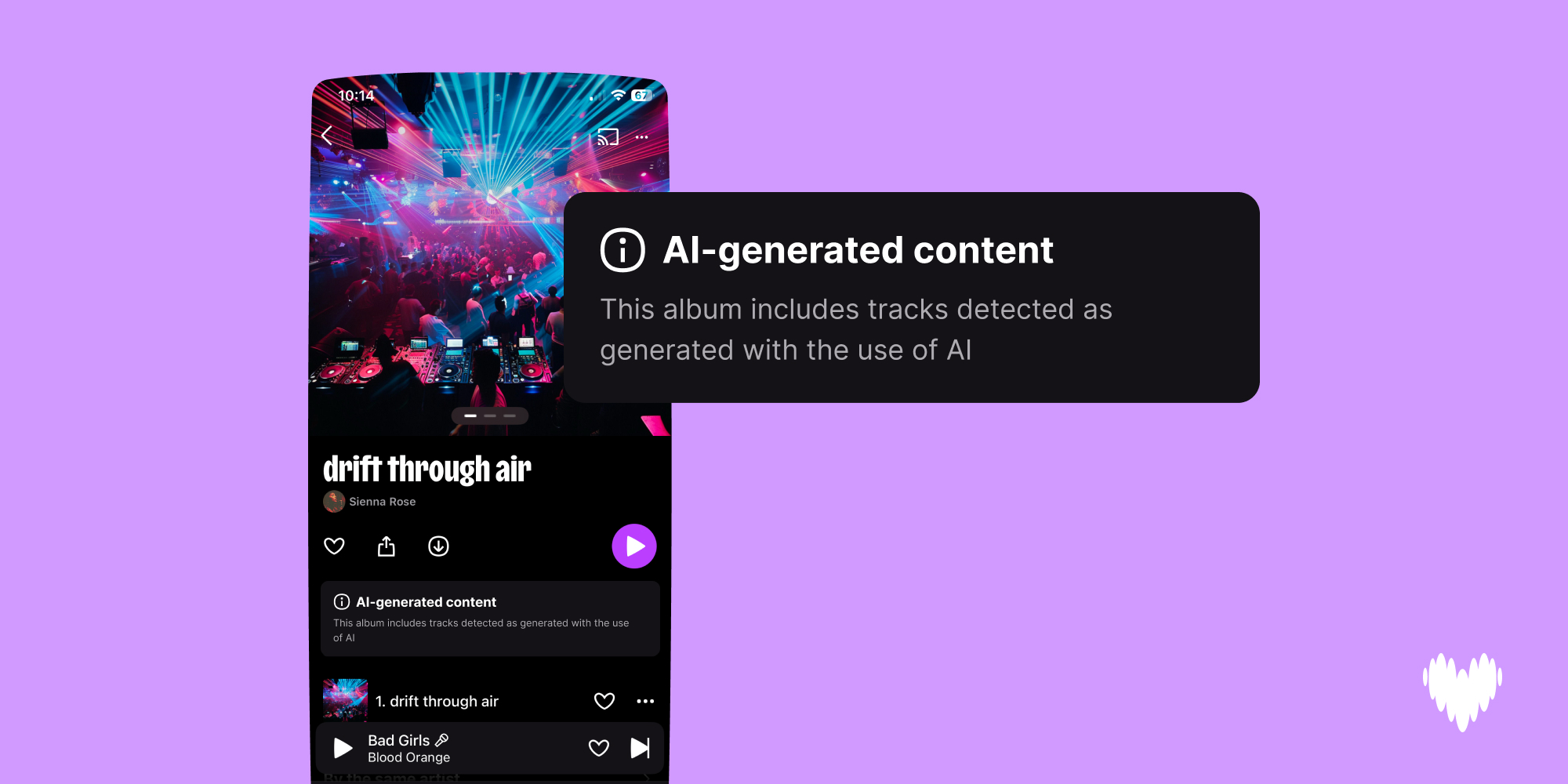
We’re introducing new labels and details in YouTube Music to give you more transparency when songs are created primarily using generative AI.
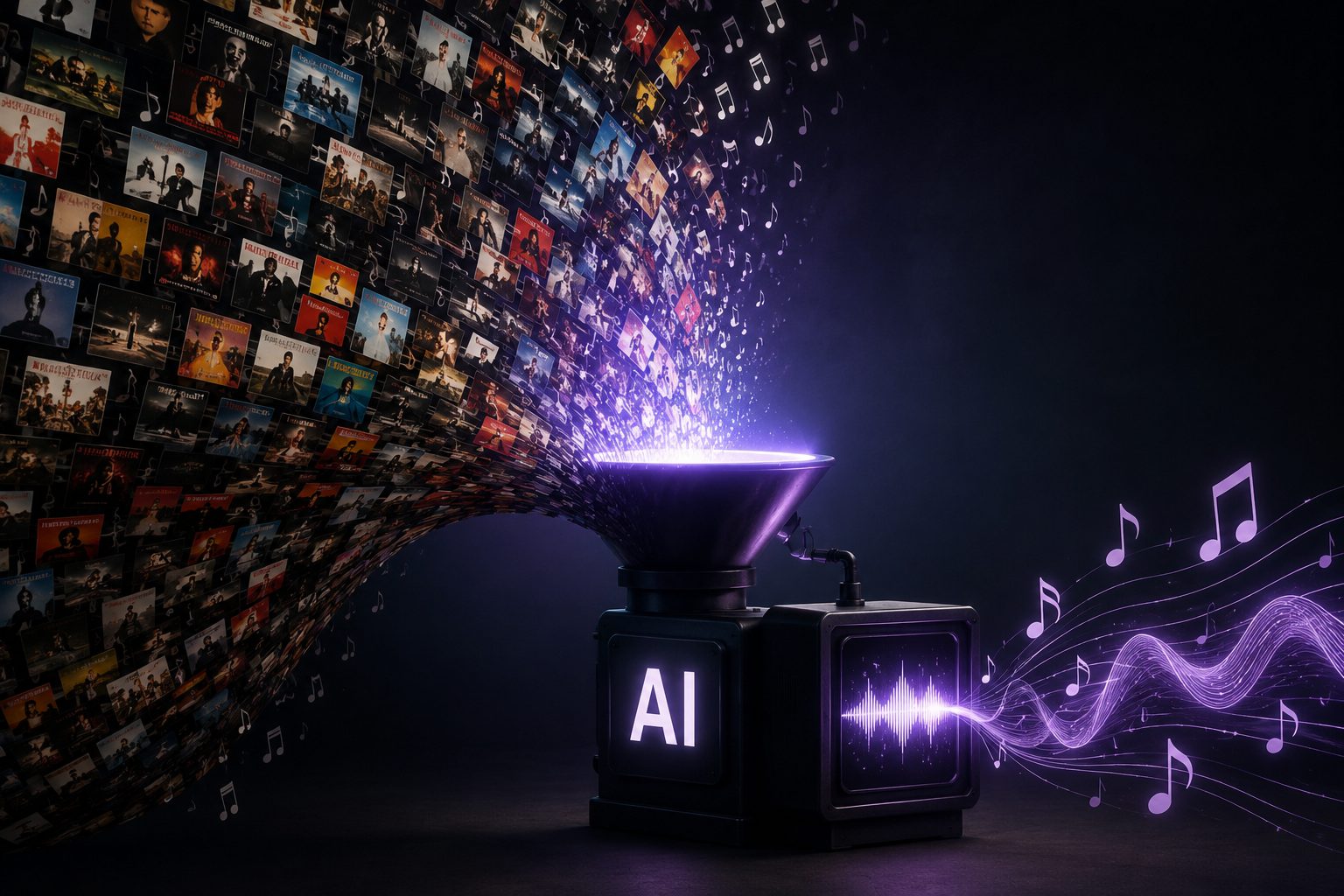
The Millions of Songs Mashed Into AI-Generated Music
Explore the astonishing amount of music available to AI developers.

HAIM: Human-AI Music Datasets for AI Music Production Tracking Benchmark
As generative platforms such as Suno and Udio reach human-grade audio quality, the scope of AI's utility has expanded across the entire music production workflow. Beyond simple track generation, these advancements have catalyzed the adoption of AI-driven methodologies in diverse forms. These include vocal synthesis, arrangement, and professional mastering. However, current detection research remains largely confined to a binary `AI-or-human' paradigm. It fails to reflect the realities of contemporary music production workflows. In real-world production, AI tools are increasingly used to refine or master human-produced tracks, and human engineers likewise post-process AI-generated material to ensure professional quality. Moreover, users often employ adversarial tactics to bypass AI detectors, such as applying human mastering to AI-generated tracks. This creates a grey area that a simple binary classification fails to capture. In this paper, we define and investigate ``AI Music Tracking'': the challenge of identifying specific AI integration across the multifaceted spectrum of music production. To this end, we introduce HAIM, a dataset with diverse labels for stages of music production. It is designed to isolate stages of AI intervention, including hybrid production and agent-level tracking. Our evaluation of state-of-the-art detectors reveals systemic flaws. By releasing HAIM, we propose a new benchmark that shifts the field beyond binary classification toward a granular, structured evaluation of AI music.

Millions of Copyrighted Songs Were Fed to AI Music Generators – Now There's Proof
Millions of copyrighted songs trained AI music generators, and new searchable databases from The Atlantic now confirm which tracks were used.
Deezer: AI-generated tracks now represent 44% of all new uploaded music - Deezer Newsroom
As the only streaming platform tagging AI-generated music, Deezer now reveals that nearly 75,000 AI-tracks are uploaded every day
Inside the Don’t Ask, Don’t Tell Era of AI in Music
From juicing demos to cloning vocals, AI music tools are creeping into the workflows of top producers, songwriters and artists. It’s mostly happening behind closed doors — for now

Google is embedding inaudible watermarks right into its AI generated music
SynthID comes to audio.

Why We’re Taking a Human‑First Stand on AI‑Generated Music — Qobuz Community
Artificial intelligence is transforming the music industry at an unprecedented pace. Faced with the explosion of AI-generated content and the legitimate questions it raises, Qobuz has chosen transparency. This charter establishes our framework: how we use AI, where we draw our lines, and what commi

IFPI Rolls Out Global Principles for the Eligibility of Recordings Developed Using AI in Official Music Charts Worldwide - IFPI
~ New principles to be applied across IFPI’s network of official charts ~ 30 July 2026, London – IFPI, the organisation representing the recording industry worldwide, today announced the roll out of a new set of principles to govern the eligibility of recordings developed with generative artificial intelligence (GenAI) services for inclusion in official music […]

AI music is flooding streaming platforms. But listeners like it less and less
Music fans are becoming increasingly uncomfortable with AI songs, according to a recent study.

How Much AI Is in This Track? Quantifying the Proportion of AI-Generated Stems in Hybrid Music Mixtures
AI-generated music is increasingly used at the stem level, with producers integrating synthetic drums, basslines, or vocals alongside human-performed instruments. However, current AI music detection systems are binary, treating tracks as either fully AI or fully human. In this paper, we reformulate AI music detection as a regression problem on a continuous AI energy ratio, alpha in [0, 1]. We propose a methodology that leverages a multi-track music dataset to assemble mixtures of human-performed and AI-reconstructed stems (obtained using a neural audio codec) with known proportions of each content type. Using this approach, we first show that a CNN-based model trained on fully AI-generated or human-performed tracks, which achieves >99% accuracy as a binary detector, when faced with mixed content, yields an output that rises with the AI stems' energy contribution, acting as a noisy and miscalibrated estimator. Our analysis of the influence of different stems shows that detection sensitivity depends on the instrument and reflects its frequency content: drums and guitar carry strong codec-artifact signatures, while vocals and bass are less detectable. Based on these insights, we train a similar CNN-based model for regression of alpha, achieving MAE = 0.076 and R^2 = 0.85 on held-out mixtures from the same pipeline. These results suggest that the regression formulation is an initial promising step towards AI-music detection in realistic music production workflows.
From Prompting to Describing: A Cross-Cultural Study of Language for AI-Generated Music
Recent text-to-music (TTM) systems such as Suno [22], Udio [23], and Google’s MusicFX [7] allow users to generate music from a natural language prompt, lowering the barrier to music creation for users without specialized musical knowledge [27]. Understanding how users write these prompts is therefore a fundamental question for music information retrieval and human-AI interaction research. Yet, prompting a generative system is not the same cognitive or linguistic act as describing music one has heard [12]. When a user writes a prompt, they encode anticipatory intent to steer the system toward a desired or imagined output, whereas when a listener describes a piece of music, their language is grounded in a perceptual experience. We argue that these two acts produce systematically different language—a distinction that, despite being intuitive, has not been quantitatively examined. This gap has practical consequences: recent TTM models are trained predominantly on metadata-centric corpora (genre labels, BPM, descriptive tags) [6] rather than on the kind of language users naturally produce when listening, leaving the prompt-description gap unexamined. Moreover, this gap limits our ability to evaluate and improve human–AI interaction in music generation, as current systems are optimized for prompt input but commonly assessed through human perception.
SlopTracker — Exposing AI-Generated Artists on Spotify
AI-generated artists are flooding Spotify, racking up millions of streams, and siphoning revenue from real musicians. See the receipts.

Deezer Launches Free AI Music Detector for Playlists
43% of people joining Deezer from other streaming platforms already have AI music in their playlists

AI music tools challenge Bay Area musicians
AI music tools challenge Bay Area musicians: As affordable AI platforms spread, artists debate creativity, copyright and survival.

Google’s invisible AI watermark will help identify generative text and video
New AI tools to generate videos and detect them as well.

Who owns an AI generated song? What we can learn from the phonograph and the evolution of copyright laws
History suggests copyright adapts to technology. AI may be no exception.