

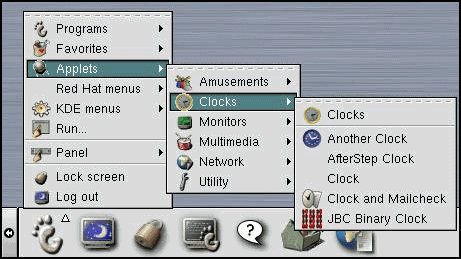
This is a bloggified version of the talk that I gave at GUADEC 2017. In converting it into print, it has been elaborated and refined. When I first got involved in GNOME, one of the things that...
Generative UI: A rich, custom, visual interactive user experience for any prompt
Yaniv Leviathan, Google Fellow, Dani Valevski, Senior Staff Software Engineer, Vishnu Natchu, Principal Engineer, and Yossi Matias, Vice President & Head of Google Research

Textualize - Home
And you’re done! Now run the following to get an impression of what it can do:

UI design is fun! (inspirational ways of looking at UI, and discussing how to better understand UI’s place in game design…) – The Candybox Blog
This post is an extended writeup of what would have been my GDC2020 talk. Since the conference has been postponed I’m sharing parts of this talk as a blogpost (I elaborated on what would have been my talk. This post is much longer).
Reverse-engineering Claude's generative UI - then building it for the terminal
Extracting Anthropic's design system from a conversation export and rebuilding generative UI for the terminal.
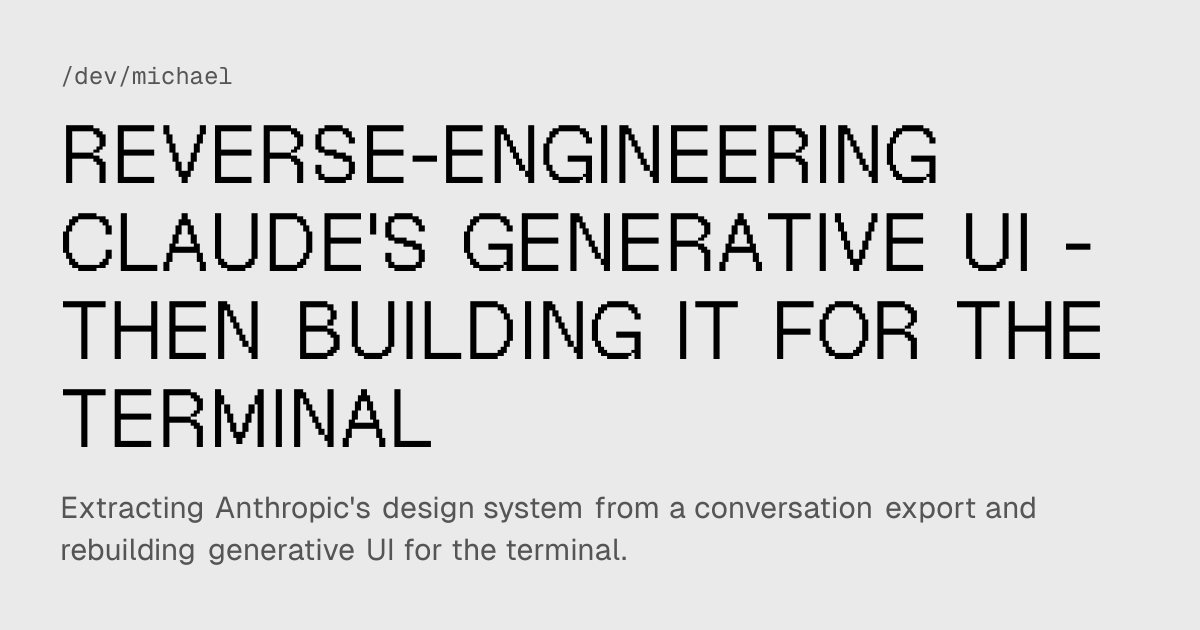
on ui as a metaphor
a personal manifesto and declaration - also known as I am threading a connection through all the notes I've sent myself over the last six months
MCP Apps
Build interactive UIs for MCP tools — charts, forms, dashboards — that render inline in Claude, ChatGPT and any other compliant chat client. Why · Quickstart...
Introducing Open Intelligent UI | The Open-Source Alternative to ChatGPT's Intelligent UI
Living documents and interactive schematics — Selin Jessa
Using LLMs to turn static figures from data analysis, schematics, and publications into interactive widgets as tools for thought
Reflection — Modal Collective
Reflection is a native GTK note taking app with local-first collaboration built on p2panda. It’s part of a broader initiative to make local-first sync a standard feature of the GNOME developer platform, and allow any app developer to easily add local-first sync to their app. You can learn more about the project from these blogposts: Apr 2026 – The Road to a Local-First App Ecosystem Apr 2026 – Reflection Spring 2026 Update Dec 2025 – Reflection Winter 2025 Update Aug 2025 – GUADEC 2025 Jun 2025 – Aardvark Summer 2025 Update Dec 2024 – Introducing Project Aardvark Nov 2023 – GNOME+p2panda Workshop Sep 2023 – GNOME 45 Hackfest Current Status Reflection is available as a preview release. We’re waiting for p2panda 1.0 before doing a stable release to avoid potentially difficult data migrations.

GUIdebook: Graphical User Interface gallery
GUIdebook: Graphical User Interface gallery
The new contribution workflow for GNOME
Hello community, I have big good news to share with you. You might know we have been working for years on materializing what we wanted the future of contribution to be, we did multiple iterations a…

Magic Ink: Information Software and the Graphical Interface
This draft was released March 15, 2006. Please email comments to bretworrydream.com. You can also download the PDF.
Magic Ink: Information Software and the Graphical Interface
This draft was released March 15, 2006. Please email comments to bretworrydream.com. You can also download the PDF.
Desktop 0.46.0
Hi dear Anytypers! We're thrilled to announce a major update and introduce a fundamental shift in Anytype's core organizing structure. We're streamlining our user experience by eliminating the current behavior and bringing a clearer, more intuitive way to use Types. The new Anytype reimagines …

Cultural Computing with Context-Aware Application: ZENetic Computer
We offer Cultural Computing as a method for cultural translation that uses scientific methods to represent the essential aspects of culture. Including images that heretofore have not been the focus of computing, such as images of Eastern thought and Buddhism, and the Sansui paintings, poetry and kimono that evoke these images, we projected the style of communication developed by Zen schools over hundreds of years into a world for the user to explore – an exotic Eastern Sansui world. Through encounters with Zen Koans and haiku poetry, the user is constantly and sharply forced to confirm the whereabouts of his or her self-consciousness. However, there is no "right answer" to be found anywhere.
