
Philosopher Tim Maudlin sees advances in free will, morality and the meaning of quantum mechanics
The clockwork universe: is free will an illusion?
The long read: A growing chorus of scientists and philosophers argue that free will does not exist. Could they be right?

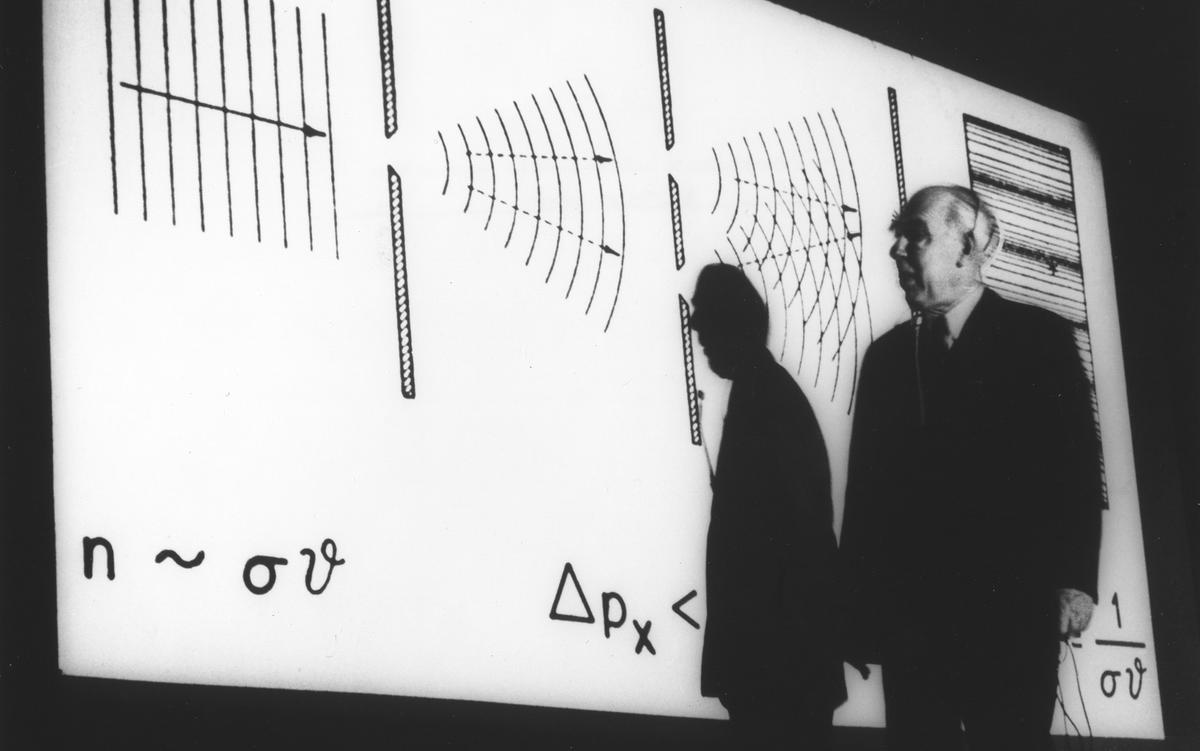
‘Shut up and calculate’ does a disservice to quantum mechanics | Aeon Essays
The cliché has it that the Copenhagen interpretation demands adherence without deep enquiry. That does physics a disservice
The Consistent Histories Approach to Quantum Mechanics
The consistent histories, also known as decoherent histories, approachto quantum interpretation is broadly compatible with standard quantummechanics as found in textbooks. However, the concept ofmeasurement by which probabilities are introduced in standardquantum theory no longer plays a fundamental role. Instead,all quantum time dependence is probabilistic (stochastic),with probabilities given by the Born rule or its extensions. Byrequiring that the description of a quantum system be carried outusing a well-defined probabilistic sample space (called a“framework”) this approach resolves many well-knownquantum paradoxes of quantum foundations. In particular, quantummechanics is local and consistent with special relativity. Classicalmechanics emerges as a useful approximation to the more fundamentalquantum mechanics under suitable conditions. The price to be paid forthis is a set of rules for reasoning resembling, but very much simplerthan, those of quantum logic. An important philosophical implicationis the absence of a single universally-true state of affairs at eachinstant of time. However, there is a correspondence limit in which thenew quantum logic becomes standard logic in the macroscopic world ofeveryday experience, and the laws of classical mechanics emerge as agood approximation to an underlying, and in principle more exact,quantum description.

Beyond Freedom and Dignity
Beyond Freedom and Dignity is a 1971 book by American psychologist B. F. Skinner. Skinner argues that entrenched belief in free will and the moral autonomy of the individual hinders the prospect of using scientific methods to modify behavior for the purpose of building a happier and better-organized society.

Against Economics
Mainstream economists nowadays might not be particularly good at predicting financial crashes, facilitating general prosperity, or coming up with models for preventing climate change, but when it comes to establishing themselves in positions of intellectual authority, unaffected by such failings, their success is unparalleled. One would have to look at the history of religions to find anything like it. To this day, economics continues to be taught not as a story of arguments—not, like any other social science, as a welter of often warring theoretical perspectives—but rather as something more like physics, the gradual realization of universal, unimpeachable mathematical truths.

Prescriptivism vs Descriptivism | The Paper Pilot
The Paper Pilot's digital garden of thoughts on philosophy, politics, and sociology
Can Longtermism Save Us All?
William MacAskill, author of What We Owe the Future, and Robert Wright debate longtermism.
Retrofuturism
As I’ve mentioned before, I’m an avid reader of L.M. Sacasas’s Convivial Society which I feel offers some of the best thinking on technology while always remaining clear and accessible, with no sensationalism and an abiding humanity. So when Mike wrote in the latest instalment (III.9) that he was offering seven theses “less cautiously formulated” with the thought that they might elicit some responses, I found jumping in hard to resist.

How are we writing the future of humanity?
Consciousness spinning

The Experience of God: Being, Consciousness, Bliss
The Experience of God: Being, Consciousness, Bliss is a 2013 book by philosopher and religious studies scholar David Bentley Hart published by Yale University Press. The book lays out a statement and defense of classical theism and attempts to provide an explanation of how the word "God" functions in the theistic faiths, drawing particularly from Christianity, Islam and Hinduism.

Planar Pioneers | The Paper Pilot
The Paper Pilot's digital garden of thoughts on philosophy, politics, and sociology
On technological optimism and technological pragmatism
"There are no guarantees that things are going to turn out very well for anyone.”

Superheros are Reactionary | The Paper Pilot
The Paper Pilot's digital garden of thoughts on philosophy, politics, and sociology

Entanglement Builds Space-Time. Now “Magic” Gives It Gravity. | Quanta Magazine
In holographic theories, physicists may have traced the pliability of space-time to its quantum roots: a measure of quantumness known as “magic.”