


So-called “information realism” has some surprising implications
Theory of Information Could Resolve One of the Great Paradoxes of Cosmology - Slashdot
KentuckyFC writes: When physicists attempt to calculate the energy density of the universe from first principles, the number they come up using quantum mechanics is 10^94 g/cm^3 . And yet the observed energy density is about 10^-27 g/cm^3. In other words, our best theory of reality misses the mark b...

Integrated information theory
Integrated information theory (IIT) proposes a mathematical model for the consciousness of a system. It comprises a framework ultimately intended to explain why some physical systems are conscious, and to be capable of providing a concrete inference about whether any physical system is conscious, to what degree, and what particular experience it has; why they feel the particular way they do in particular states, and what it would take for other physical systems to be conscious. The theory inspired the development of new clinical techniques to empirically assess consciousness in unresponsive patients.

The identity of information science
Purpose. This paper offers a definition of the core of information science, which encompasses most research in the field. The definition provides a unique identity for information science and positions it in the disciplinary universe.Design/methodology/approach. After motivating the objective, a definition of the core and an explanation of its key aspects are provided. The definition is related to other definitions of information science before controversial discourse aspects are briefly addressed: discipline vs. field, science vs. humanities, library vs. information science and application vs. theory. Interdisciplinarity as an often-assumed foundation of information science is challenged.Findings. Information science is concerned with how information is manifested across space and time. Information is manifested to facilitate and support the representation, access, documentation and preservation of ideas, activities, or practices, and to enable different types of interactions. Research and professional practice encompass the infrastructures – institutions and technology –and phenomena and practices around manifested information across space and time as its core contribution to the scholarly landscape. Information science collaborates with other disciplines to work on complex information problems that need multi- and interdisciplinary approaches to address them.Originality/value. The paper argues that new information problems may change the core of the field, but throughout its existence, the discipline has remained quite stable in its central focus, yet proved to be highly adaptive to the tremendous changes in the forms, practices, institutions and technologies around and for manifested information.

Quantum mysteries dissolve if possibilities are realities
Quantum mysteries can be avoided if reality encompasses possibilities as well as actualities, a new paper proposes.

The science of consciousness does not need another theory, it needs a minimal unifying model
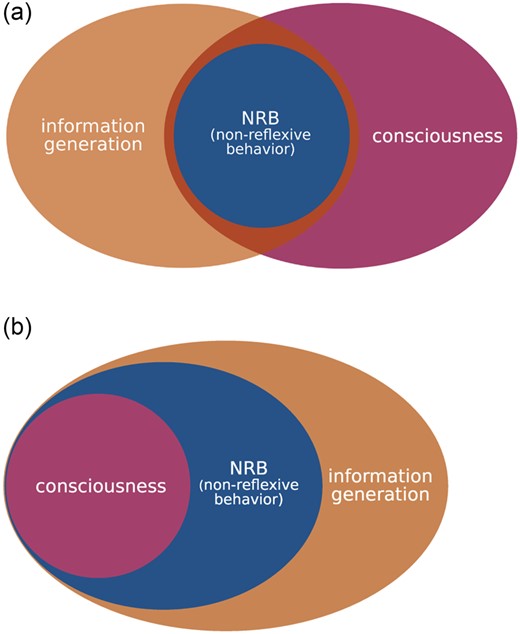
Abstract. This article discusses a hypothesis recently put forward by Kanai et al., according to which information generation constitutes a functional basi
the information apocalypse · discrete blogarithm
My friend Aviv was recently the subject of a popular Buzzfeed article about the possibility of an impending “information apocalypse”. tl;dr: Aviv extrapolates from the fake news crisis that started in 2016 to a world in which anyone can create AI-assisted misinformation campaigns indistinguishable from reality to the average observer. From there, a series of possible dystopian scenarios arise, including:
Ultra-Processed Information: AI and the Coming Deluge of Noise | Frankly 128
The Universe Is Not Locally Real, and the Physics Nobel Prize Winners Proved It
Elegant experiments with entangled light have laid bare a profound mystery at the heart of reality

Model Collapse Ends AI Hype
Do conspiracy theorists see more patterns in randomness? Apparently not
Three experiments found no difference in conspiracists’ information processing...

AI Data Centers Will Be Obsolete (Geometric Reasoning Explained)
A quote by Edsger W. Dijkstra
The question of whether a computer can think is no more interesting than the question of whether a submarine can swim.

The Abstraction Fallacy: Why AI Can Simulate But Not Instantiate Consciousness
Computational functionalism dominates current debates on AI consciousness. This is the hypothesis that subjective experience emerges entirely from abstract causal topology, regardless of the underlying physical substrate. We argue this view fundamentally mischaracterizes how physics relates to information. We call this mistake the Abstraction Fallacy. Tracing the causal origins of abstraction reveals that symbolic computation is not an intrinsic physical process. Instead, it is a mapmaker-dependent description. It requires an active, experiencing cognitive agent to alphabetize continuous physics into a finite set of meaningful states. Consequently, we do not need a complete, finalized theory of consciousness to assess AI sentience—a demand that simply pushes the question beyond near-term resolution and deepens the AI welfare trap. What we actually need is a rigorous ontology of computation. The framework proposed here explicitly separates simulation (behavioral mimicry driven by vehicle causality) from instantiation (intrinsic physical constitution driven by content causality). Establishing this ontological boundary shows why algorithmic symbol manipulation is structurally incapable of instantiating experience. Crucially, this argument does not rely on biological exclusivity. If an artificial system were ever conscious, it would be because of its specific physical constitution, never its syntactic architecture. Ultimately, this framework offers a physically grounded refutation of computational functionalism to resolve the current uncertainty surrounding AI consciousness.

“‘Information’ is a relational concept that assumes meaning only when related to the cognitive structure of the observer.” -- Heinz von Foerster
Control Information Theory: The “Missing Link” In the Science Of Cybernetics | Institute for the Study of Complex Systems
complexsystems.orgI call this the dark matter theory of science. Blogs, social media, etc - a majority of what actually influences science is invisible to the system (esp in AI) Real systems change in science will only be possible when we recognize these sources of influence and intentionally design for them

Eugene Vinitsky 🍒
Kinda feel weird that a few blog posts I’ve written in a few hours will probably have more educational impact than any amount of teaching I’ll ever do

