

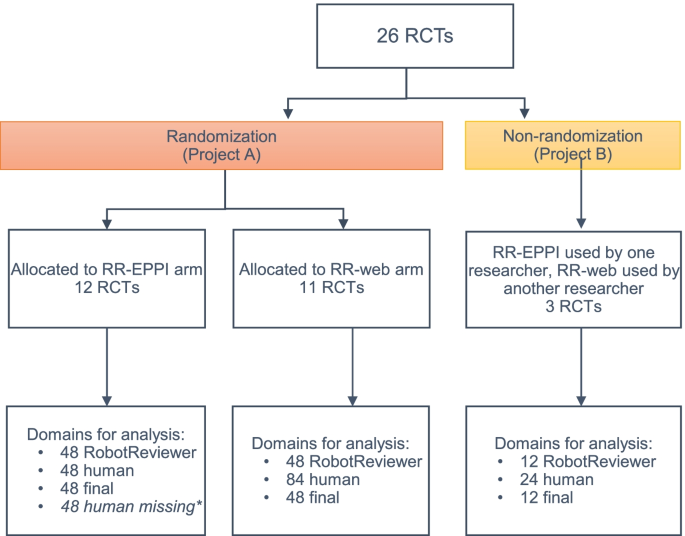
Machine learning and automation are increasingly used to make the evidence synthesis process faster and more responsive to policymakers’ needs. In systematic reviews of randomized controlled trials (RCTs), risk of bias assessment is a resource-intensive task that typically requires two trained reviewers. One function of RobotReviewer, an off-the-shelf machine learning system, is an automated risk of bias assessment.
Machine learning to help researchers evaluate biases in clinical trials: a prospective, randomized user study
Assessing risks of bias in randomized controlled trials (RCTs) is an important but laborious task when conducting systematic reviews. RobotReviewer (RR), an open-source machine learning (ML) system, semi-automates bias assessments. We conducted a user study of RobotReviewer, evaluating time saved and usability of the tool.

RobotReviewer: evaluation of a system for automatically assessing bias in clinical trials
Abstract. Objective To develop and evaluate RobotReviewer, a machine learning (ML) system that automatically assesses bias in clinical trials. From a (PDF-
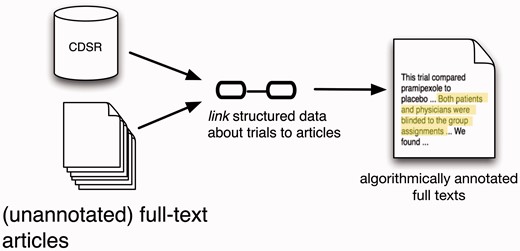
Machine learning to assist risk-of-bias assessments in systematic reviews
Abstract. Background: Risk-of-bias assessments are now a standard component of systematic reviews. At present, reviewers need to manually identify relevant
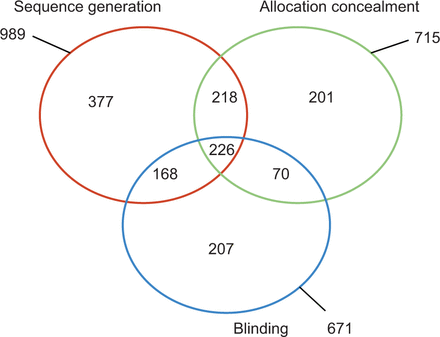
Agreement in Risk of Bias Assessment Between RobotReviewer and Human Reviewers: An Evaluation Study on Randomised Controlled Trials in Nursing‐Related Cochrane Reviews
Abstract Purpose RobotReviewer is a machine learning system for semi‐automated assistance in risk of bias assessment. The tools’s performance in randomized controlled trials (RCTs) in the field of nursing remains unknown. We aimed therefore to evaluate the agreement in risk of bias assessment between RobotReviewer and human reviewers. Design Evaluation study using a retrospective diagnostic design. Methods We used RobotReviewer as the index test and human reviewers’ risk of bias assessment reported in Cochrane reviews as the reference test. A convenience sample of electronically available English‐language full texts of RCTs included in Cochrane reviews with nurs* in the title were eligible for inclusion. In this context, we assessed random sequence generation, allocation concealment, and blinding (personnel or participants and assessors) corresponding to Cochrane risk of bias version 2011. Two independent research teams performed and double‐checked data extraction and analysis. We calculated sensitivity, specificity, receiver operating characteristic (ROC) curve, the area under the ROC curve, predictive values, observed percentage of agreement, and Cohen’s kappa (including confidence intervals, if applicable). Findings The selection process yielded 190 RCTs published between 1958 and 2016 in 23 Cochrane reviews published between 2000 and 2018. Missing assessments of risk of bias domains in Cochrane reviews or RobotReviewer yielded varying sample sizes per risk of bias domain. Sensitivity ranged from 0.44 to 0.88 and specificity from 0.48 to 0.95. Positive predictive value was highest for allocation concealment (0.79) and lowest for blinding assessors (0.25). Cohen’s kappa was moderate for randomization (0.52), allocation concealment (0.60), and for blinding of personnel/patients (0.43). Blinding of outcome assessors had only slight agreement (0.04). Conclusions This is the first evaluation of risk of bias assessment by RobotReviewer in RCTs included in nursing‐related Cochrane reviews. It yielded a moderate degree of agreement with human reviewers for randomization and allocation concealment, and an adequate sensitivity for detecting low risk of selection bias. Clinical Relevance Based on our results, using the RobotReviewer for risk of bias assessment in RCTs can be supportive in some risk of bias domains. However, human reviewers should supervise the semi‐automated assessment process.

ChatGPT for assessing risk of bias of randomized trials using the RoB 2.0 tool: A methods study
Abstract Background Internationally accepted standards for systematic reviews necessitate assessment of the risk of bias of primary studies. Assessing risk of bias, however, can be time- and resource-intensive. AI-based solutions may increase efficiency and reduce burden. Objective To evaluate the reliability of OpenAI’s ChatGPT for performing risk of bias assessments of randomized trials using the revised risk of bias tool for randomized trials (RoB 2.0). Methods We sampled recently published Cochrane systematic reviews of medical interventions (up to October 2023) that included randomized controlled trials and assessed risk of bias using the Cochrane-endorsed RoB 2.0. From each eligible review, we collected data on the risk of bias assessments for the first three reported outcomes. Using ChatGPT-4, we assessed the risk of bias for the same outcomes using three different prompts: a minimal prompt including limited instructions, a maximal prompt with extensive instructions, and an optimized prompt that was designed to yield the best risk of bias judgements. The agreement between ChatGPT’s assessments and those of Cochrane systematic reviewers was quantified using weighted kappa statistics. Results We included 34 systematic reviews with 157 unique trials. We found the agreement between ChatGPT and systematic review authors for assessment of overall risk of bias to be 0.16 (95% CI: 0.01 to 0.3) for the maximal ChatGPT prompt, 0.17 (95% CI: 0.02 to 0.32) for the optimized prompt, and 0.11 (95% CI: −0.04 to 0.27) for the minimal prompt. For the optimized prompt, agreement ranged between 0.11 (95% CI: −0.11 to 0.33) to 0.29 (95% CI: 0.14 to 0.44) across risk of bias domains, with the lowest agreement for the deviations from the intended intervention domain and the highest agreement for the missing outcome data domain. Conclusion Our results suggest that ChatGPT and systematic reviewers only have “slight” to “fair” agreement in risk of bias judgements for randomized trials. ChatGPT-4 cannot be relied upon to judge risk of bias and should not be used for this purpose. Since this study was completed, ChatGPT has advanced and OpenAI has released newer models with different capabilities. These may prove more adept at risk of bias evaluation. There may also be opportunities to use ChatGPT to streamline other aspects of systematic reviews, such as screening of search records or collection of data.
A new peer reviewer? Comparing AI with human performance in randomized controlled trial risk-of-bias assessment
Title abbreviation: Adv Clin Exp MedJournal Impact Factor (JIF 2025) – 2.5Journal Citation Indicator (JCI 2025) – 0.40Scopus CiteScore (2025) – 4.2Index Copernicus Value (ICV 2025) – 162.75MNiSW – 70 ptsISSN 1899–5276 (print), ISSN 2451-2680 (online)Periodicity – monthly
Large Language Models and the Analyses of Adherence to Reporting Guidelines in Systematic Reviews and Overviews of Reviews (PRISMA 2020 and PRIOR)
In the context of Evidence-Based Practice (EBP), Systematic Reviews (SRs), Meta-Analyses (MAs) and overview of reviews have become cornerstones for the synthesis of research findings. The Preferred Reporting Items for Systematic Reviews and Meta-Analyses (PRISMA) 2020 and Preferred Reporting Items for Overviews of Reviews (PRIOR) statements have become major reporting guidelines for SRs/MAs and for overviews of reviews, respectively. In recent years, advances in Generative Artificial Intelligence (genAI) have been proposed as a potential major paradigm shift in scientific research. The main aim of this research was to examine the performance of four LLMs for the analysis of adherence to PRISMA 2020 and PRIOR, in a sample of 20 SRs and 20 overviews of reviews. We tested the free versions of four commonly used LLMs: ChatGPT (GPT-4o), DeepSeek (V3), Gemini (2.0 Flash) and Qwen (2.5 Max). Adherence to PRISMA 2020 and PRIOR was compared with scores defined previously by human experts, using several statistical tests. In our results, all the four LLMs showed a low performance for the analysis of adherence to PRISMA 2020, overestimating the percentage of adherence (from 23 to 30%). For PRIOR, the LLMs presented lower differences in the estimation of adherence (from 6 to 14%) and ChatGPT showed a performance similar to human experts. This is the first report of the performance of four commonly used LLMs for the analysis of adherence to PRISMA 2020 and PRIOR. Future studies of adherence to other reporting guidelines will be helpful in health sciences research.

AI-Powered Systematic Review & Literature Review Platform
Rayyan is the pioneering AI-powered platform redefining evidence-based research & decision-making. Designed for efficient systematic literature review ...
How AI agents shape experts’ judgment calls
In a randomized trial, professional analysts working with an AI coding agent went with the option the agent was randomly assigned to favor 86% of the time. We look at what this means for human oversight of AI-assisted work.

AI assistants can sway writers’ attitudes, even when they’re watching for bias | Cornell Chronicle
Cornell Tech researchers found that writers who used biased AI auto-suggestions saw their views gravitate toward the AI’s positions without their realizing it — even when they were made aware of the biased AI.

Can AI Agents Synthesize Scientific Conclusions?
Scientific AI agents increasingly retrieve evidence, reason across sources, and synthesize conclusions used in consequential decisions. Yet, their ability to do so in high-stakes domains such as health remains unclear. We introduce SciConBench, a large-scale live benchmark of 9.11K questions and expert-written conclusions from systematic reviews to evaluate open-domain scientific conclusion synthesis. The benchmark draws on an expert-validated automated evaluation pipeline that decomposes conclusions into atomic facts and measures correctness and comprehensiveness via factual precision and recall. To mitigate data leakage, we further introduce SciConHarness, a clean-room evaluation harness that equips agents with controlled web interaction to ensure valid measurement. Evaluating 8 frontier models and deep research agents, we find that factual quality remains low: under clean-room settings, the best agent achieves only a factual F1 of 0.337. Our clean-room setting consistently reduces performance relative to unconstrained evaluation, suggesting that leakage inflates estimates of models' true synthesis capabilities. Finally, we audit consumer-facing agents (e.g., Google AI Overview, OpenEvidence) and find they frequently generate incomplete and sometimes contradictory conclusions, even when the ground-truth answer is available. Overall, our results show that reliable synthesis of scientific conclusions remains an open challenge, and that clean-room evaluation is essential for assessing open-domain AI agents.

The Utility of AI Tools in Auditing Adherence to Pre-Analysis Plans
Pre-analysis plans (PAPs) can improve research reproducibility by reducing researchers’ degrees of freedom, but their value depends on adherence. We argue that large language models (LLMs) can provide an efficient, scalable, and systematic way for authors and reviewers to assess adherence to PAPs. In an application to our own research, an LLM systematically identifies precommitted design choices, evaluates deviations, and diagnoses gaps in pre-specification, substantially reducing the human labor required for these tasks. However, variability in audit output across LLMs underscores the continued importance of human judgment. We discuss implications for best practices in AI-assisted PAP auditing.

Underspecified Human Decision Experiments Considered Harmful
Decision-making with information displays is a key focus of research in areas like human-AI collaboration and data visualization. However, what constitutes a decision problem, and what is required for an experiment to conclude that decisions are flawed, remain imprecise. We present a widely applicable definition of a decision problem synthesized from statistical decision theory and information economics. We claim that to attribute loss in human performance to bias, an experiment must provide the information that a rational agent would need to identify the normative decision. We evaluate whether recent empirical research on AI-assisted decisions achieves this standard. We find that only 10 (26%) of 39 studies that claim to identify biased behavior presented participants with sufficient information to make this claim in at least one treatment condition. We motivate the value of studying well-defined decision problems by describing a characterization of performance losses they allow to be conceived.

Risk of bias tools - Current version of RoB 2
Current version Download the 22 August 2019 version: The full guidance document. The cribsheet summarizing the tool. A template for completing the assessment. An Excel tool to implement RoB 2 (contains macros; download to your computer before using; some text is slightly out of date). We have

Algorithmic Bias · Open Encyclopedia of Cognitive Science
Algorithmic bias refers to prejudicial, discriminatory, unjust, inaccurate, or otherwise disparate performance or outcomes from algorithmic systems based on racial, gender, or other attributes of an individual or a group. The concept of algorithmic bias emerged at the intersection of computer science, artificial intelligence (AI) research, critical data studies, human–computer interaction, law, philosophy, and similar disciplines. Although problems and discrepancies at the model level denote the most commonly studied form of bias, the term algorithmic bias is also used as a shorthand to describe a multitude of problems and challenges at various steps of the AI pipeline from ideation, problem framing, training data curation and processing, model training and validation, and deployment as well as emergent issues that arise from interaction with the real world. Potential sources of bias, appropriate metrics to define, measure, and mitigate bias, and the utility and merit of technical approaches to bias mitigation are fiercely debated in the current AI landscape.

Verification in the Age of AI Scientists
AI Scientists now operate at a scale that outpaces human capacity for manual review. Systems such as Sakana’s AI Scientist write entire workshop papers end-to-end. Lila Sciences runs autonomous ``AI Science Factories’’ that hypothesize, experiment, and iterate without human guidance. FutureHouse’s Kosmos and Robin generate thousands of candidate hypotheses in a single run, and Google’s Co-Scientist proposes testable experiments at a rate no laboratory can fully evaluate. Each of these systems emphasizes verified results, yet that standard ranges from near-perfect formal proof in mathematics to decade-long clinical trials in medicine, with no shared framework for judging sufficiency across domains. As outputs scale beyond what humans can manually inspect, the question of which results to trust becomes as hard as generating them. The bottleneck for AI for Science is no longer hypothesis generation, it is verification.