


This post brings together a two topics of research into Long-Covid. Full disclosure. I do primary care for a relative suffering from Long-Covid. I live in Arizona, which according to…
Long COVID linked to lower brain oxygen levels, cognitive problems and psychiatric symptoms | Waterloo News | University of Waterloo
Long COVID is associated with reduced brain oxygen levels, worse performance on cognitive tests and increased psychiatric symptoms such as depression and anx
What we now know about long COVID and our brains
After three years of the COVID-19 pandemic we know more about PCNS or Long COVID, but there’s a vital need for more research says University of Melbourne expert

What Are COVID-19’s Long-Term Medical Effects?
Fascinating email from TPM Reader JO, whose personal bio is tailor-made for...

Nervous system consequences of COVID-19
Neurological symptoms highlight the need to understand pathophysiologic mechanisms , Although severe acute respiratory syndrome coronavirus 2 (SARS-CoV-2) is considered a respiratory pathogen, myriad neurologic complications—including confusion, stroke, and neuromuscular disorders—manifest during acute COVID-19. Furthermore, maladies such as impaired concentration, headache, sensory disturbances, depression, and even psychosis may persist for months after infection, as part of a constellation of symptoms now called Long Covid. Even young people with mild initial disease can develop acute COVID-19 and Long Covid neuropsychiatric syndromes. The pathophysiological mechanisms are not well understood, although evidence primarily implicates immune dysfunction, including nonspecific neuroinflammation and antineural autoimmune dysregulation. It is uncertain whether unforeseen neurological consequences may develop years after initial infection. With millions of individuals affected, nervous system complications pose public health challenges for rehabilitation and recovery and for disruptions in the workforce due to loss of functional capacity. There is an urgent need to understand the pathophysiology of these disorders and develop disease-modifying therapies.

Long COVID stemmed from mild cases of COVID-19 in most people
90% of people living with long COVID initially experienced only mild illness.

Current status and future perspectives on the mechanistic and pathophysiological understanding of long COVID
Viral and infectious illnesses can exert profound and enduring effects on population health and well-being. In the aftermath of SARS-CoV-2 infection, post-acute sequelae, collectively referred to as Long COVID, have emerged as a major global health challenge, affecting more than 400 million people and contributing to estimated annual economic costs exceeding $1 trillion. Long COVID encompasses a wide and heterogeneous spectrum of debilitating symptoms, including cognitive dysfunction, sleep disturbances, severe fatigue, and post-exertional malaise. Despite its substantial burden, fundamental uncertainties remain regarding its underlying pathophysiology, the development of robust diagnostic criteria, and the identification of effective therapeutic options. This review synthesises current evidence on the biological mechanisms thought to contribute to Long COVID, spanning immune dysregulation, viral persistence, autonomic dysfunction, microvascular pathology, and other emerging hypotheses. We examine advances and limitations in contemporary diagnostic approaches and critically appraise existing treatment strategies, highlighting inconsistencies and gaps that hinder clinical consensus. By integrating interdisciplinary insights, this review underscores the urgent need for mechanistic clarity, validated diagnostic frameworks, and rigorously evaluated treatment pathways. Addressing these gaps will be essential to developing effective, evidence-based management strategies and mitigating the long-term impact of Long COVID on global health.
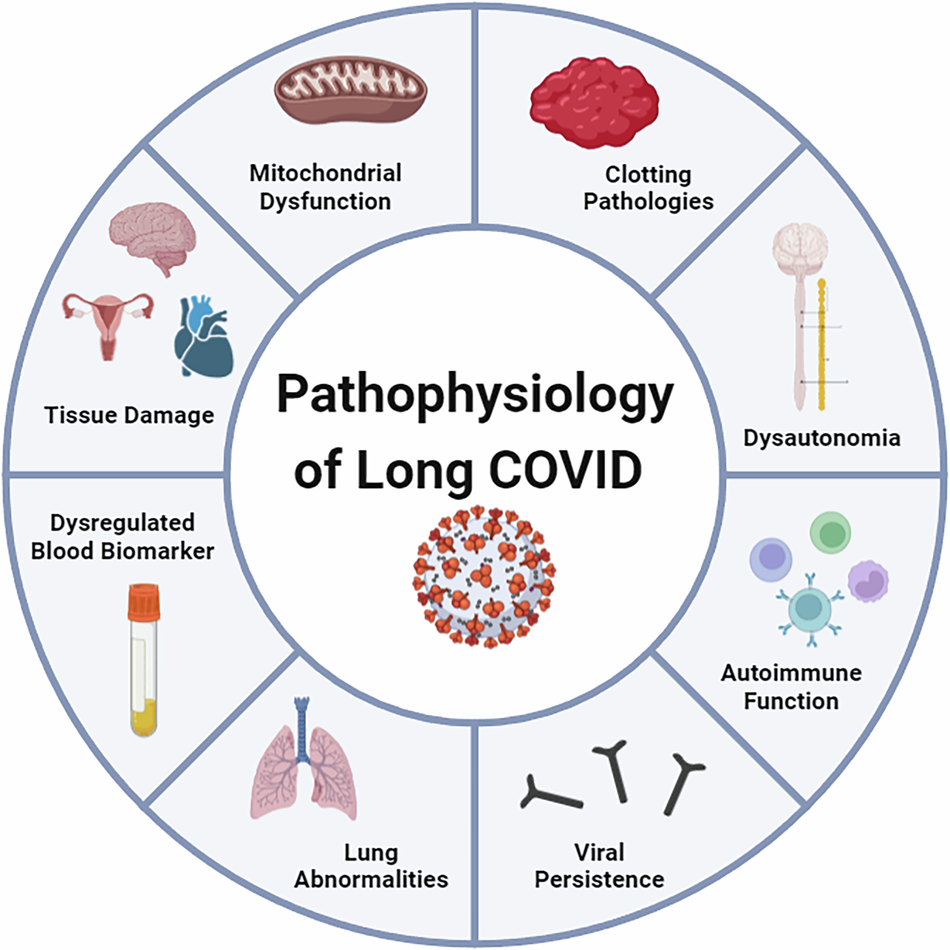
Current status and future perspectives on the mechanistic and pathophysiological understanding of long COVID
Viral and infectious illnesses can exert profound and enduring effects on population health and well-being. In the aftermath of SARS-CoV-2 infection, post-acute sequelae, collectively referred to as Long COVID, have emerged as a major global health challenge, affecting more than 400 million people and contributing to estimated annual economic costs exceeding $1 trillion. Long COVID encompasses a wide and heterogeneous spectrum of debilitating symptoms, including cognitive dysfunction, sleep disturbances, severe fatigue, and post-exertional malaise. Despite its substantial burden, fundamental uncertainties remain regarding its underlying pathophysiology, the development of robust diagnostic criteria, and the identification of effective therapeutic options. This review synthesises current evidence on the biological mechanisms thought to contribute to Long COVID, spanning immune dysregulation, viral persistence, autonomic dysfunction, microvascular pathology, and other emerging hypotheses. We examine advances and limitations in contemporary diagnostic approaches and critically appraise existing treatment strategies, highlighting inconsistencies and gaps that hinder clinical consensus. By integrating interdisciplinary insights, this review underscores the urgent need for mechanistic clarity, validated diagnostic frameworks, and rigorously evaluated treatment pathways. Addressing these gaps will be essential to developing effective, evidence-based management strategies and mitigating the long-term impact of Long COVID on global health.
Possible cause of long COVID ‘brain fog’ revealed - study
In the course of their research, scientists found that the neurological effects of long-COVID were strikingly similar to Alzheimer's and Parkinson's.

New research shows younger and middle-aged adults have worse long COVID symptoms than older adults
New study from Northwestern Medicine finds symptoms occurred regardless of mild or severe COVID-19 infection

Long Covid Studies - Possible long COVID treatments
See all researched treatments for long COVID, along with evidence summaries.
Can addressing gut issues treat long COVID in children?
Study hopes to answer questions about connection between GI and neurological symptoms.

Evidence mounts that Long Covid is damaging the hearts of those affected
There are also increasing signs that the condition can disrupt the autonomic nervous system

Even Mild Covid is Linked To Brain Damage, Scans Show - Slashdot
During at least the first few months following a coronavirus infection, even mild cases of Covid-19 are associated with subtle tissue damage and accelerated losses in brain regions tied to the sense of smell, as well as a small loss in the brain's overall volume, a new British study finds. Having mi...

Patient Led Research Collaborative – for Long COVID
Cite as: O’Connor, A. M. (2023). Hypothesis: Long COVID brain fog is caused by free glycan sugar chains in the brain. Patient-Generated Hypotheses Journal for Long COVID & Associated Conditions, Vol. 1, 5-12
Do cognitive deficits persist after COVID-19 and, if so, what is their biological basis? Our NEW pre-print under review in @NaturePortfolio https://t.co/4JPGfeaSiB We report one-year cognitive, serum biomarker, and neuroimaging findings in 351 patients A thread 1/n
Do cognitive deficits persist after COVID-19 and, if so, what is their biological basis?Our NEW pre-print under review in @NaturePortfolio https://t.co/4JPGfeaSiBWe report one-year cognitive, serum biomarker, and neuroimaging findings in 351 patients A thread 1/n pic.twitter.com/W8MXV3qkVt— Greta Karen Wood (@gkwood3) January 9, 2024

COVID-19

About the disease itself and/or SARS-CoV-2

49% of COVID infections are asymptomatic according to Yale School of Public Health. Yale advises layered protection: N95 masks, HEPA filters…
doi.org