How a unique form of working together has built—and is critical to sustain—our age of information. Peer production describes a unique form of global collaboration that is responsible for creating some of the most vital parts of the internet. Information ecosystem powerhouses like Wikipedia and the Linux operating system were founded on principles of open cooperation, and only exist today due to the contributions of thousands, and in some cases, millions of people. In Peer Production, Benjamin Mako Hill, Christian Pentzold, and Aaron Shaw describe the central role that peer production plays in today’s information environment, and how it is a much broader phenomenon than the handful of famous projects that are now household names. The book offers three core ideas: peer production functions as a critical mode of collaborative knowledge production; represents a novel type of social collaboration; and has unique advantages over previous forms of collaboration. The authors show that peer production is not just the foundation of the internet as we know it, but also the engine driving the global digital economy to generative AI. Finally, the book also charts the uncertain future of peer production as it confronts new threats and a changing digital landscape.
Peer Production
Peer production describes a unique form of global collaboration that is responsible for creating some of the most vital parts of the internet. Information ec...

From Linux to Wikipedia: How Volunteers Build the Internet
Peer production is responsible for some of the most valuable online resources, challenging the authority of firms, markets, and government bureaucracies.

Peersky (@peersky@mastodon.social)
Attached: 1 video After 3.5 years, #PeerSky v1.0.0 is finally here 🎉 Create information. Share it directly with peers. Access it anywhere. Even when the internet goes down. All power corrupts. Power should be distributed. PeerSky is more than a browser; it's a new foundation for the web. That's how we save the internet and build better societies, one peer at a time. Try it out! 👉 https://peersky.p2plabs.xyz/

Spritely and Veilid: Exciting Projects Building the Peer-to-Peer Web
While there is a surge in federated social media sites, like Bluesky and Mastodon, some technologists are hoping to take things further than this model of decentralization with fully peer-to-peer
Introducing PeerSky | P2P Labs
After 3.5 years, #PeerSky v1.0.0 is finally here 🎉 Create information. Share it directly with peers. Access it anywhere. Even when the internet goes down. All power corrupts. Power should be distributed. PeerSky is more than a browser; it's a new foundation for the web. That's how we save the internet and build better societies, one peer at a time. Try it out! 👉 https://lnkd.in/d7qp_93B
Beyond the Individual: Understanding the Evolution of Collective Intelligence
This chapter outlines the evolution of collective intelligence, starting from its ancient roots and concluding with modern digital platforms. It discusses intelligence theories, project examples, and the impact of technology on collaborative efforts. Key focuses include the role of the internet and online communities in boosting our collective IQ, with a particular emphasis on Douglas Engelbart's contributions and the open-source movement, as exemplified by Linux's development. The chapter examines how digital transformation has facilitated new forms of community and knowledge sharing, significantly influencing fields such as management, decision-making, and organizational learning. Various scholars and their definitions of CI are discussed, including Pierre Lévy's vision of universally distributed intelligence and the concept of swarm intelligence in biological sciences. We then move on to practically implemented CI projects, exploring crowdsourcing as a manifestation of CI in business and social projects and examining possibilities of harnessing the wisdom of crowds for problem-solving and innovation. The chapter concludes with a presentation of the current state of collective intelligence academic research.
Peer-to-Peer Republic
A movement, open republic of humans building peer-to-peer systems that redistribute power and reimagine the internet as a public good, not a product a platform sells.
Peer Production in Citizen Science: A Community-Centered Approach on the Example of Personal Science
Citizen science encompasses a wide range of practices where online collaboration for knowledge production plays a significant role. However, the study of forms of online collaboration other than crowdsourcing in citizen science has remained largely unexplored. This thesis aims to fill this gap by investigating peer production as a form of collaboration in online citizen science communities of practice. First, peer production theory was operationalized as a working model and used to analyze collaboration in citizen science case studies. This was followed by a comprehensive participatory design process for a specific use case involving the personal science community of practice. This process resulted in the creation of the “Personal Science Wiki”, an online space for consolidating community knowledge through peer production. Subsequently, a usability and card sorting study identified and resolved issues with the wiki implementation, and provided insights into mental models and content requirements regarding self-research knowledge. The lessons learned from the participatory design process were generalized as process recommendations for designing peer production solutions and knowledge management systems with communities of practice.
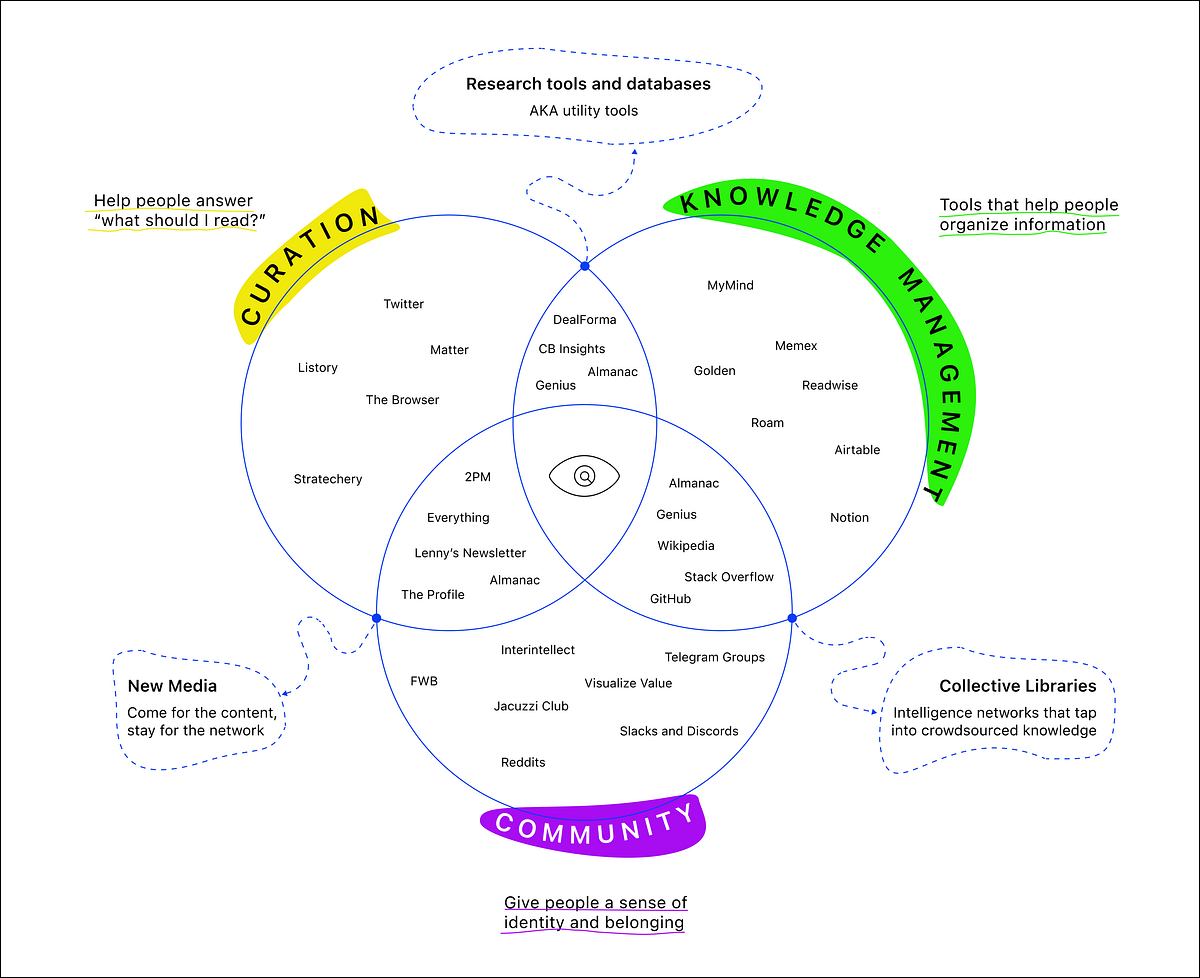
The rise of community-curated knowledge networks
The Internet put thousands of years of human thought at our fingertips, and enabled billions of people to create content. At least 2.5…
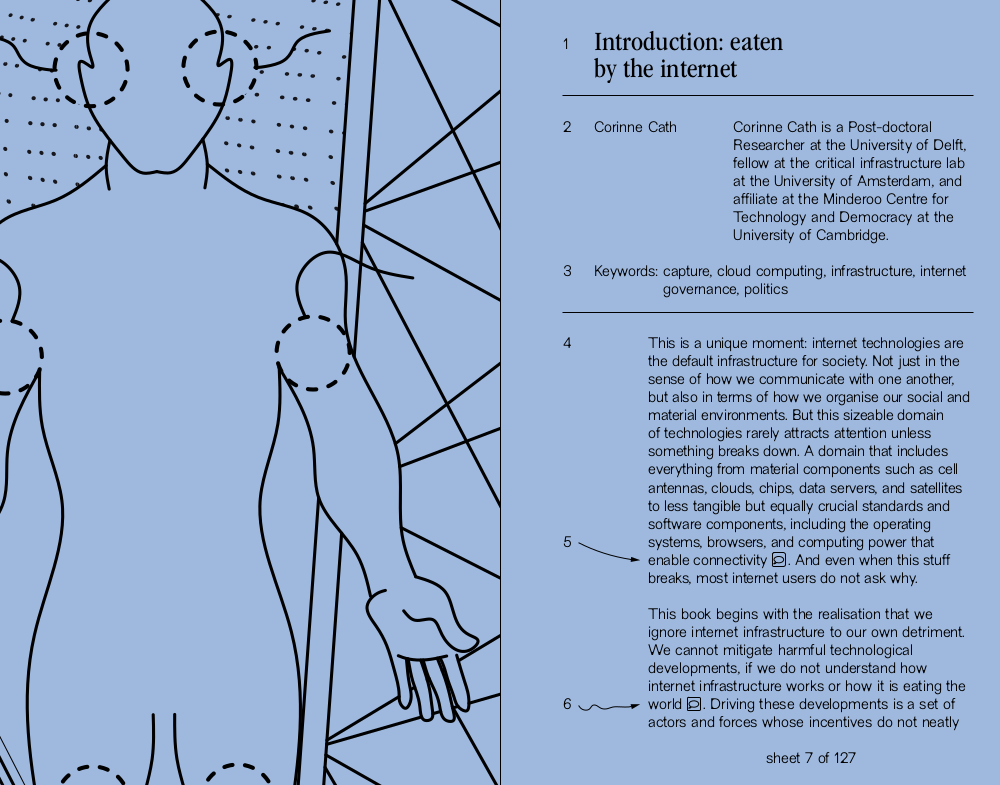
Eaten by the Internet
This book makes internet infrastructure visible as a force of political power, which is transforming the social world, from the bottom up—through fifteen chapters contributed by a global set of researchers, activists, and techies. We are living a unique moment: internet technologies are the default infrastructure for society, not just how we communicate but also how we organise our social life, politics, and economy, all the way down to our material environments, like cities. Our world is eaten by the internet. This means that those who control the internet control the bounds of public speech, economic production, social cohesion, and politics, making its infrastructure a core political terrain in the networked age. The book’s chapters cover a wide set of topics, spanning from the global politics of content moderation by internet infrastructure to the colonialism inherent in the race to plug the moon, from the harms wrought by blockchain companies in rural America to the particularities of online censorship across Asia. The chapters take on thorny topics, discussing power consolidation in the advertisement and cloud industry, the role of internet infrastructure in the war in Ukraine, and tech’s environmental impact—amongst others. In doing so, this book roots contemporary technology debates in the politics of internet infrastructure and urges us to ask how can we ensure our infrastructures sustain us, rather than consume us?
Local-First Peer-to-Peer Infrastructure: Create, Collaborate, and Publish Without the Cloud
The Paradox of Open
Numerous organisations and initiatives have been launched with a belief in openness and free knowledge. Their proponents placed their bets on the combined power of networked information services and new governance models for the production and sharing of content and data. We – as members of this broad movement – were among those who believed it possible to leverage this combination of power and opportunity to build a more democratic society, unleashing the power of the internet to create universal access to knowledge and culture. For us, such openness meant not only freedom, but also presented a path to justice and equality.
Stigmergic Collaboration: A Theoretical Framework for Mass Collaboration
"This thesis presents an application-oriented theoretical framework for generalised and specific collaborative contexts with a special focus on Internet-based mass collaboration. The proposed framework is informed by the author's many years of collaborative arts practice and the design, building and moderation of a number of online collaborative environments across a wide range of contexts and applications. The thesis provides transdisciplinary architecture for describing the underlying mechanisms that have enabled the emergence of mass collaboration and other activities associated with 'Web 2.0' by incorporating a collaboratively developed definition and general framework for collaboration and collective activity, as well as theories of swarm intelligence, stigmergy, and distributed cognition. "Accompanying this creative arts thesis is a DVD-Rom which includes offline versions of the three Internet based collaborative environments designed, built and implemented in accordance with the frameworks for digital stigmergy and mass collaboration developed in the written work. The creative works in conjunction with the written thesis help to explore and more rigorously define the collaborative process in general, while testing the theory that stigmergy is an inherent component of collaborative processes which incorporate collective material production. "Supported by a range of contemporary examples of Internet activity, including the accompanying creative works, it is found that stigmergy is a deeply rooted mechanism inherent in not only traditional material collaborative processes, but a range of emerging online practices which may be broadly categorised as digital stigmergic cooperation and collaboration. This latter class enables the extreme scaling seen in mass collaborative projects such as Wikipedia.org, open source software projects and the massive, multiplayer environment, Second Life. This scaling is achieved through a range of attributes which are examined, such as the provision of a localised site of individualistic engagement which reduces demands placed upon participants by the social negotiation of contributions while increasing capacity for direct and immediate creative participation via digital workspaces. Also examined are a range of cultural, economic and sociopolitical impacts which emerge as a direct result of mass collaboration's highly distributed, non-market based, peer-production processes, all of which are shown to have important implications for the further transformation of our contemporary information and media landscape."
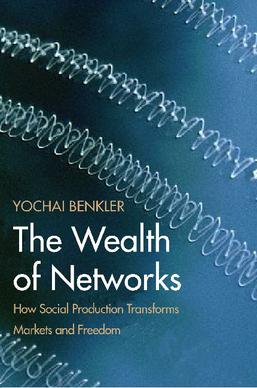
The Wealth of Networks
The Wealth of Networks: How Social Production Transforms Markets and Freedom is a book by Harvard Law School professor Yochai Benkler published by Yale University Press on April 3, 2006. The book has been recognized as one of the most influential works of its time concerning the rise and impact of the Internet on the society, particularly in the sphere of economics. It also helped popularize the term Benkler coined few years earlier, the commons-based peer production (CBPP).
The Politics of Open Infrastructures: Power, Governance, and Justice in Digital Knowledge Practices
This volume examines how openness is designed, governed, contested and lived in contemporary digital knowledge infrastructures. From open source software and internet standards, to citizen science platforms, public sector data systems and alternative computing practices, the book shows that infrastructures are never neutral technical backbones.