

Disparate thoughts on personal information management after traversing the hype cycle.
The Panoptic Sort: A Political Economy of Personal Information
A Political Economy of Personal Information

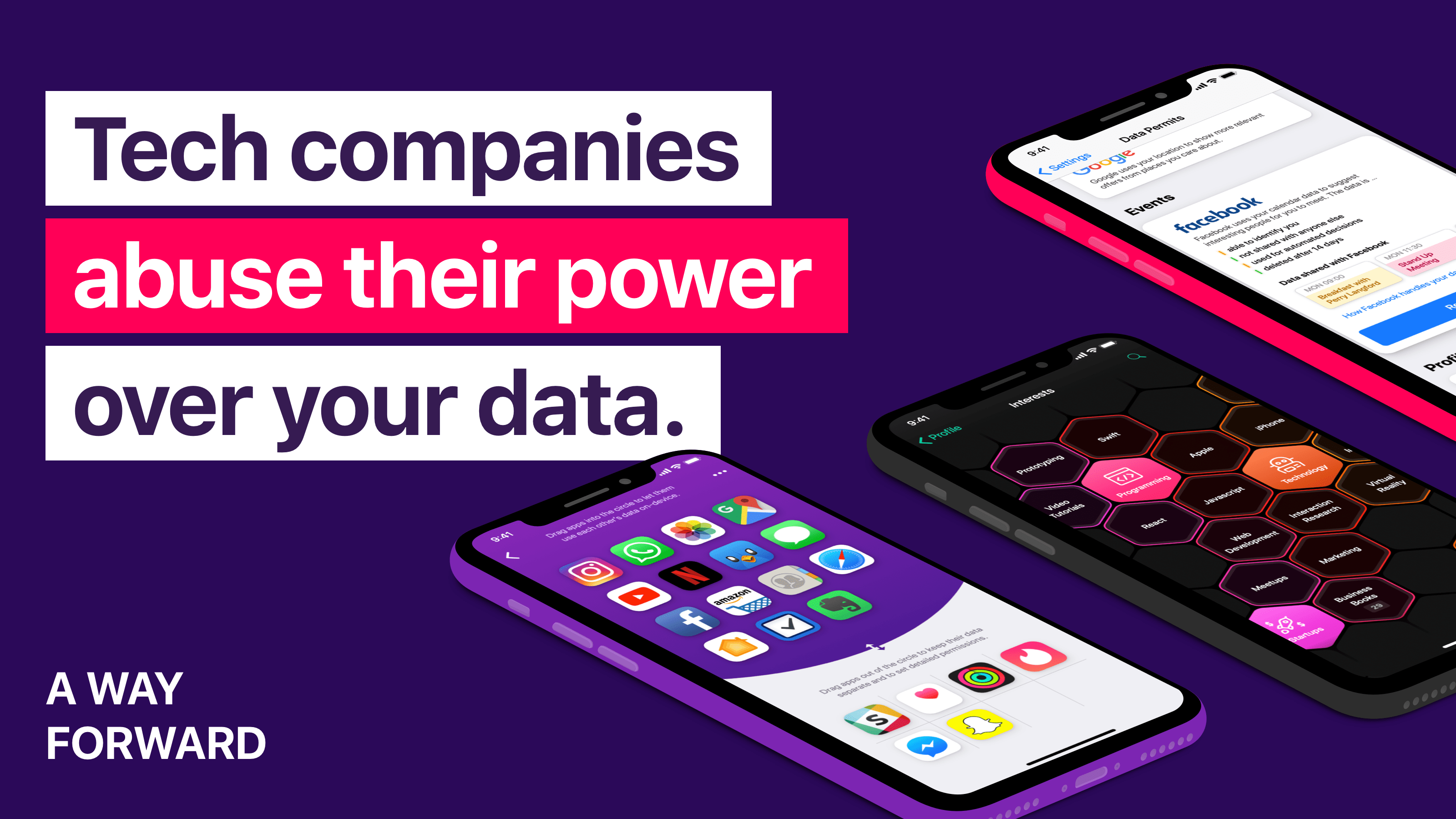
Rethinking how technology uses our personal data
This essay explores visually how keeping data and AI on‑device could empower not only users, but also companies.
Guardian Angels: LLM Personalization for Productivity and Security
I propose an approach for highly personalized LLMs, for near-future productivity gains and personal info/cybersecurity against increasingly powerful LLMs: they should, in the spirit of uploading, try to emulate the user’s values and preferences in order to amplify the principal—not replace them. I discuss a package of techniques and proposals to accomplish such ‘guardian angels’; dynamic evaluation of LLMs combined with active learning and elicitation and heavy inner-monologue search/data-augmentation.

Information scraps: How and why information eludes our personal information management tools
In this article we investigate information scraps —personal information where content has been scribbled on Post-it notes, scrawled on the corners of sheets of paper, stuck in our pockets, sent in email messages to ourselves, and stashed in miscellaneous digital text files. Information scraps encode information ranging from ideas and sketches to notes, reminders, shipment tracking numbers, driving directions, and even poetry. Although information scraps are ubiquitous, we have much still to learn about these loose forms of information practice. Why do we keep information scraps outside of our traditional PIM applications? What role do information scraps play in our overall information practice? How might PIM applications be better designed to accommodate and support information scraps' creation, manipulation and retrieval? We pursued these questions by studying the information scrap practices of 27 knowledge workers at five organizations. Our observations shed light on information scraps' content, form, media, and location. From this data, we elaborate on the typical information scrap lifecycle, and identify common roles that information scraps play: temporary storage, archiving, work-in-progress, reminding, and management of unusual data. These roles suggest a set of unmet design needs in current PIM tools: lightweight entry, unconstrained content, flexible use and adaptability, visibility, and mobility.

The Interfaces With Which We Think
The concepts in modern operating systems — apps, windows, desktops, notifications, and so on — have so permeated our understanding of personal computing, it’s hard to imagine anything else, let alone believe there could be anything better.
What Managers Need to Know About Social Tools
To identify the value that social tools can bring to companies, the authors split employees at a large financial services firm into two groups, only one of which used an internal social platform, and observed them for six months. Those who had used the tool became 31% more likely to find coworkers with relevant expertise and 88% more likely to discover who had useful connections. Internal social tools can help employees make faster decisions, develop more innovative ideas for products and services, and become more engaged in their work and their companies. But companies that try to “go social” often fall into four traps: They (1) assume that Millennials will embrace social tools at work; (2) struggle to foster personal interaction that builds trust and promotes knowledge sharing; (3) fail to recognize how learning occurs on social tools; and (4) focus on the wrong data. The authors offer advice on how to avoid these traps.

Meta’s Mass Data Collection Is Not A-Muse-ing
At the beginning of September, Meta launched Muse, a “personal AI agent” marketed to collect as much data as possible assist users with whatever tasks they request or enable. Suggested uses in the initial release include filling out forms, negotiating on the user’s behalf, and responding to emails. Almost immediately, concerns over Muse have exploded, and many people have questioned whether this new release is really just another of Meta’s ploys to scoop up as much personal data as possible.

Blog
For quite some time now, i have been working on and off on a fully self-hosted search engine, in hope to make it easier to search across Personal data in an end to end manner. Even as individuals, we are hoarding and generating more and more data with no end in sight. Such "personal" data is being stored from local hard-disks to corporate controlled cloud-centers which makes it distributed in nature. So for following discussion, "Personal" meaning would be flexible enough to accommodate resources on a remote server and/or on different devices, as long the user could prove authentication and/or authorization to that data. Current implementation supports only "images", but eventual goal is also to support other modalities like video, text and audio, some code would be shared, while some new code would be required to better extract Features for each modality.
How People Use ChatGPT
Despite the rapid adoption of LLM chatbots, little is known about how they are used. We document the growth of ChatGPT’s consumer product from its launch in November 2022 through July 2025, when it had been adopted by around 10% of the world’s adult population. Early adopters were disproportionately male but the gender gap has narrowed dramatically, and we find higher growth rates in lower-income countries. Using a privacy-preserving automated pipeline, we classify usage patterns within a representative sample of ChatGPT conversations. We find steady growth in work-related messages but even faster growth in non-work-related messages, which have grown from 53% to more than 70% of all usage. Work usage is more common for educated users in highly-paid professional occupations. We classify messages by conversation topic and find that “Practical Guidance,” “Seeking Information,” and “Writing” are the three most common topics and collectively account for nearly 80% of all conversations. Writing dominates work-related tasks, highlighting chatbots’ unique ability to generate digital outputs compared to traditional search engines. Computer programming and self-expression both represent relatively small shares of use. Overall, we find that ChatGPT provides economic value through decision support, which is especially important in knowledge-intensive jobs.

Can “Conscious Data Contribution” Help Users to Exert “Data Leverage” Against Technology Companies?
Tech users currently have limited ability to act on concerns regarding the negative societal impacts of large tech companies. However, recent work suggests that users can exert leverage using their role in the generation of valuable data, for instance by withholding their data contributions to intelligent technologies. We propose and evaluate a new means to exert this type of leverage against tech companies: "conscious data contribution" (CDC).
For You, For Everyone - Graze Newsletter
How Graze built a "composable personalization" engine for the open social web — and why it matters right now.
For You, For Everyone - Graze Newsletter
How Graze built a "composable personalization" engine for the open social web — and why it matters right now.
ltjed/freephdlabor
freephdlabor: customizing personalized multiagent systems that researchs 24/7 on your own scientific problem
You have to mainline info all the time because our information tools make you do so. Infinite scroll timelines, group chats with no beginning or end, recommender algorithms with no sense of place — all of them require constant vigilance to make sense of. We can do better.

Charlie Warzel
had a death in the family and was almost completely off the internet for a few days & my observation is that there is too much happening too fast such that basic facts abt the world are difficult to ascertain unless you are mainlining info all the time & doing that seems to drive people insane
Personal Computing

www.cs.columbia.edu

Are we stuck with the same Desktop UX forever? | Ubuntu Summit 25.10
Triumph of the Nerds: The Transcripts, Part I
Everest Pipkin

Digital Topology & Economic Power
bandukwala.me
