

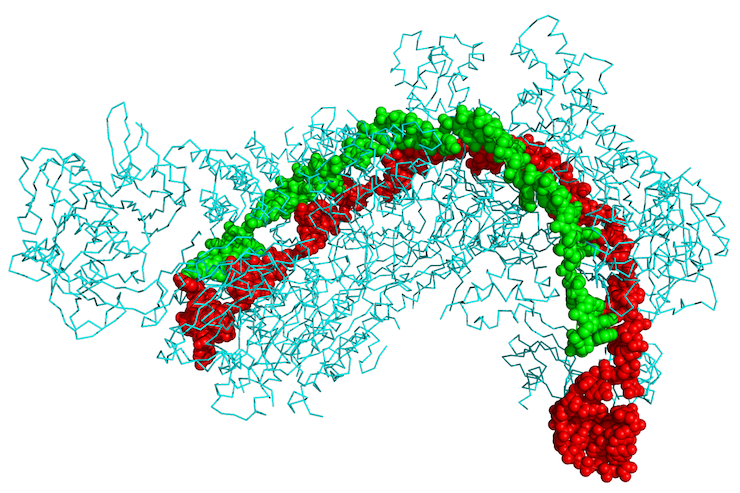
The patent war for DNA-editing technology.
How DNA Editing Could Change Life on Earth
Researchers hope to use the powerful biological tool to alter the genetic destiny of species and eliminate diseases.

How Intellectual Property Reinforces Inequality
In its recent, unanimous decision that human genes cannot be patented, the Supreme Court gave a rare victory to the cause of economic fairness.

AI-designed nucleases build on nature’s design
Researchers used AI to create variants of a CRISPR-Cas12-like nuclease, some of which show increased editing activity

The current war on science, and who’s behind it
A vaccine developer and a climate scientist walk into a bar write a book.

How Extending Patent Protection For Antibiotics Creates Perverse Incentives To Render Them Useless
We take antibiotics and their ability to kill practically all bacteria for granted. But scientists are increasingly warning that we may be about to leave what might come to be seen as a golden age …

ASAPbio - Accelerating Science And Publication In Biology
A scientist-driven nonprofit accelerating discovery by promoting innovation and transparency in life science communication through preprints and open peer review.

Biohackers Encoded Malware in a Strand of DNA
Researchers planted a working hacker exploit in a physical strand of DNA.


$250 million, 300 scientists and 40 labs: Sean Parker’s revolutionary project to ‘solve’ cancer
The collaboration, which will be formally announced Wednesday, focuses on immunotherapy -- an area of research that many believe represents the future of cancer treatment.

The Risks of Industry Influence in Tech Research
Emerging information technologies like social media, search engines, and AI can have a broad impact on public health, political institutions, social dynamics, and the natural world. It is critical to develop a scientific understanding of these impacts to inform evidence-based technology policy that minimizes harm and maximizes benefits. Unlike most other global-scale scientific challenges, however, the data necessary for scientific progress are generated and controlled by the same industry that might be subject to evidence-based regulation. Moreover, technology companies historically have been, and continue to be, a major source of funding for this field. These asymmetries in information and funding raise significant concerns about the potential for undue industry influence on the scientific record. In this Perspective, we explore how technology companies can influence our scientific understanding of their products. We argue that science faces unique challenges in the context of technology research that will require strengthening existing safeguards and constructing wholly new ones.

(PDF) Highly efficient genome editing using oocyte-specific z cas9 transgenic zebrafish
PDF | Since its first application, CRISPR/Cas9 rapidly becomes a routine technique to perform genome editing in a variety of biological systems. To... | Find, read and cite all the research you need on ResearchGate

Technology and Below-the-Line Labor in the Copyfight over Intellectual Property
Andrew Ross, Technology and Below-the-Line Labor in the Copyfight over Intellectual Property, American Quarterly, Vol. 58, No. 3, Rewiring the "Nation": The Place of Technology in American Studies (Sep., 2006), pp. 743-766
CIA’s Venture Capital Arm Is Funding Skin Care Products That Collect DNA
A company with an innovative line of cosmetic products caught the attention of Oprah’s lifestyle magazine and beauty bloggers. Now the CIA is involved, too.
If the DNA molecule is the book of life, it's a very strange book indeed - 3 Quarks Daily
by Yohan J. John
We live in a golden age of biology. So why are people still dying from disease? Because discovery and development move slower than they should. Today, we’re partnering with Incyte to change… | Samuel G. Rodriques | 491 comments
We live in a golden age of biology. So why are people still dying from disease? Because discovery and development move slower than they should. Today, we’re partnering with Incyte to change that. Kosmos is now the first agent that can compress months of drug development into weeks, from the earliest stages of scientific discovery through to FDA approval. Incyte will be the first company to deploy it across their pipeline. Work that used to take a team of scientists months now happens in weeks. Patients can't wait, and neither can we. | 491 comments on LinkedIn
From ownership to stewardship: reimagining intellectual property governance through the Knowledge Commons Framework
Contemporary intellectual property (IP) governance remains strongly shaped by proprietary logics of exclusivity, control, and rights allocation, even as knowledge production becomes increasingly co...
