

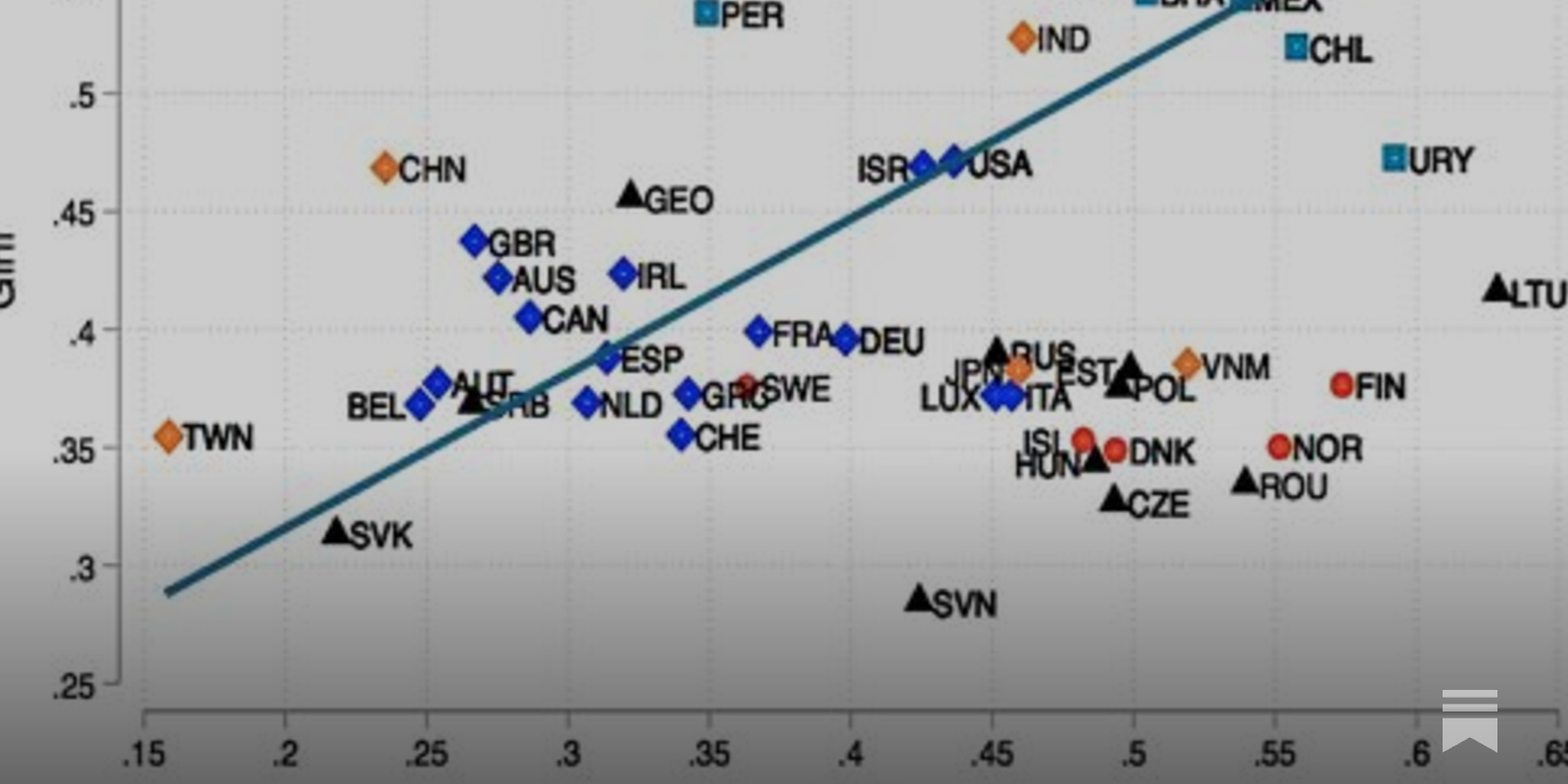
Are all class-based societies unequal?
Le nouveau capitalisme (2/3) : inégalités compositionnelles versus inégalités de revenu
Traduction de "New capitalism II: Compositional vs income inequality. Are all class-based societies unequal?" de Branko Milanovic

The Origin and Future of Economic Inequality
Why did capitalism begin in the West?
Culture, class, and the origins of capitalist development
The Divide — Jason Hickel
The Divide: A Brief Guide to Global Inequality and its Solutions Penguin Random House UK, 2017

(PDF) The Precariat and Class Struggle *
PDF | The world economy is in the midst of a Global Transformation that is producing a new global class structure. A new class is emerging – the... | Find, read and cite all the research you need on ResearchGate

The American Black Bourgeoisie, a story
*The American Black Bourgeoisie is affirmed on this date in 1619. They are America’s Black upper class based on financial income. The Black Bourgeoisie comprises engineers, lawyers, accountants, doctors, politicians, business executives, venture capitalists, CEOs, celebrities, entertainers, entrepreneurs, and heirs with annual incomes of $200,000 or more. This social class sometimes referred to as the […]
Le nouveau capitalisme (1/3)
Traduction de "New capitalism in America. Richest capitalists and richest workers are increasingly the same people" de Branko Milanovic

Cognitive Capitalism - Public Seminar
There are broadly three ways of thinking historically about capitalism. One draws on Marx’s value theory and pretty much treats...Read More

Capitalism
Capitalism is an economic system based on the private ownership of the means of production and its use for the purpose of obtaining profit. This socioeconomic system has developed historically in several stages, and is defined by a number of constituent elements: private property, profit motive, capital accumulation, competitive markets, commodification, wage labor, and an emphasis on innovation and economic growth. Capitalist economies may experience business cycles of economic expansion followed by recessions.
A new middle-class fraction with a distinct subjectivity: Tech workers and the transformation of the entrepreneurial self
With the rise of digital capitalism, a novel occupational segment has emerged: so-called ‘tech workers’. Members of this grouping render and encode the digital technologies that permeate contemporary social life. While there are many studies about highly precarious digital labourers, research on these digital professionals remains scarce. Based on 40 original interviews, the article explores the subjectivity of tech workers. Specifically, it asks whether understandings of middle-class employees as entrepreneurial selves with a holistic market orientation hold true for this grouping, or whether new cultures of subjectivation are emerging. The key finding from these interviews is that tech workers show contours of a post-neoliberal subjectivity. While the figure of the entrepreneurial self remains an alluring force, this study detected four transformative cultures of subjectivation: (1) a return of the critique of economic inequality; (2) a concern for diversity; (3) an ethic of mindfulness; and (4) a lifestyle that signals ordinariness. These distinct forms of subjectivity point to the formation of a new middle-class fraction. However, drawing on the sociology of critique, this article also considers how this transformation of subjectivity can be appropriated as yet another new spirit of capitalism.

A quote from 1984
In the long run, a hierarchical society was only possible on a basis of poverty and ignorance.

Denizen
What are some of the fundamental flaws of capitalism? How might we instantiate a market-based economy that is growth agnostic?
The PMC Is Not a New Class
The “professional managerial class” is a staple of recent cultural commentary, but there's no empirical evidence for its existence. The PMC catch-all clouds our understanding of the middle classes and the capital-labor divide.

Will capitalism end capitalism? | Steve Loftus | The Critic Magazine
Imagine waking up one morning to discover your job still exists, but your services are no longer required. The work is being done, just not by you, not by anybody. Somewhere, a machine is doing it…

Capitalism and markets are closely connected, but they aren't exactly the same thing. And once we recognize that it opens up a huge new terrain for different types of social organization. J.K. Gibson Graham wrote on this a lot. en.wikipedia.org/wiki/J._K._Gibson-Graham
J. K. Gibson-Graham - Wikipedia
en.wikipedia.orgif there's one conclusion that the study of both labor history and imperialism converge on, it is that the richest people in the world are happy to burn money on control, power, impunity. and the "everything is about profit" version of anti-capitalism does not survive serious contact with either

Leonard Pierce
Adding to this thread: it’s a common mistake (I’ve made it myself, many times) to think of the motivations of the capitalist elites as essentially mercantilist: that is, that they are largely still motivated *entirely* by profit and loss, selling product, etc. This has not been true for a while.

