Most of the software you use includes some sort of product analytics, or usage data collection, as does every major browser. And for good reason — knowing which features are resonating and which need work is an important part of making software that’s a pleasure to use.
Which browsers are best for privacy?
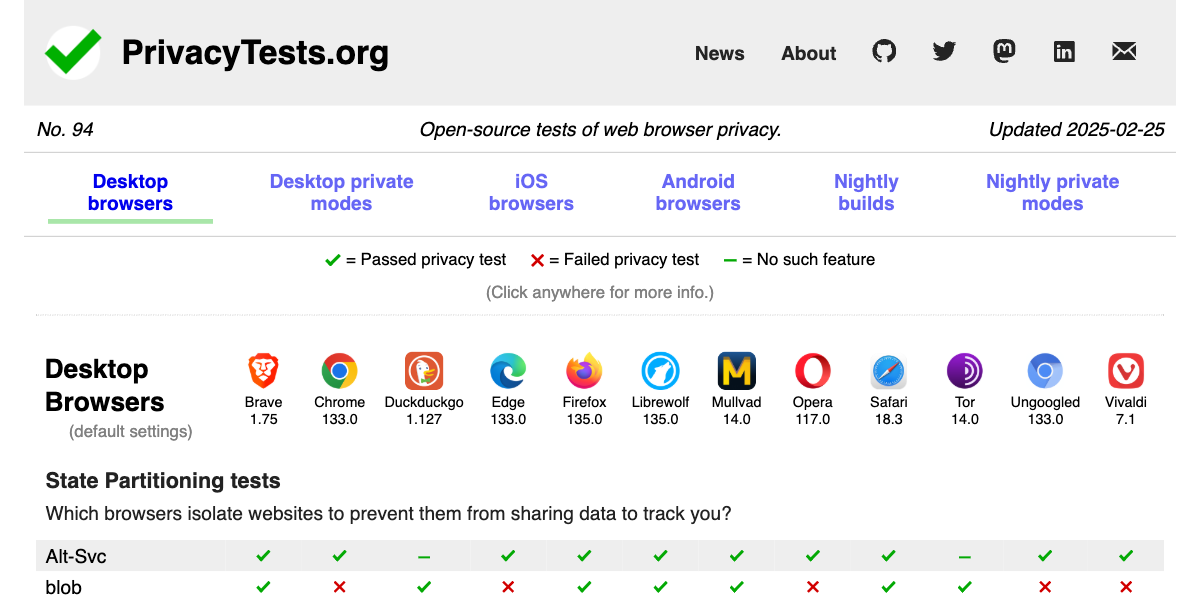
An open-source privacy audit of popular web browsers.
Your data, your rules: Firefox’s privacy-first AI features you can trust | The Mozilla Blog
Firefox is expanding its AI-powered features, all designed to keep your data private. We believe technology should serve you, not monitor you. Our team und

Cloudflare Announces Web Analytics, a Privacy-First, Free Alternative for All Website Owners | Cloudflare
New solution gives anyone a more accurate way to track website performance without compromising visitors’ privacy

Measuring the Privacy Experience
How do you know that a product respects your privacy – other than by wading through the fine print? We’ve created a framework to measure the way people actually experience privacy in tech products.

Keeping Data Private | Web Browser Engineering
Our browser has grown up and now runs (small) web applications. With one final step—user identity via cookies—it will be able to run all sorts of personalized online services. But capability demands responsibility: our browser must now secure cookies against adversaries interested in stealing them. Luckily, browsers have sophisticated systems for controlling access to cookies and preventing their misuse.
Statcounter Global Stats - Browser, OS, Search Engine including Mobile Usage Share
Tracks the Usage Share of Search Engines, Browsers and Operating Systems including Mobile from over 3 billion monthly page views.

P3P
The Platform for Privacy Preferences Project (P3P) is an obsolete protocol allowing websites to declare their intended use of information they collect about web browser users. Designed to give users more control of their personal information when browsing, P3P was developed by the World Wide Web Consortium (W3C) and officially recommended on April 16, 2002. Development ceased shortly thereafter and there have been very few implementations of P3P. Internet Explorer and Microsoft Edge Legacy were the only major browsers to support P3P. Microsoft has ended support from Windows 10 onwards. Internet Explorer and Edge [Legacy] on Windows 10 no longer support P3P as of 2016.[3] W3C officially obsoleted P3P on 2018-08-30.[4] The president of TRUSTe has stated that P3P has not been implemented widely due to the difficulty and lack of value.[5]
Premium Plugins now available on the Piwik Analytics Marketplace - Analytics Platform - Matomo
Ready to use in minutes, Matomo gives you:✔ Accurate privacy-first analytics ✔ Full data ownership ✔ GDPR compliance

Privacy by Design
In view of rapid and dramatic technological change, it is important to take the special requirements of privacy protection into account early on, because new technological systems often contain hidden dangers which are very difficult to overcome after the basic design has been worked out. So it makes all the more sense to identify and examine possible data protection problems when designing new technology and to incorporate privacy protection into the overall design, instead of having to come up with laborious and time-consuming “patches” later on. This approach is known as “Privacy by Design” (PbD).

Introducing Mozilla Monitor Plus, a new tool to automatically remove your personal information from data broker sites | The Mozilla Blog
Today, Mozilla Monitor (previously called Firefox Monitor), a free service that notifies you when your email has been part of a breach, announced its new p

The scourge of web analytics - Stavros' Stuff
I’ve been making web apps since 2003, which means that I’ve been doing this for fourteen years now, or it means that I can’t count. So, there are few people more qualified than me to tell you this:


5 things every product manager should know how to measure
Using analytics to improve your product doesn’t have to be complicated.

A Better Approach to Privacy for Third-Party Social Media Tools
A robust ecosystem of third-party tools that will require fresh thinking about privacy, say Chand Rajendra-Nicolucci and Ethan Zuckerman.

Online tracking: A 1-million-site measurement and analysis
Online tracking: A 1-million-site measurement and analysis is the largest and most detailed measurement of online tracking to date. We measure stateful (cookie-based) and stateless (fingerprinting-based) tracking, the effect of browser privacy tools, and "cookie syncing". This measurement is made possible by our web measurement tool OpenWPM, a mature platform that enables fully automated web crawls using a full-fledged and instrumented browser.
Websites have a new way to spy on visitors: Analyzing their SSD activity
Telltale SSD activity can be measured in the browser using simple JavaScript.